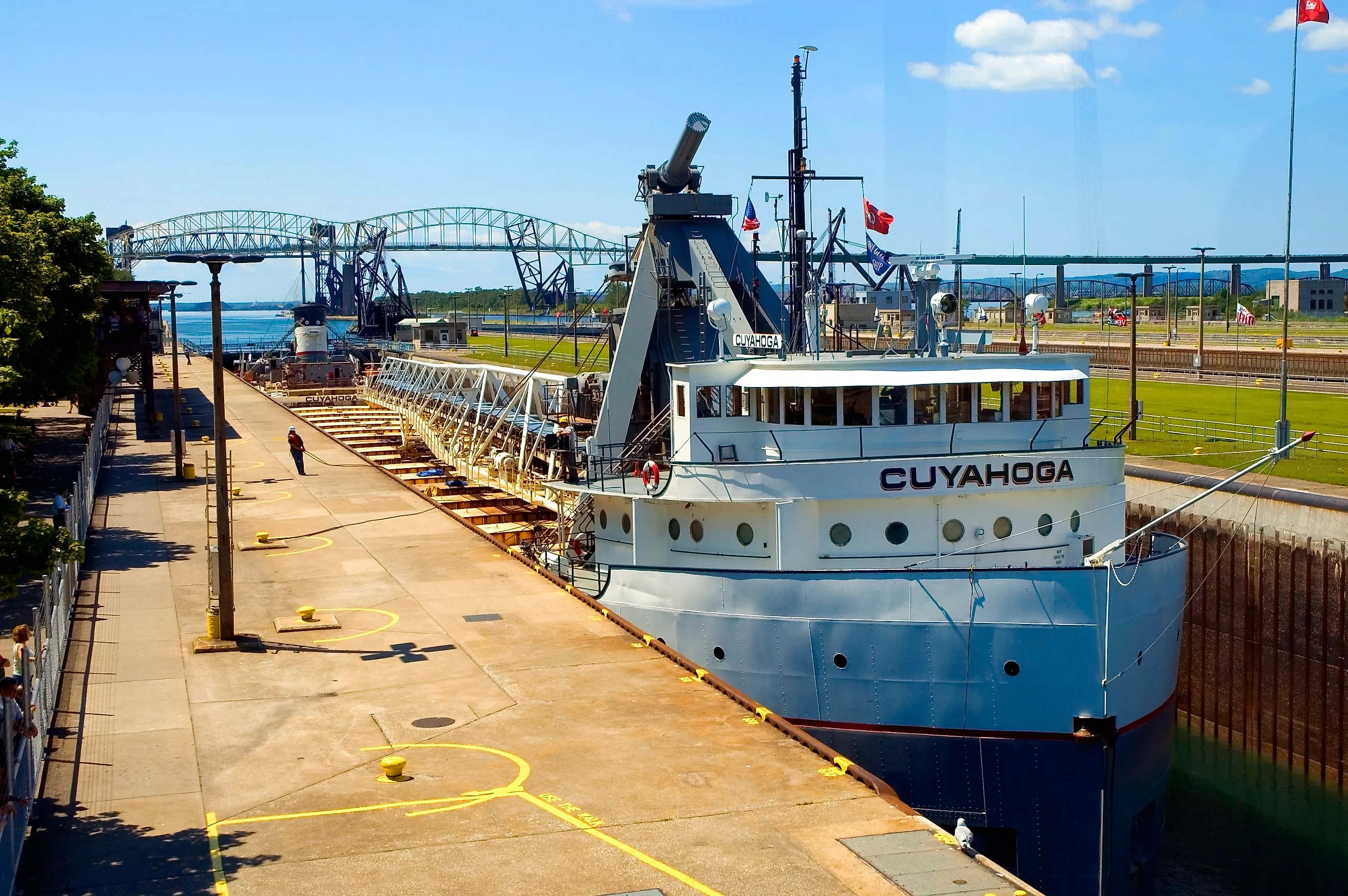
How The Soo Locks Lift A 1,000-Foot Ship Without A Single Pump
Several times a day at Sault Ste. Marie, Michigan, a piece of engineering theater plays out that sounds impossible when stated plainly: a freighter a fifth of a mile long, loaded with up to 70,000 tons of iron ore, slides into a concrete chamber, and 10 minutes later it has risen 21 feet, lifted as gently as a toy in a filling bathtub, without a motor straining, a piston firing, or a single pump running anywhere in the system. The Soo Locks, among the busiest waterway chokepoints in North America, perform this lift thousands of times a season on nothing but gravity, and the secret is that the machinery doing the work is not in the lock at all. It is Lake Superior, the largest freshwater lake on Earth, sitting 21 feet above its neighbors and pressing to get down, and the locks are simply the world's most profitable way of letting a little of it through.
The 21-Foot Problem

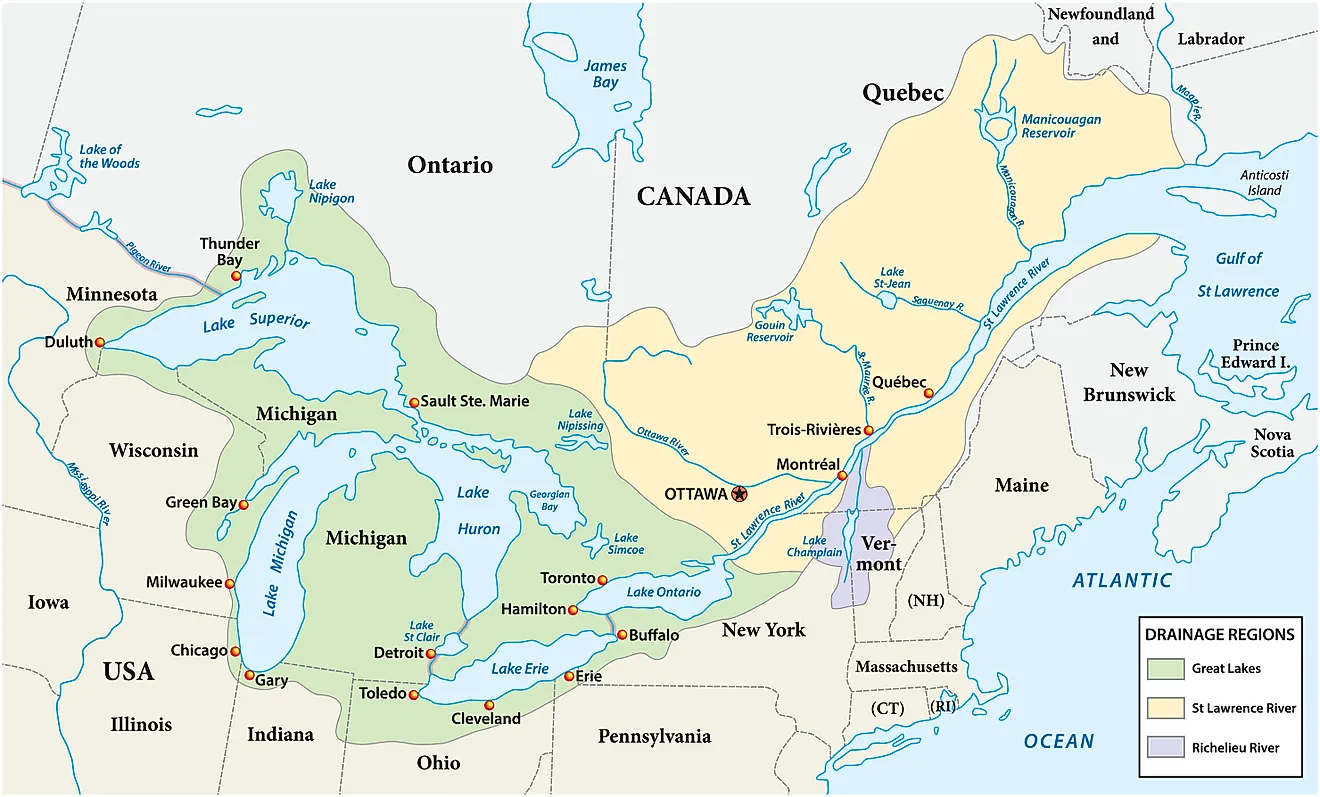
The problem the locks solve is a step in the continent's staircase. Lake Superior sits about 21 feet higher than Lakes Michigan and Huron, and its entire outflow funnels down the St. Marys River at Sault Ste. Marie, where the drop is concentrated in a single stretch of rapids that no cargo vessel could ever run. For thousands of years the rapids were a destination rather than an obstacle, the great whitefish fishery the Ojibwe called Bawating, the place of the rapids, and for the fur trade era they were a portage, with every canoe and cargo carried around by hand, and later on a horse-drawn tram, because the lakes above and below might as well have been on different floors of a building.
The first serious American lock opened in 1855, built by the State of Michigan just as the Marquette iron ranges began shipping, and the timing made it one of the most consequential pieces of infrastructure in US history: the ore that built American steel, and the steel that built everything else, has been riding through locks at this exact spot ever since. The complex has been rebuilt, enlarged, and federalized across 17 decades, but the job description has never changed by a word: get ships up and down 21 feet, all day, in bulk.
The Trick: The Water Does All The Work

A lock chamber is a box with a door at each end and, crucially, plumbing in its bones: large filling and emptying culverts, tunnels built into the lock's walls and floor, controlled by valves. To lift an upbound ship, the operators close the gates behind it and simply open the upstream valves, and Lake Superior does the rest, flowing downhill through the culverts and boiling up evenly through ports in the chamber floor until the water inside stands level with the lake above, a rise of 21 feet that takes on the order of 10 minutes and moves roughly 20-plus million gallons. Then the upper gates swing open and the ship steams out onto Superior, one floor up.

Going down is the same trick in reverse, with downstream valves draining the chamber to the lower river's level, and in neither direction does any machine touch the water. The only motors in the system move the gates and valves; the lift itself is pure gravity, powered by the head of water the Ice Age stacked behind Sault Ste. Marie, and the same drop is so energetic that hydroelectric plants beside the locks have been milking it for over a century. The locks and the powerhouse are siblings running the same waterfall, one turning the descent into electricity, the other spending it, a chamber at a time, on lifting ships.
The Lock Does Not Know The Ship Is There

Here is the physics that makes the whole arrangement feel like a magic trick: the ship's weight costs the lock nothing. A floating vessel displaces exactly its own weight in water, so when a loaded thousand-footer enters the chamber, it pushes out a thousand-footer's worth of water, and the total weight the lock holds, water plus ship, stays the same as if the chamber were full of water alone. Filling the lock lifts a 100,000-ton ship and an empty rowboat with identical ease, for identical cost, which is to say none beyond the water itself. Archimedes worked out the principle more than 2,000 years before the first ore boat, and the Soo has been cashing his check ever since.

That indifference to cargo is the economic genius of lock engineering, because the energy bill for lifting the heaviest moving objects in North America, ships that had to be launched sideways into rivers too narrow to hold them, rounds to the cost of opening a valve. Superior's water was going to flow down to Huron anyway; the lock merely insists it carry a freighter partway.
The Poe: The Only Door That Fits

The complex runs two working chambers, and they are not equals. The MacArthur Lock, 800 feet long and opened in wartime 1943, handles the smaller traffic; the Poe Lock, 1,200 feet long and 110 feet wide in its modern form opened in 1968, is the giant, and for the fleet's 13 thousand-footers, the Tregurtha included, it is not the best door but the only one, the single chamber in the landlocked world those ships can ever sail that fits them. Every pound of cargo on a 1,000-foot laker, and the majority of all tonnage through the Soo, rides on one aging concrete box.

Federal planners have described that dependence in genuinely alarming terms, with studies concluding that an unplanned Poe shutdown of months would choke the iron ore supply, idle steel mills, and cascade through the national economy on a scale few single structures could match, which is why, after decades of lobbying, a second Poe-sized chamber, the New Lock at the Soo, has been under construction since 2020 on the footprint of two retired locks, due to open around the end of the decade. Until it does, the iron route from Duluth and Marquette to the mills runs through a needle's eye with no spare.

The stakes explain the ritual quality of the place. Roughly 80 million tons of cargo pass through in a season, more than 7,000 vessel transits, iron ore above all, and passage has been toll-free since the federal government took over in 1881, an open staircase run as public infrastructure on the theory, proven for 14 decades, that what rides through it pays the nation back many times over.
A Day And A Year At The Soo

In season, the rhythm is continuous: a ship warps in, gates close, the chamber boils quietly for 10 minutes, gates open, and the whole passage, approach to exit, runs under an hour, repeated around the clock while tourists watch from an observation platform close enough to read the hull markings, one of the few places in the world where the public can stand an arm's length from a working thousand-footer in weather fair and foul. The town built itself around the spectacle, and a summer evening at the viewing stand remains one of the Great Lakes' best free shows.

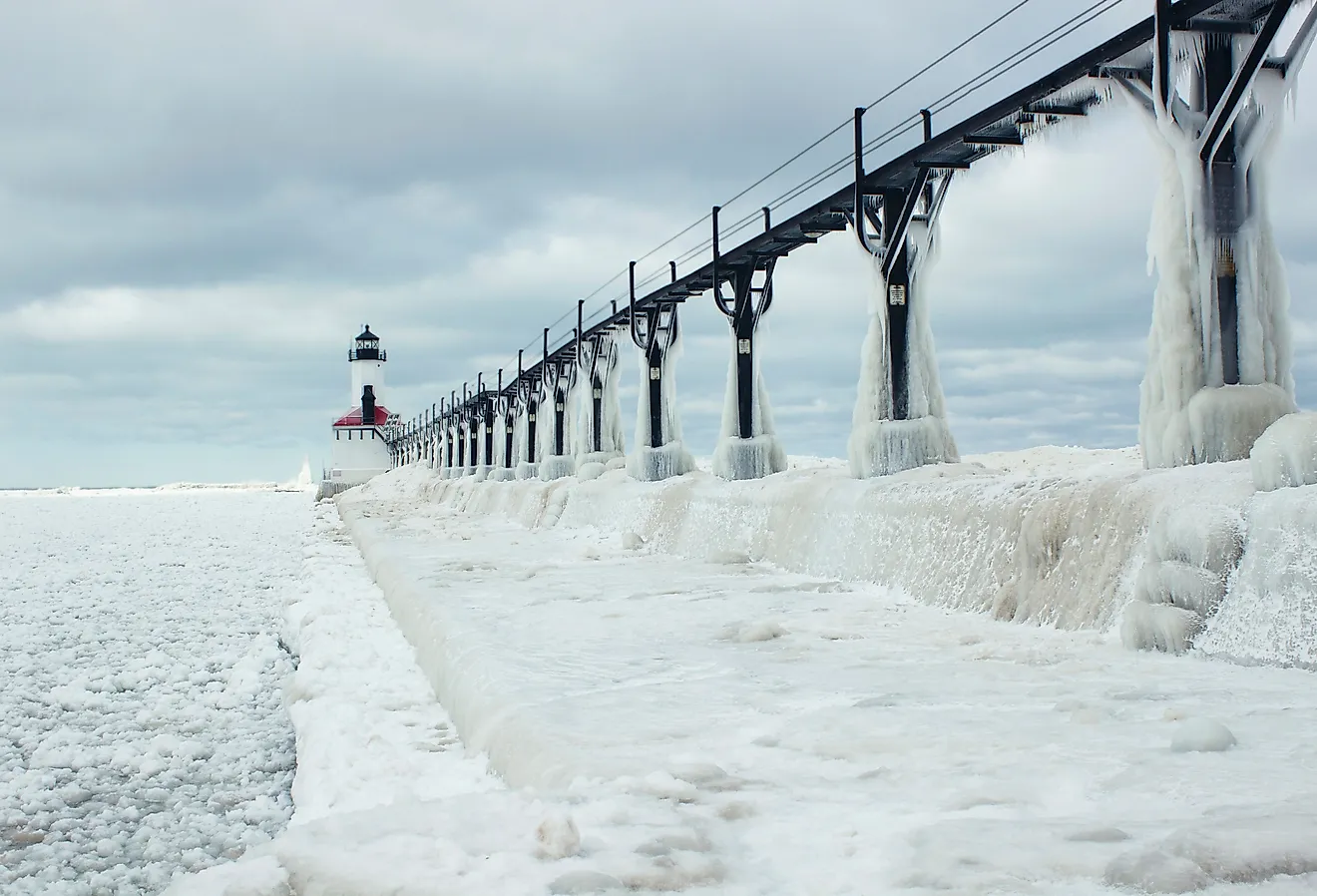
The year has a hard calendar: the locks close each January 15 and reopen March 25, the dates that define the entire Great Lakes shipping season, with icebreakers escorting the last downbound boats through the freezing St. Marys and the first spring convoys back up it. The 10-week closure is the system's pit stop, when chambers are dewatered and crews work in the drained concrete canyons on gates and valves through the UP's deepest cold, so that the staircase is ready the moment Superior's fleet steams back to work.
The Waterfall That Carries Ships

So the Soo Locks lift 1,000-foot ships without a single pump because the pump was never needed: Lake Superior itself supplies the pressure, 21 feet of head stacked by the glaciers behind Sault Ste. Marie, delivered into the chamber through valves and floor ports until the biggest lake on Earth has gently handed its cargo down a floor, with Archimedes ensuring the ship's 100,000 tons ride along for free. It is the rare piece of critical national infrastructure whose core technology is older than the republic and whose energy source is a landform, a waterfall rebuilt as a staircase, spending a sliver of Superior's endless outflow to carry the steel economy past the rapids, 10 quiet minutes at a time.