The Tunnels That Run Behind Niagara Falls
There are two tunnels open to visitors behind Horseshoe Falls, the largest of the three waterfalls collectively named Niagara Falls. Called Journey Behind the Falls, this attraction is on the Canadian side of Niagara Falls. However, there are other tunnels behind Horseshoe Falls, including the historic Scenic Tunnel, opened in 1903; it ran behind Horseshoe Falls and was open to the public until World War II, and was finally abandoned in 1944. Niagara Parks is planning to reopen the Scenic Tunnel as part of Journey Behind the Falls in 2027. In addition to these public tunnels, there are several that were built as access tunnels for hydroelectric power generation and other industrial purposes, as well as water diversion. Most of those run underneath the Niagara River gorge, or through the bedrock near the Falls. On the US side of Niagara Falls, there was once a natural cave behind the smallest of the three waterfalls, Bridal Veil Falls, which is right beside the second-largest of the three waterfalls, American Falls. This cave was open to the public until it collapsed.
Journey Behind The Falls

Early visitors to Niagara Falls during the 19th century had close access to the falls through staircases descending into the gorge. They were actually able to walk behind the falls. The attraction was called Behind the Sheet. The earliest known person to venture behind Horseshoe Falls was a Monsieur M. Bonnefons, who claimed to have descended the 160-foot gorge in 1753 and found an accessible space behind the falls. By the mid-19th century, competing tourist operators built their own staircases for visitors to descend into the gorge and walk behind the falls, the earliest built in 1832. This was much more hazardous than visiting the falls today, with no actual safety standards. A hydraulic elevator was installed by the Niagara Parks Commission in 1887, as the attraction was more formalized for visitor safety. There was a narrow ledge behind the falls, with enough room for visitors to carefully pass under the falls, for up to 150 feet until an obstruction known as Termination Rock was reached. By 1889, rock falls and changes in the flow of water made walking behind Horseshoe Falls impossible.

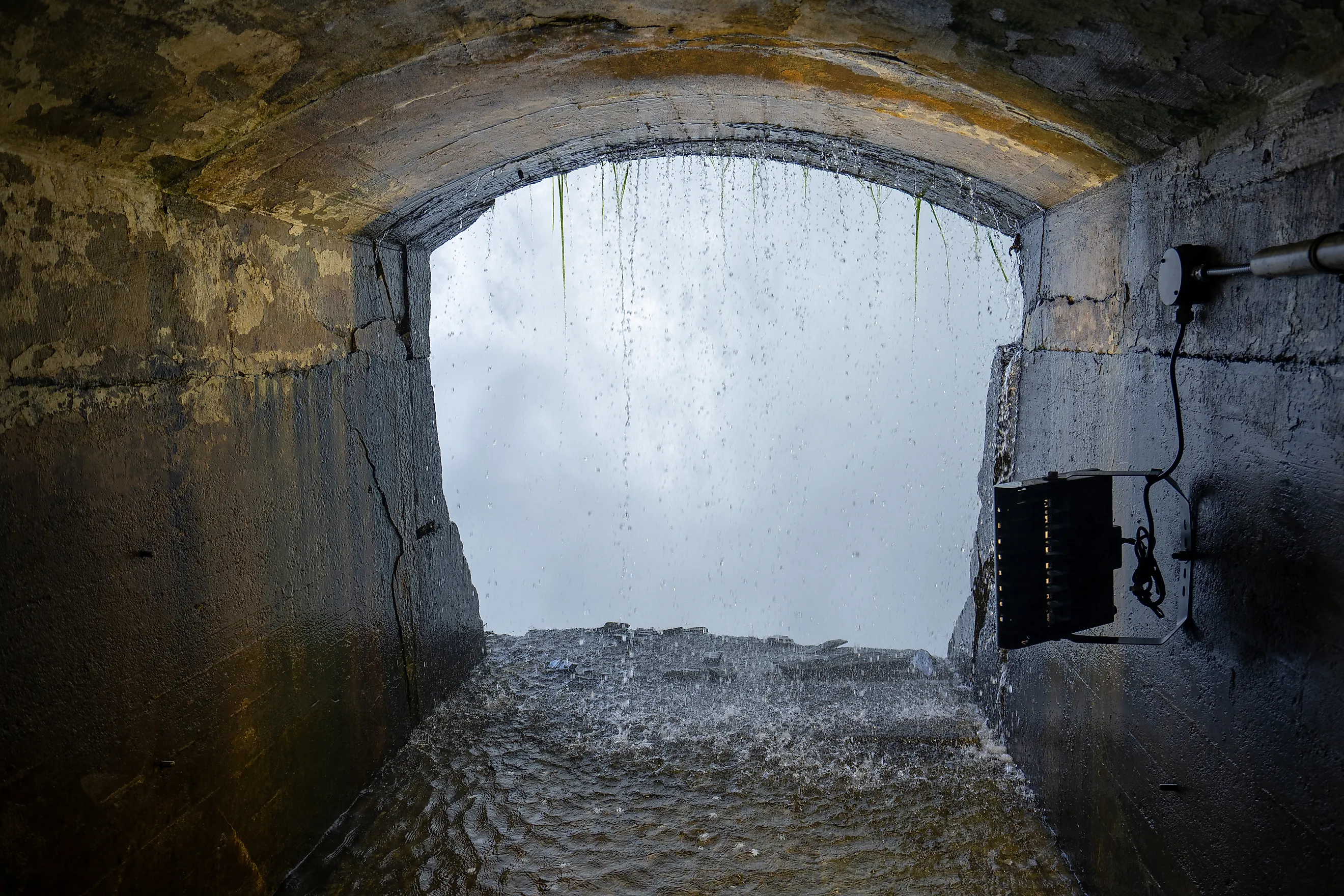
The first tunnels were blasted through the bedrock and opened to visitors in 1889 as a replacement for walking behind the falls. At 150 feet (46 m), the tunnels provided a way to view the falls from behind the falling water. These tunnels were unlit, and guides carried lanterns to accompany visitors. In 1903, a new tunnel was constructed while the Ontario Power Company was developing a hydroelectric generating station close by. With continued erosion of Horseshoe Falls, the original tunnel system became hazardous and was closed permanently in 1944. A replacement tunnel was excavated 60 feet (18 m) farther back into the rock. It was lined with concrete and had electric lighting. Descending around 125 feet (38 m) below ground, visitors have access to two openings, called the Cataract Portal and the Great Falls Portal, approximately 150 feet (46 m) behind the falls. This is the tunnel system still used today under the name Journey Behind the Falls.

The 1903 Scenic Tunnel

The 1903 Scenic Tunnel was abandoned in 1944 after an inspection deemed it unstable. As part of a $25 million Niagara Parks redevelopment of the Journey Behind the Falls attraction, the Scenic Tunnel is being restored for a planned reopening in summer 2027. The original passage through the bedrock is being stabilized while preserving its historic appearance, making the almost 125-year-old tunnel's character part of the visitor experience. Rock anchors and galvanized steel will secure unstable sections and hold loose rock, while sprayed concrete will reinforce sections of the tunnel. Modern lighting and stainless-steel safety railings will be added. Visitors will see the naturally carved and exposed rock walls, with original-style exposed wooden beams emphasizing the turn-of-the-20th-century feel and appearance. A platform is being designed to provide an elevated panoramic view of the Horseshoe Falls and the Niagara Gorge, with a covered and heated viewing area.
Toronto Power Generating Station Tailrace Tunnel

This tailrace tunnel, an underground passage carrying water away from a hydroelectric turbine, was built for the Toronto Power Generating Station and began operating in 1906. It is around 2,000 feet (610 m) in length and 33 feet (10 m) in diameter. It was built to carry the discharged water from the powerhouse back into the Niagara River beneath the Falls. The generating station was built to provide electricity for Toronto, some 90 miles (145 km) away. The unusual feature of this tailrace tunnel was that it carried discharged water beneath Horseshoe Falls before releasing it back into the river. With changes in technology for hydroelectricity, the tunnel's use was increasingly limited, and it was closed in 1973. The original generating station remains intact and is undergoing redevelopment planning. The tunnel itself was sealed off and remains closed.
Canadian Niagara Power Company Tailrace Tunnel

The tunnel began operating in 1905 for the Rankine Generating Station, part of the Canadian Niagara Power Company. The tunnel runs around 2,200 feet (671 m) from the generating station near Cedar Island above the falls to an outlet in the Niagara River gorge near the base of Horseshoe Falls. The tunnel carried water from the powerhouse in the Niagara River near the base of the Horseshoe Falls, where it rejoined the lower Niagara River. One of Niagara Falls' longest operating hydroelectric facilities, the Rankine Generating Station closed in 2005. The powerhouse was restored and is open to the public. However, the tailrace tunnel is closed to the public.

Bridal Veil Falls

Discovered in the mid-19th century behind Bridal Veil Falls and beside the American Falls, a natural cave was once open to the public. Originally referred to as Aeolus's Cave, it was later called Cave of the Winds. Historical descriptions suggest that the cavern was approximately 100 feet (30 m) high, 120 feet (37 m) across, and 50 feet (15 m) wide, although measurements varied between accounts. Visitors could descend into the cavern to see the falls from behind. Guided tours began in 1841, but rockfalls made the original cave unsafe. The geological structure of the Niagara Gorge consists of alternating layers of Lockport dolostone, limestone, and much softer shale. Water erosion weakens the softer material over time. The cave ceiling and walls were particularly unstable: on August 2, 1857, a rockfall injured several visitors. On September 6, 1920, a major rockslide inside the cavern killed three people and injured others. The attraction was soon closed down.
The name Cave of the Winds was carried on, starting with a new attraction consisting of wooden walkways and viewing platforms built in front of Bridal Veil Falls, allowing visitors the ability to see the falls up close without entering the dangerous overhang. In 1954, a large rockfall damaged the remaining overhang. In 1955, engineers, deciding that the unstable rock presented an unacceptable danger to visitors, deliberately removed the remaining sections with controlled dynamite. The Cave of the Winds is now a new attraction. An elevator from Goat Island takes visitors down the gorge to a series of platforms and walkways leading to Bridal Veil Falls. One section, the Hurricane Deck, allows visitors to stand extremely close to the falling water.
American Falls

Although there are many structures associated with the American Falls, there are no natural or human-made tunnels directly behind the falls. The structures near the falls are observation facilities, walkways, and engineering works used for managing the river and stabilizing the rock under and around the falls. In January 1910, an underground elevator facility was opened at Prospect Point at the American Falls. It had an elevator shaft of 158.7 feet (48.4 m) and the tunnel below was 110.9 feet (33.8 m) in length. There were two electric elevators and a 251-step concrete staircase. The tunnel passed through the rock, reaching a large waiting room at the river's edge, at the base of the American Falls. The elevator was built to carry visitors from the brink of the American Falls to the base of the falls. In 1954, water began leaking into the elevator shafts, just before the Prospect Point rockfall of that year, when many tons of rock collapsed into the gorge. The shaft was condemned and sealed in concrete.
The American Falls was famously "turned off" in 1969. From June 9-12, 1969, the US Army Corps of Engineers built a 600-foot (182 m) cofferdam between Goat Island and the New York shore, diverting the Niagara River away from the American Falls channel. This was done to examine the underlying geology of the falls. The water stopped flowing over the falls by June 12. The water diversion revealed that there were extensive fractures in the dolostone, and water was seeping through cracks in the underlying rock. The base of the falls had large quantities of accumulated rock debris. It was decided to leave the rock pile intact and to not reinforce the waterfall, leaving the natural formations undisturbed. The cofferdam was removed on November 25, 1969, restoring the flow of the water over the American Falls.
Behind The Falls

At the moment, there is one opportunity to experience Niagara Falls from behind the falling water. Two arms of a tunnel behind Horseshoe Falls give visitors an up-close view, with another restored historic tunnel scheduled to be opened in 2027. There are other tunnels behind Horseshoe Falls, service tunnels for hydroelectricity that the public is not permitted to enter, including tunnels right under the falls. Although not located behind the falls, the Niagara Parks Power Station's 2,200-foot tailrace tunnel is now open to visitors. Built to carry water discharged from the power station back into the Niagara River, it runs 180 feet underground, ending with an observation platform at the river's edge near the base of Horseshoe Falls. The tunnel was opened to the public in 2022. For other close-up views, the Cave of the Winds allows visitors to almost touch Bridal Veil Falls, while the Prospect Point Observation Tower provides elevator access to the Maid of the Mist boat landing, near the base of the American Falls.