5 Most Snake-Filled Bodies Of Water In Oklahoma
How many lakes there are in Oklahoma depends on how lakes are defined and which sources are consulted. The Oklahoma Water Resources Board (OWRB) lists 133 lakes within the state, or shared with a neighboring state. All the lakes counted are dam-created lakes and reservoirs. Some sources will put the number closer to 200, and if counting playa and oxbow lakes, hundreds more bodies of water can be added to the list. The larger lakes tend to be the main focus when counting indigenous snake populations, and the numbers of snakes will vary by source, each lake being assessed individually, often by local government or conservation groups.
With no official state ranking of snake numbers, a list of most snake-filled bodies of water in Oklahoma will rely on several factors, including known habitat suitability, reports from wildlife agencies and conservation groups, and documented sightings reported in local media. Among the public, there is often confusion between harmless watersnakes and venomous snakes such as cottonmouths (water moccasins), which are mostly common in eastern and southeastern Oklahoma.
Watersnakes of every variety are found in every type of aquatic habitat in the state, and non-venomous watersnakes far outnumber the venomous species such as cottonmouths. The numbers are often in flux because of misreporting non-venomous watersnakes for cottonmouths. Watersnakes and other snakes found adjacent to water thrive in marshlands, highly vegetated shorelines, and areas with large fish populations. Lakes with high snake activity will have a mix of non-venomous watersnakes and venomous species such as cottonmouths, copperheads, and rattlesnakes.
Lake Eufaula

Located in McIntosh County, Eastern Oklahoma, Lake Eufaula is the largest lake entirely within Oklahoma. With heavily vegetated shorelines, the lake provides some of the best habitats for snake populations. With its extensive marshland, shallow coves, and abundant flooded timber, or inundated forests, Lake Eufaula is a strong candidate for being Oklahoma's most snake-populated body of water. Although exact numbers are very difficult to obtain for snakes, it is estimated that the total snake population of Lake Eufaula, including all known species, is easily in the tens of thousands and may be as high as 100,000.

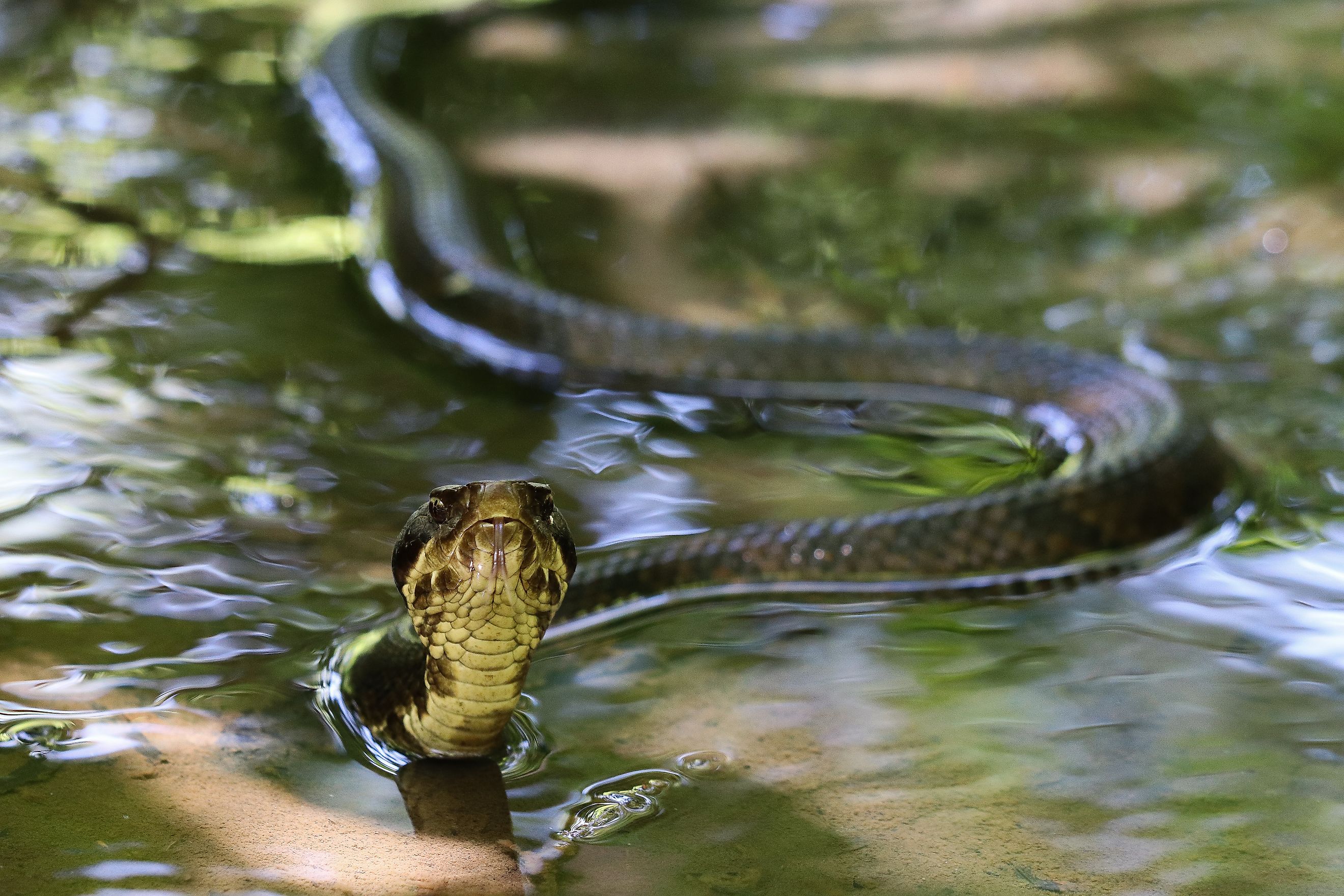
Created by damming the Canadian River, Lake Eufaula has over 105,000 surface acres and is a major hub for recreation and wildlife. Much of its marshy shoreline is isolated, making it ideal as a habitat for different snake species. Non-venomous snakes are abundant; watersnakes, garter snakes, and rat snakes can be found in the water or along the shoreline. In eastern Oklahoma, the most common aquatic snakes are the diamondback watersnake (Nerodia rhombifer) and the plain-bellied watersnake (Nerodia erythrogaster), both heavy-bodied fish-eaters often seen basking on branches over the water. There are four species of venomous snakes found around Lake Eufaula: copperheads, western diamondback rattlesnakes, western pygmy rattlesnakes, and western cottonmouths (water moccasins). Of the four, western cottonmouths are most commonly found on the water itself. These harmless watersnakes are often confused with the western cottonmouth. A key behavioral distinction is that these watersnakes will swim away from encounters with humans, while western cottonmouths may stand their ground. Cottonmouth venom is lethal to humans, but can be treated with immediate medical intervention.
Collinsville Lake

The conditions of this Northeast Oklahoma reservoir, shallow water and heavily vegetated shorelines, make Collinsville Lake ideal habitat for snakes. The number of snakes across all known species is difficult to establish. As a much smaller reservoir than Lake Eufaula, the total number of snakes is smaller, but the area is nevertheless home to a large number of snakes relative to its size. The snake population is estimated to be in the thousands, but without official published scientific estimates, the numbers can only be speculated, with sources suggesting between 2,000 and 5,000 snakes in total. However, with its small size and shallow waters, the density of snakes is rather high in Collinsville Lake.
The primary habitats for snakes in and around Collinsville Lake include the marshy shorelines of the lake and the dense forests surrounding the lake. There are large populations of the venomous western cottonmouth, which thrive in the lake's conditions. Non-venomous snakes found on the lake include the diamondback watersnake, the plain-bellied watersnake, the common garter snake, the western ribbon snake (semi-aquatic subspecies of garter snake), and the western ratsnake. In addition to the cottonmouth, the other venomous snake in the area is the copperhead. They are generally found in wooded habitat surrounding the lake, rather than in the water itself. Species of rattlesnakes are sometimes found in the area, but not in significant numbers. Wildlife officials maintain that given its high population in a small area, cottonmouths are a danger to humans. Swimming is discouraged, and visitors are advised to avoid entering the water in marshy and shallow areas.
Lake Texoma

This lake sits on the Oklahoma and Texas border. With its large size, around 139 square miles, and an extensive shoreline, Lake Texoma has a highly diverse range of snake species. Non-venomous snake species are predominant, but there are significant populations of venomous snakes, particularly in the marshlands on the shoreline. A reservoir on the Red River, Lake Texoma was completed in 1944 with the construction of Denison Dam. The lake is one of the largest man-made lakes in the United States and is a crucial center for recreation, flood control, and hydroelectric power for both states. The lake is also known for its high populations of snakes, one of the most snake-filled bodies of water in Oklahoma.

The lake's marshlands and the surrounding woodlands are home to venomous species, including cottonmouths, copperheads, and three rattlesnake species: western diamondback rattlesnakes, timber rattlesnakes, and western pygmy rattlesnakes. With over 580 miles of shoreline, comprised of wetlands, coves, as well as rocky bluffs, forests, and prairies in the surrounding landscape, Lake Texoma has an abundance of fish, frogs, tadpoles, rodents, and birds, ideal prey for snakes. Like other lakes, no official number of snakes exists due to the difficulty in accurately measuring the population of snakes in general. Snakes are one of the most difficult vertebrates to count, due to their isolated natures, hidden among vegetation, underground, or underwater. Rough estimates from biologists put the number in the tens of thousands, easily over 10,000 individual snakes.
Lake Hefner

This lake near Oklahoma City is a recreational hub for the area. Lake Hefner is approximately 2,500 acres, with an average depth of 29 feet. The rocky shorelines of the lake support a large population of snakes, with the majority being non-venomous. This abundance of non-venomous snakes makes the lake ideal for human recreation; however, harmless watersnakes are often mistaken for venomous cottonmouths, leading to panic or the unnecessary deaths of non-venomous snakes. The most common non-venomous species here include the diamondback watersnake and the plain-bellied watersnake, harmless to humans, but defensive if cornered.

The most common venomous snake in the area is a few species of rattlesnakes, found in the surrounding bush and woodlands, and they are generally easy to avoid. Although rattlesnakes can be deadly to humans, fatalities in the United States are rare, and most people bitten by a rattlesnake survive if given immediate medical care. Other venomous species occasionally found around the lake are eastern copperheads and western massasauga. With a sizable surface area and a shoreline lined with coves and marshes, Lake Hefner provides abundant prey for its snake population, with large populations of fish, frogs, rodents, and small birds. The total number of snakes across all species found at the lake is 2,000-10,000 individuals, depending on the season and the amount of suitable shoreline habitat.
Grand Lake o' the Cherokees

This shallow lake, with coves and vegetated shoreline, is an ideal habitat for aquatic snakes. Located in northeastern Oklahoma in the foothills of the Ozark Mountain Range, the lake is a 46,500-acre reservoir, formed in 1940 by the Pensacola Dam on the Neosho River. Non-venomous watersnakes are abundant, while venomous cottonmouths are found in the suitable habitat around the lake. The lake has over 1,300 miles of shoreline, with much of it suited for the roughly estimated number of 20,000 to 50,000 snakes across all species. Depending on water levels and available prey, that number can increase to around 100,000 individuals.

The most abundant species of snake found at Grand Lake O' the Cherokees are the non-venomous plain-bellied watersnakes and diamondback watersnakes. Venomous species include cottonmouths, usually in or near the water, and copperheads, found in the bush and woodlands around the lake. Non-venomous snakes are more defensive than aggressive and will, more often than not, swim away from humans encountered in the water. Swimming is permitted in the lake, with precautions to be wary of cottonmouths, who are often indistinguishable to the general public from harmless watersnakes. Fatal encounters are extremely rare.
The Role of Snakes in the Ecosystems of Oklahoma's Bodies of Water
The reservoirs, rivers, and wetlands of Oklahoma are ideal for large populations of snakes throughout the state. It has some of the most diverse species in the central United States, with around 50 species known to live there. Around 84% of the species are non-venomous, but there are a handful of species posing threats to humans in and around the water. Snakes are crucial to the ecosystems of Oklahoma's lakes, controlling populations of fish, amphibians, rodents, and crayfish, while the snakes themselves are important prey for hawks, herons, egrets, foxes, and other snakes.