The Most Alligator-Dense Wetlands In The US
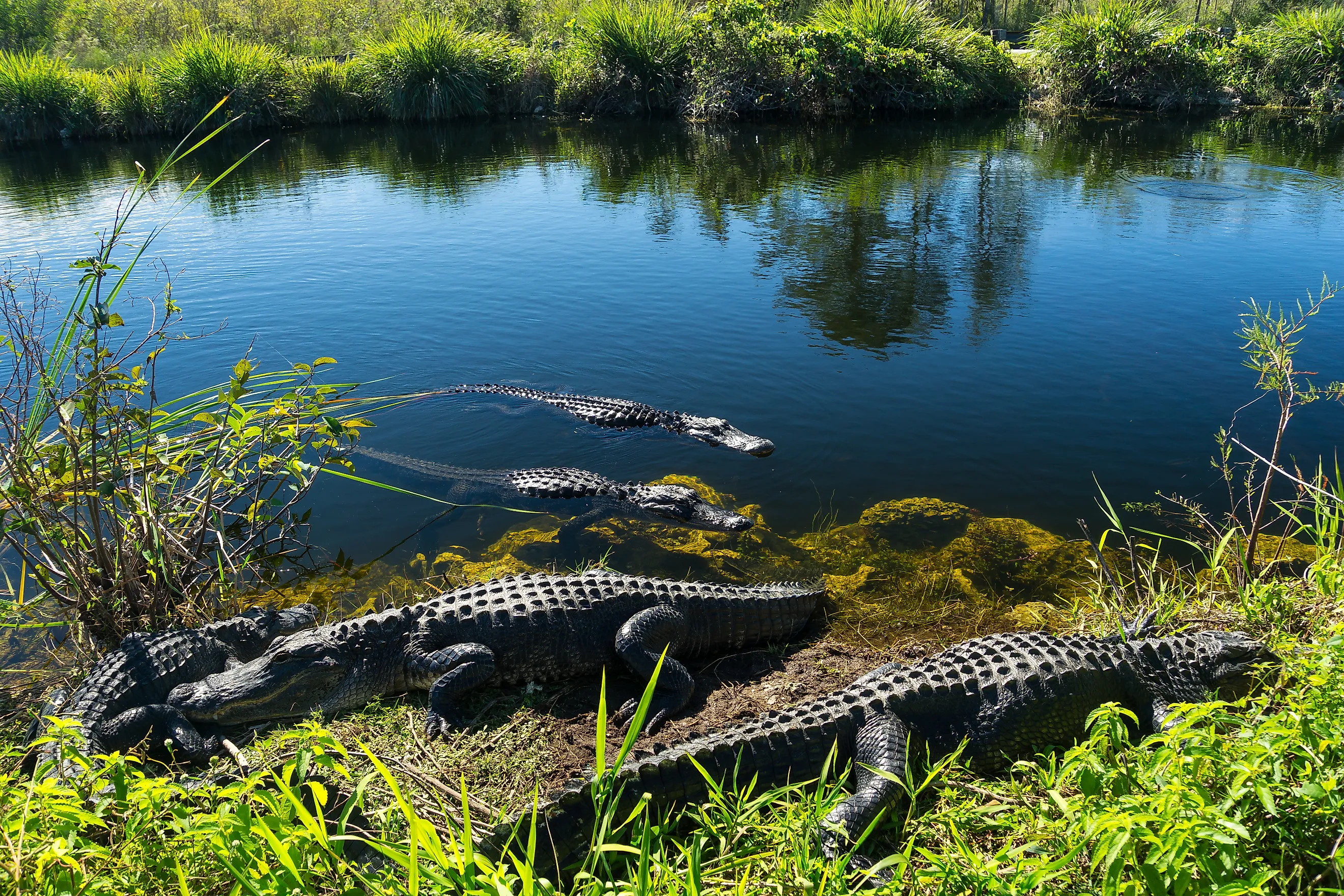
American alligators occupy freshwater wetlands across much of the southeastern United States, with estimates of around 5 million individuals living across the region. The highest concentrations occur in large, slow-moving river deltas, subtropical marsh systems, and protected impoundments where permanently meandering waters also support healthy numbers of fish and other prey, as well as reliable nesting sites. In these select environments, local alligator communities can often exceed one or more adults per acre during peak conditions, with Florida and Louisiana hosting the largest overall populations. This is while other select refuges and preserves in neighboring states concentrate these large predators into smaller, intensively monitored areas. With that, the destinations we will highlight below represent some of the most consistently alligator-dense systems in the US, based on survey data, overall habitat health, and long-term population stability.
The Everglades

The Florida Everglades has the largest singular concentration of American alligators in any national park across the country, with around 200,000 living specimens! This subtropical zone spans roughly 1.5 million acres of sawgrass marshes, lazy river channels, and elevated, tree islands in total, creating a web of shallow, watery habitats that also sustain abundant prey (fish, turtles, wading birds) and year-round warmth, critical factors driving alligator abundance.

Unlike many temperate wetlands where alligator numbers fluctuate widely by season or drought, the Everglades’ hydrology supports notably stable populations as well. Furthermore, adult males commonly exceed 10 feet in length, and resident females frequently nest very visibly along elevated vegetation in late spring near popular tourist areas.
The alligator presence here is so pervasive that their territorial pathways and nesting mounds shape water flow and vegetation patterns across the landscape. If you know what you're looking at, these traces left behind may also tell you where not to go, so long as you don't wish to stumble upon a possibly busy gator nest!
Big Cypress National Preserve, Florida

Just north of the Everglades, Big Cypress National Preserve covers more than 729,000 acres of cypress swamp and pineland wetlands, typical of South Florida. Its freshwater sheet flow, seasonal floodplains, and a dense network of sloughs create a continuous shallow habitat with the neighboring national park that is ideal for foraging and nesting, only adding to Florida's immense population of alligators, totalling about 1.3 million across the whole state.

Spotlight studies in this specific area, however, routinely record high encounter rates of all kinds of reptiles, with 51 species found throughout. You may find snakes, turtles, lizards, and, of course, American alligators, along nearby canals, natural sloughs, and roadside water bodies, particularly during the late dry season when receding water concentrates groups of fish and other water-dwelling food sources.
Atchafalaya Basin, Louisiana

The Atchafalaya Basin (or Atchafalaya Swamp) is the largest river swamp in the United States, covering around 1 million acres of bottomland forests, cypress-tupelo swamp, and backwater lakes. Fed by the Mississippi River and the Red River, it maintains persistently shallow water, high fish biomass, and dense vegetative cover, all conditions that support some of the highest alligator populations outside of southern Florida.

Estimated to have 2-3 million statewide, the Basin serves as a core stronghold housing a large chunk of this number. Surveys conducted by the Louisiana Department of Wildlife and Fisheries routinely document thousands of alligators during annual nest counts, and in productive swamp-lake margins, densities commonly exceed one adult per acre, with significantly higher concentrations possible in isolated backwater pockets. However, Louisiana’s regulated harvest program, in place since the 1970s, has maintained a stable population.
Large males here regularly measure up to 14 feet long, and nesting activity peaks from late June through July along elevated spoil banks and natural levees.
Okefenokee Swamp, Georgia-Florida

Okefenokee Swamp spans roughly 438,000 acres of peat-filled wilderness along the Georgia-Florida line, housing another one of the greatest alligator populations in the Deep South. Long-term studies conducted within the refuge estimate more than 15,000 resident gators, with most communities most productive in the area's swamp-adjacent prairies and hidden blackwater channels.

This swamp’s slow-moving, tannin-stained water makes it very easy for these large predatory reptiles to stay undercover and out of sight, allowing them to reliably stalk favorite prey, including bowfin, gar, amphibians, and wading birds. On the other hand, pockets of elevated peat islands provide ample nesting substrate during late spring and early summer, when water levels tend to be higher. During drought cycles, though, the shrinking waters concentrate fish and amphibians, subsequently increasing alligator clustering along deeper runs and boat trails.
Like in the other mentioned locations, alligators within Okefenokee function as keystone engineers of sorts, maintaining open-water “gator holes” that retain water during dry periods and directly influence wetland hydrology across the system, allowing this species to be a part of the environment in more ways than simply being the top of the food chain.
Brazos Bend State Park, Texas

Brazos Bend State Park, located along the Brazos River floodplain just southwest of Houston, boasts a relatively modest 5,000 acres of lakes, oxbows, and forests that happen to support one of the highest observable alligator densities in Texas.

Park-managed surveys and routine visitor reports document near constant sightings around locales like Elm Lake, 40 Acre Lake, and Pilant Slough, where permanently sitting water and abundant fish sustain year-round occupancy. Because of that, unlike many Texas wetlands that fluctuate sharply with drought, Brazos Bend maintains a stable aquatic habitat through a network of impoundments and natural backwaters, housing up to 300 gators each year. During spring and early summer, females build vegetation mound nests along elevated lake margins, whereas hatchling presence is common by late summer.
The combination of protected status, consistent freshwater, and limited hunting pressure sustains a healthy population relative to other sites in Texas, a state with relatively few state and/or federally managed parks.
ACE Basin National Wildlife Refuge, South Carolina

The ACE Basin National Wildlife Refuge, also known as Ernest F. Hollings ACE Basin National Wildlife Refuge, watches over about 11,815 acres within a larger 350,000-acre estuarine system formed by the Ashepoo, Combahee, and Edisto rivers. Its freshwater impoundments, tidal marshes, and remnants of former rice fields and plantations support one of the liveliest alligator populations in coastal South Carolina.

State and federal surveys often record sizable populations here, and although exact numbers aren't available, it likely contributes heavily to South Carolina's estimated total of 100,000 gators. Again, the refuge’s status as a protected green space and its extensive watery habitats allow its resident alligators to persist at such high densities relative to most other wetlands within this state.
Mobile-Tensaw Delta, Alabama

The Mobile-Tensaw Delta is where the Alabama and Tombigbee rivers converge before entering Mobile Bay. It is the largest river delta in Alabama, spanning 260,000 acres, and boasts one of the state’s highest American alligator populations. Extensive cypress swamps, lakes, and backwaters provide abundant permanent habitat, with strong prey-fish populations to match.

Various Alabama Department of Conservation and Natural Resources spotlight surveys regularly document high encounter rates across the lower portions of the delta, particularly in slow-moving tributaries and impounded marshes, with large males exceeding 11 feet being periodically recorded. Moreover, regulated harvests have maintained a more stable population since hunting resumed in 2006.
Conserving America's Alligators
Alligator populations in America's abundant wetlands reflect a balance of habitat quality, water management, and protective regulations. As you can imagine, areas with stable hydrology, abundant prey, and minimal human disturbance sustain the highest populations, sometimes numbering in the hundreds of thousands!
From the subtropical marshes of Florida to river deltas in Louisiana and Alabama, these wetlands not only support an abundance of American alligators but also shape the overall structure and function of the ecosystems they inhabit. Maintaining these habitats is critical for preserving the survival of these apex predators as well as ourselves.