Yellow-Bellied Sea Snake
Across the surface of the world's tropical oceans lives a serpent so fully adapted to water that land has become an afterthought. The yellow-bellied sea snake (Hydrophis platurus) is one of the most extraordinary reptiles on Earth. It spends its entire life at sea, drifting with currents and hunting in open water. Many never even touch land at birth. This is one of the most widely distributed snakes on the planet, found in tropical oceans worldwide except the Atlantic, with records from Costa Rica, Australia, Hawaii, and as far as New Zealand. Read on to learn more about this aquatic serpent.
Taxonomic Classification

The yellow-bellied sea snake belongs to the animal kingdom (Animalia) and the phylum Chordata, placing it among vertebrates with spinal columns. It is a reptile (Reptilia) in the order Squamata, which includes all snakes and lizards. Within that order, it belongs to the suborder Serpentes and the family Elapidae, a group that also includes cobras, kraits, and mambas, all known for their highly developed venom systems.
Its current accepted name is Hydrophis platurus. The species was originally described by Linnaeus in 1766 as Anguis platura, then placed in the genus Pelamis in 1803, where it remained for nearly two centuries. Recent molecular evidence has confirmed that it belongs within Hydrophis, and the older name Pelamis platurus is now considered obsolete in scientific literature, though it still appears in many older sources. Two subspecies are currently recognized: the widespread H. p. platurus, and H. p. xanthos, an entirely yellow form found only in the Golfo Dulce of Costa Rica. This places the species among some of the most venomous snakes in the world, but its lifestyle sets it apart from nearly all of them.
Range and Habitat

Few snakes on Earth have a range as wide. The yellow-bellied sea snake is found throughout the tropical and subtropical waters of the Pacific and Indian Oceans, including the eastern coast of Africa, the broader Indian Ocean, Southeast Asia, Australia, the Pacific Islands, and the eastern Pacific from the Gulf of California south to Ecuador, with strays carried by currents as far as the Galápagos and into temperate waters off Chile, New Zealand, and southern Australia. The Atlantic Ocean is the one major exception. The species has not established a population there, although several stranded specimens have been recorded in the western Atlantic, likely brought through the Panama Canal.
Unlike coastal sea snakes that remain near reefs or shorelines, this species is truly pelagic and lives in the open ocean. It is frequently found drifting at the surface, especially along convergence zones where currents meet, and floating debris gathers. These drift lines become feeding corridors where small fish and plankton accumulate, drawing in the snake as it rides the ocean currents. Occasionally, storms or unusual currents wash them toward shore, but land is not part of its ecological design. Once stranded, it is helpless and typically cannot survive long outside the sea.
Physical Description

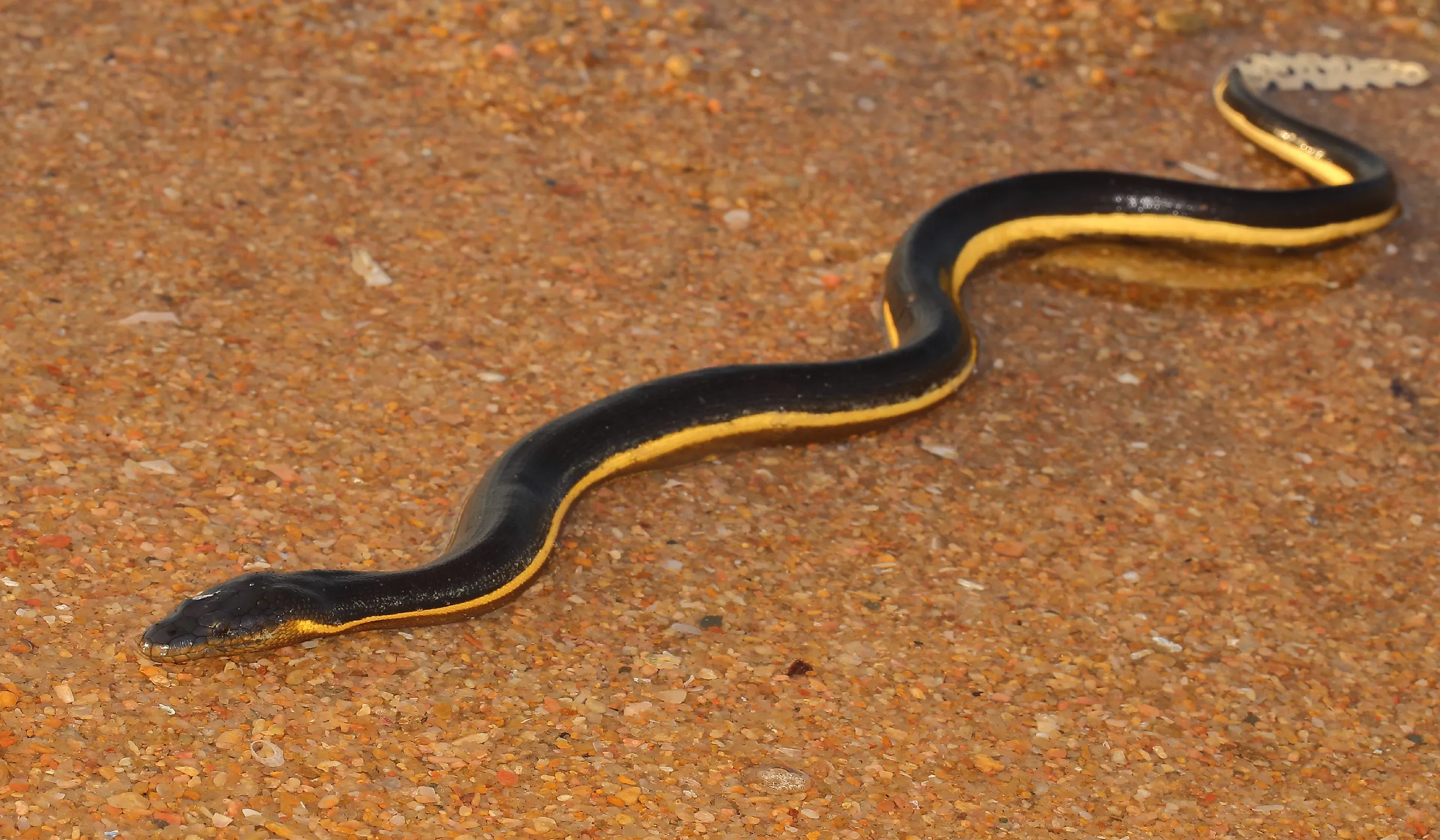
The yellow-bellied sea snake has a body built for life in water rather than on land. Adults typically measure between 50 and 90 centimeters (20 to 35 inches) in total length, with reported maximums around 1.13 meters (about 45 inches). Females are larger than males on average, reaching up to 1.1 m, while males rarely exceed 0.7 m. Adult weights range from about 90 to 240 grams. The body is slender, elongated, and laterally compressed, essentially shaped like a ribbon that cuts through water with minimal resistance.
Coloration is one of its most distinctive features and gives the species its common name. The dorsal (upper) side is typically dark, black, deep brown, or bluish-gray, while the ventral (underside) is bright yellow. The division between these colors is often sharp and dramatic, a pattern thought to function as both camouflage and warning depending on the viewing angle in water. The tail is flattened into a paddle-like shape, an adaptation that provides propulsion through ocean currents, and is typically marked with black spots or bars that extend onto the yellow ground color.
The head is narrow and only slightly distinct from the body, with large eyes positioned for detecting movement in open water. The nostrils sit high on the snout and can close when submerged, preventing water intake. Like all elapids, it possesses short, fixed fangs at the front of the mouth, connected to potent venom glands. One of the most unusual physiological adaptations is its ability to absorb up to about a third of its oxygen requirement directly through its skin, which lets it stay submerged for extended periods between surface breaths.
Food and Feeding Behavior

The yellow-bellied sea snake is a carnivorous predator, feeding primarily on small fish, including the larval and juvenile stages of larger species. It often hunts in a passive but highly effective way. Rather than actively chasing prey over long distances, it drifts with ocean currents, hovering near the surface in calm water zones where fish naturally concentrate. When prey approaches, the snake strikes quickly with a sideways lunge, injecting venom that rapidly immobilizes its target. It then swallows the fish headfirst, a process made easier by its highly flexible jaws.
One particularly well-documented behavior is its association with surface slicks: long lines of calm water along convergence zones where small fish gather to feed on plankton concentrated by the same currents. The snake can hang motionless within these slicks for hours, ambushing fish that approach. The snake's exposed dorsal coloration, which appears dark from above and bright from below, may help it blend into both views simultaneously.
Behavior

One of the most remarkable traits of this species is its completely pelagic lifestyle. It does not rest on land, breed on land, or hunt near shorelines. It spends most of its life floating at or near the ocean's surface, sometimes in large aggregations numbering in the thousands. These aggregations are not coordinated schools in the traditional sense, but rather concentrations created by ocean currents. At times, these drifting groups can stretch for miles, forming visible lines of life across otherwise empty water.
Despite its venom, the yellow-bellied sea snake is not aggressive toward humans. Encounters are rare, and bites are uncommon because the snake's habitat keeps it far from typical human activity. Bites have been documented mostly among fishermen handling specimens caught in nets, and human envenomation is rare in the medical literature. When threatened, the snake is more likely to flee or drift away than to engage. Another unusual adaptation is its ability to drink fresh water that collects on the ocean surface after rain, since marine reptiles cannot drink seawater. Studies in the eastern Pacific have shown that the snake can become severely dehydrated during prolonged dry seasons and depends on rainfall events for survival.
Reproduction

Reproduction occurs entirely in the ocean. The species is viviparous (sometimes also described as ovoviviparous), meaning females give birth to live young in open water. Gestation has been inferred to last at least five to six months. Females reach sexual maturity at a snout-vent length of around 62 centimeters. Litters typically range from 2 to 6 offspring, with newborns measuring approximately 25 centimeters (about 10 inches) at birth. Breeding may occur year-round in warmer seas but is restricted to the warmer months in cooler waters.
The young are immediately independent. They are born at sea and begin feeding almost immediately, already adapted to the drifting life their parents lead. There is no nesting, no return to land, and no parental care beyond birth itself. The reproductive cycle is entirely self-contained and adapted to a fully marine existence.
Importance

Though it is not a species of economic importance, the yellow-bellied sea snake plays a meaningful ecological role. As a mid-level predator, it helps regulate populations of small fish in pelagic ecosystems, and in doing so, it contributes to the balance of open-ocean food webs that are among the most complex and least understood ecosystems on the planet.
It is also scientifically important. As one of the few reptiles fully adapted to open-ocean life, it offers insight into how terrestrial animals can evolve to occupy extreme marine environments. Its physiology, especially its ability to survive long periods of drifting, regulate salt intake through its sublingual salt gland, take up oxygen across its skin, and hunt in open water, makes it a key species in evolutionary biology and physiology research.
Threats

The yellow-bellied sea snake is currently listed as Least Concern on the International Union for Conservation of Nature (IUCN) Red List, reflecting its enormous geographic range and the fact that it has no major commercial harvest. The IUCN also notes that population trends are unknown across most of its range. Despite the wide distribution, threats remain.
One significant danger is accidental capture in fishing operations, particularly trawl nets, where snakes can be trapped and drown. Marine pollution is another concern. Plastic debris, oil contamination, and chemical pollutants can disrupt the surface ecosystems where the snake feeds. Floating plastic also interferes with its hunting behavior, since it relies on drift lines where natural prey accumulates. Climate change adds further uncertainty. Shifts in ocean temperature and current patterns may alter the distribution of both the snakes and their prey, and at least one regional population, the yellow form H. p. xanthos in Costa Rica's Golfo Dulce, is restricted to a small area where it is more vulnerable to local environmental change.
The yellow-bellied sea snake is not just a marine reptile. It is a creature that has fully surrendered to the ocean as a way of life. It does not visit the sea. It belongs to it entirely, carried endlessly across the planet's warm waters, a small but enduring thread in the vast, moving fabric of the open ocean.