Wildfires And Habitat Loss Are Killing Jaguars In The Amazon Rainforest
The Amazon rainforest spans nine countries, with about 60% of it inside Brazil. Beginning in the late 2010s and through the early 2020s, fire became one of the defining threats to the forest, with deliberately set agricultural and clearing fires escaping into surrounding habitat under increasingly hot and dry conditions. Wildlife losses have run into the millions, and among the larger species, jaguars have been hit especially hard.
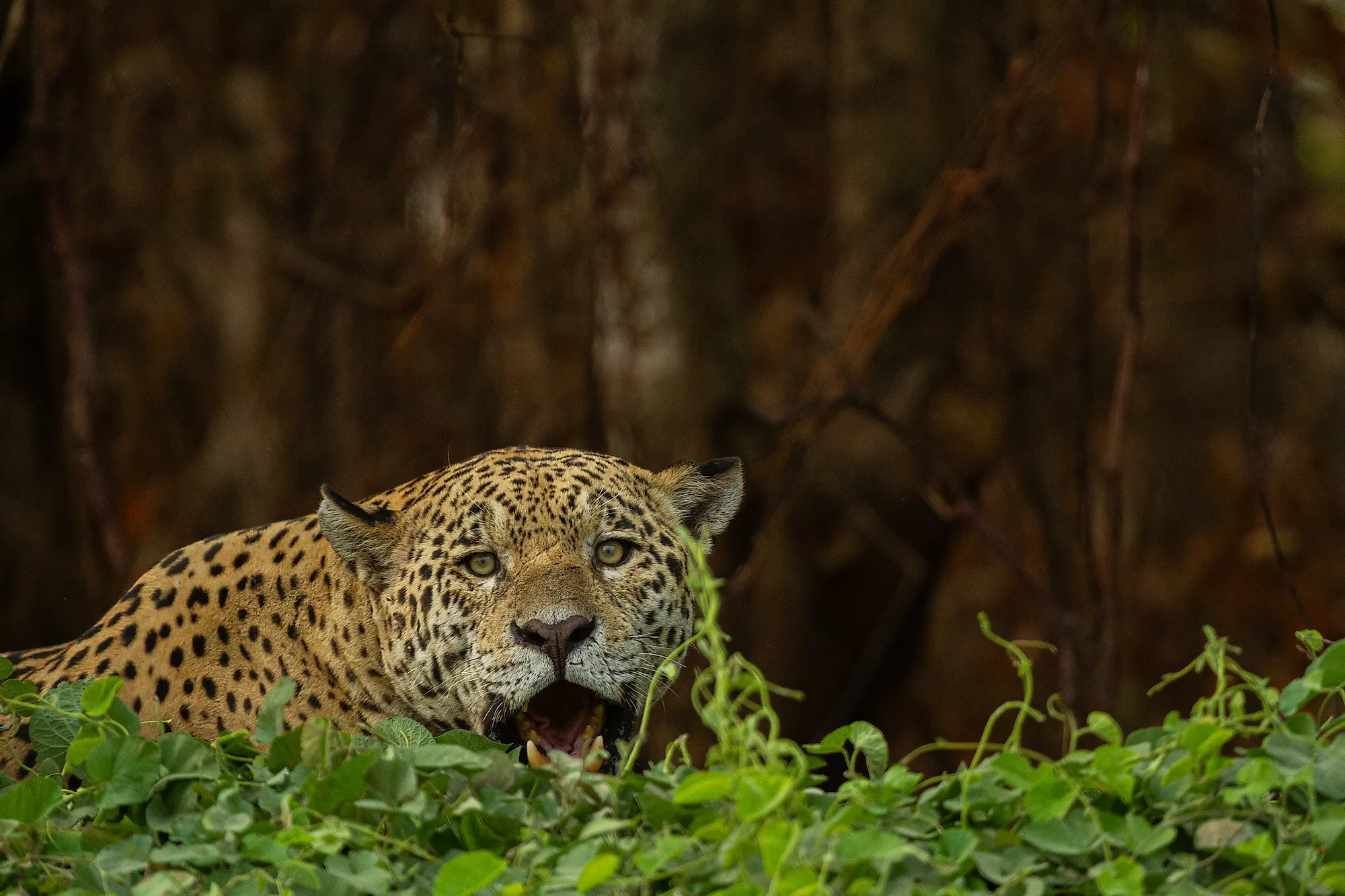
According to research by Panthera, the global wild cat conservation organization, fires across the Brazilian Amazon killed or displaced at least 1,470 jaguars between 2016 and 2019. Habitat loss and fire-driven displacement claim the lives of at least 300 jaguars in the Brazilian Amazon every year on average. Dr. Fernando Tortato, a Conservation Scientist at Panthera, says the loss is not a number that can be normalized.
"Headlines of wildfires devastating large swaths of habitats, even fast-moving wildlife populations, and human communities are becoming the new normal around the globe, with 'fire season' emerging as a perennial state. But as our research shows, the scale of loss for jaguars alone with at least 300 individuals killed or displaced each year is not a norm we can accept," he stated.
Amazon On The Edge

The Amazon is the most species-rich ecosystem on Earth, holding an estimated 10% of all known species on the planet within its boundaries. Its tributaries feed the Amazon River, the largest river system on the planet by discharge, which supports the agriculture, transportation, and drinking water of tens of millions of people across South America. About 1.5 million Indigenous people from more than 350 distinct groups live within the basin and depend directly on the forest for their livelihoods. The Amazon is also one of the largest natural carbon sinks on the planet, and its transpiration drives rainfall patterns across much of the continent and as far north as Central America and the southern United States.
Brazil's National Institute for Space Research (INPE) reported that 13,235 km² of forest were cleared in the 2020-2021 monitoring year, a 22% increase from the previous year and the highest annual loss recorded since 2006. Since then, the trajectory has reversed sharply. After President Luiz Inácio Lula da Silva returned to office in January 2023 and reactivated the federal enforcement and monitoring agencies that had been defunded under his predecessor, deforestation in the Brazilian Legal Amazon fell for three consecutive years. The 2024-2025 PRODES rate was 5,796 km², the lowest annual figure in 11 years and a roughly 50% reduction from the 2022 peak. Brazil hosted the COP30 climate summit in Belém in November 2025, where the government's emerging zero-illegal-deforestation-by-2030 target and the proposed $125 billion Tropical Forest Forever Facility were the headline announcements.
The threat picture has shifted with the trend. Even as outright clear-cutting has slowed, fires and drought-driven forest degradation have surged. The 2024 drought across the Amazon basin was among the most severe on record, and a recent INPE analysis found that fire-driven progressive degradation accounted for 38% of total Amazon forest loss in the 2024-2025 monitoring year, up from just 7% in 2022. Brazilian climate scientists Carlos Nobre and Thomas Lovejoy have warned for years that cumulative deforestation of roughly 20% to 25% of the original Amazon could trigger a tipping point at which large parts of the forest convert irreversibly to savanna. The basin has now lost an estimated 17% to 20% of its original cover.
Jaguar Loss Acts As An Alarm Bell

It is not just trees disappearing. The animals living in the forest are also being lost in numbers most people never see, and the jaguar is one of the clearest indicators of how widespread the damage has become.
Jaguars are apex predators at the top of the Amazon's trophic structure, and conservationists use them as both an umbrella species and a flagship species. Protecting enough habitat to support a viable jaguar population means protecting the habitat that thousands of smaller species also depend on, which is the umbrella effect. Jaguars are also large, charismatic, and individually identifiable from their unique rosette patterns, which makes them effective for fundraising and public awareness, the flagship effect. Jaguars prefer continuous forest, and when forest is fragmented or burned, displaced jaguars often end up close to human settlements where they begin preying on cattle and other livestock and are then killed by ranchers in retaliation. The collapse of a jaguar population is therefore one of the more reliable signals that an ecosystem is in trouble.
"Faced with the scenario of constant habitat loss and fragmentation, each jaguar removed is unlikely to be replaced. In other words, the loss of at least 300 jaguars each year in the Brazilian Amazon means these individuals will not bounce back; they are forever lost. The forested landscape replaced by pastures and crops are no longer sources of jaguar populations. The scientific community calls such areas 'sinks.' Jaguars are apex predators in the Americas, and a forest without jaguars is an ecologically dysfunctional environment," said Tortato.
The Fires Behind the Losses

Wildfires are the leading proximate cause of jaguar loss across the Brazilian Amazon. Most of the fires are set by ranchers, miners, farmers, loggers, and land speculators to clear ground for cattle pasture or crops, or to open access into otherwise inaccessible forest. Deforestation in the Amazon is not new, but the fires of recent years have been more frequent, more intense, and more widespread than at any time in the satellite record. The combination of climate-driven drought conditions and intentional ignition has turned routine agricultural burning into a regional disaster. Burned area in the Amazon dropped 45% between the 12 months ending September 2024 and the 12 months ending September 2025, but the underlying conditions, hotter and drier years on average, persist.
"Wildfires in the Amazon are a consequence of deforestation. The threats act in synergy. Deforestation cuts down the forest, the fire burns the deforested areas and their edges, and then the area is transformed into pasture for cattle or crops," explained Tortato.

Tortato notes that jaguars displaced by deforestation and fire are unlikely to integrate into surrounding territories. Resident jaguars do not accept newcomers easily, and a displaced animal arriving in unfamiliar country has no working knowledge of where its preferred prey is or how to avoid the local human population.
"One critical issue is that these individuals don't know where to find their natural prey as well as they did in their home range, leading them to hunt easy and often unguarded targets, such as livestock. This behavior, of course, often leads to local ranchers killing jaguars either because of the perceived or known threat to the ranchers' livelihoods," said Tortato.
The Way Out

The numbers are starting to move in the right direction at the basin level, but jaguar conservation requires more than just slowing the rate of clearance. Panthera scientists recommend continued strict monitoring of jaguar populations across priority landscapes, targeted conservation interventions in the regions with the highest jaguar densities, expansion of protected areas, support for sustainable cattle production methods that reduce conflict, certification programs for beef and timber, and reduced overall meat consumption among consumers in Brazil and abroad.
Tortato emphasizes that while the threats act together, the responses can be modular. Enforcement of land-use regulations and political pressure to maintain that enforcement are essential to reducing illegal deforestation and the fires that follow. Public policy that rewards forest-compatible land use rather than clearing is the longer-term half of the equation.
On the human-jaguar conflict side, Tortato points to specific tested interventions:
"Conflict with cattle ranchers requires actions that integrate farmers in strategies to reduce the vulnerability of their herds, thus making coexistence with jaguars and other wildlife possible. Proven tactics to mitigate conflict include housing cattle in well-fortified predator-proof corrals, particularly at night. The use of electric fencing, solar-powered lights that deter wild cats from approaching livestock corrals, and the use of territorial cattle breeds whose males defend females and young, are also helpful," he mentioned.
The basin-level deforestation slowdown of the past three years is the first reason for cautious optimism in more than a decade, but the trend remains conditional on continued enforcement, on outcomes at COP30 and the climate finance discussions that follow, and on whether climate-driven drought continues to push fire deeper into otherwise intact forest. Tortato's closing point is that the time window for keeping the Amazon's jaguar population functional is narrow but still open.
"Despite the staggering numbers of losses, there is still time to establish conservation actions to ensure that the Amazon does not follow the same path as other biomes where jaguar populations are critically endangered. Now we must utilize strategic conservation actions to reduce these numbers and ensure that jaguar populations remain connected," he stated.