Lionfish
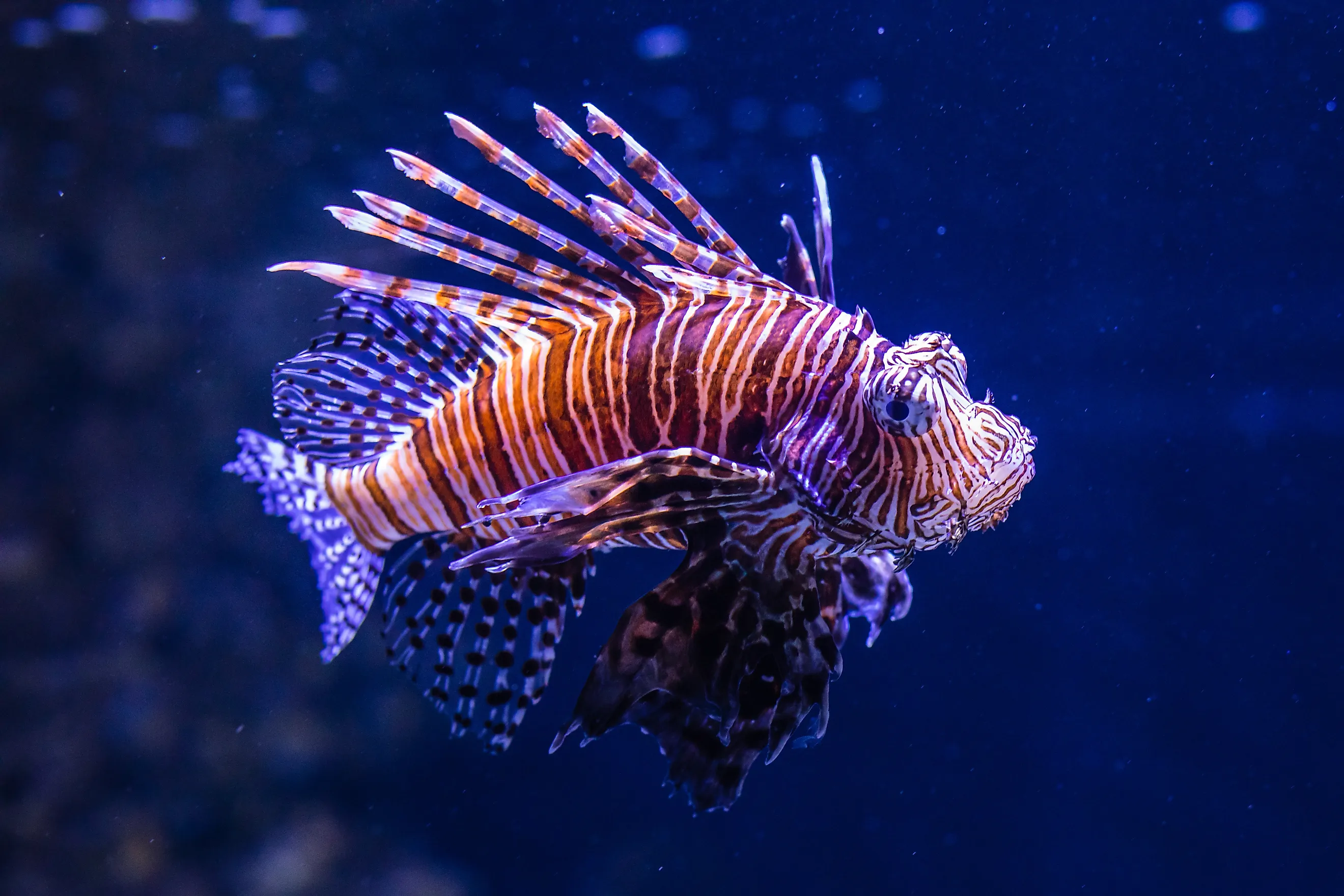
Lionfish (Pterois) are a group of venomous fish native to the Indo-Pacific that have established invasive populations across warm Atlantic waters since the 1980s. The most visible features are the enlarged pectoral fins, the elongated dorsal spines, and the strong red, brown, white, and orange banding. The 18 venomous spines in the fin rays carry a neurotoxin that is rarely fatal to humans but produces severe pain, swelling, and (in some cases) respiratory or cardiovascular symptoms. In their invasive ranges, lionfish have become one of the most damaging marine introductions on record.
Taxonomic Classification

Lionfish are classified in the family Scorpaenidae (the scorpionfishes), an order of bony fishes characterized by venomous fin-ray spines. The lionfish proper are divided among three genera: Pterois (the full-size lionfish, with about 10 to 12 recognized species), Dendrochirus (the dwarf lionfish, with around 5 species), and Nemapterois (a small genus). The red lionfish (Pterois volitans) and the devil firefish (Pterois miles) are the two species that have established invasive populations outside their native range. Stonefish (Synanceia), often grouped with lionfish in older sources, are now placed in a separate family, Synanceiidae, following taxonomic revisions over the past two decades.
Physical Description

Most species of lionfish are reddish-brown to maroon with white vertical bands along the body. The long fan-shaped pectoral fins and elongated dorsal spines together produce the mane-like silhouette that gives the family its common name. Adults of the larger species typically reach 30 to 38 centimeters (12 to 15 inches), with specimens in the invasive Atlantic range occasionally exceeding 45 centimeters (about 18 inches), larger than the average size in their native Indo-Pacific waters.
The venom apparatus consists of 18 spines: 13 in the dorsal fin, 3 in the anal fin, and 1 in each pelvic fin. Each spine has two grooves along its length housing venom glands. The venom is a complex mixture of proteins, a neuromuscular toxin, and the neurotransmitter acetylcholine. Effects in humans range from severe localized pain and edema to systemic symptoms including sweating, breathing difficulty, and (rarely) paralysis. Antivenom is not generally available; treatment is symptomatic, with immersion in hot water often providing relief by denaturing the venom proteins. Lionfish typically live 10 to 15 years in the wild.
Range and Habitat

The native range covers a broad sweep of the Indo-Pacific from the eastern coast of Africa across the Indian Ocean, the South Pacific, and up to southern Japan and South Korea. Native populations occur in Australian coastal waters, Malaysian reefs, French Polynesia, the Pitcairn Islands, the Kermadec Islands of New Zealand, and most reef systems in between.
Red lionfish (P. volitans) first appeared in the western Atlantic in 1985, when a single specimen was reported off South Florida. Aquarium releases are the documented introduction pathway. Genetic studies (Hamner et al., 2007) showed that the entire invasive Atlantic population descends from a small number of founder individuals, indicating that deliberate releases by aquarium owners over multiple years were the dominant introduction mechanism. The often-repeated story that Hurricane Andrew in 1992 released large numbers of lionfish from destroyed Florida aquariums is partly documented (six lionfish were reportedly released after the hurricane) but does not match the genetic evidence as the main cause. By the early 2000s, established breeding populations were present along the southeastern U.S. coast. Juveniles have since been collected as far north as Long Island, New York, and across the Caribbean and Gulf of Mexico.

The devil firefish (P. miles) has established a parallel invasion in the Mediterranean. The species entered the eastern Mediterranean from the Red Sea through the Suez Canal (a Lessepsian migration) and had established breeding populations along the southern coast of Cyprus by 2016. It has since spread north along the Levantine coast and west to Italy, Greece, and Tunisia. Lionfish in general are found in warm marine waters from 1 to 150 meters depth (about 3 to 500 feet), using hard bottoms, mangroves, seagrass beds, coral reefs, and artificial structures such as shipwrecks for shelter.
Behavior and Feeding

Lionfish in their native range are largely nocturnal, becoming active at dusk to hunt. In invasive Atlantic ranges, where they have effectively no natural predators, they are commonly observed feeding during daylight hours, both alone and in small groups. The diet is dominated by small fish, shrimp, crabs, and other crustaceans. Lionfish stalk prey by spreading their pectoral fins to herd it into a corner before lunging and engulfing it whole. They can also direct jets of water at prey to disorient it. In conditions of food scarcity, cannibalism on smaller lionfish has been documented.
The impact on Atlantic reef communities has been severe. A widely cited experimental study (Albins and Hixon, 2008) on artificial reefs in the Bahamas found that a single lionfish reduced juvenile reef fish populations by roughly 80 percent within five weeks of arrival. Lionfish prey on more than 50 documented fish species in the invasive range, including ecologically and economically important taxa such as juvenile snapper and grouper. They show strong site fidelity, with adults occupying preferred reef structures and forming densities of more than 200 individuals per acre in some invasive sites.
Reproduction

Lionfish reach sexual maturity within about a year. Males mature at around 10 centimeters (4 inches) total length; females at around 17 to 18 centimeters (7 inches). Spawning behavior involves a multi-day courtship: the male displays his fins and spines to attract a female and intimidate rival males. If she joins him, the pair perform a circling ascent toward the surface. The female releases two buoyant egg masses, each held together by a gelatinous matrix; the male releases sperm into the cloud as the masses rise to the surface for external fertilization.
The egg matrix contains chemical deterrents that discourage predation, which contributes to high survival rates compared with other reef fish eggs. Eggs hatch within 24 to 36 hours. The pelagic larvae are strong swimmers from the start and feed on ciliates and small zooplankton. In the Caribbean, the species reproduces year-round, with mature females producing two egg masses of roughly 12,000 to 15,000 eggs each, every 2 to 4 days. Total reproductive output can approach 2 million eggs per female per year, which is part of the explanation for the invasion's speed.
Importance and Management

In the Indo-Pacific native range, lionfish are eaten as a food fish in some local fisheries and serve as prey for larger reef predators such as sharks, groupers, eels, and cornetfish. In invasive Atlantic and Mediterranean ranges, management programs encourage spearfishing removal, organized "lionfish derby" tournaments, and culinary promotion. The flesh is white, firm, and mild, and (despite the venom in the fin spines, which is safely removed in cleaning) is gaining traction as a sustainable seafood option in Curaçao, Cyprus, Florida, and the Carolinas. In Florida, lionfish has been promoted as an alternative to overfished snapper and sea bass.
Lionfish remain an active aquarium-trade species in the United States, though several states have introduced restrictions to discourage the releases that started the invasion.
Conservation Status
Lionfish are not currently considered threatened or endangered in their native Indo-Pacific range. Long-term population pressure from coral bleaching, ocean warming, pollution, and habitat degradation may affect their native populations as reef ecosystems degrade. In the Atlantic and Mediterranean, by contrast, lionfish are among the most damaging invasive marine species on record and the management priority is reducing their numbers, not protecting them.