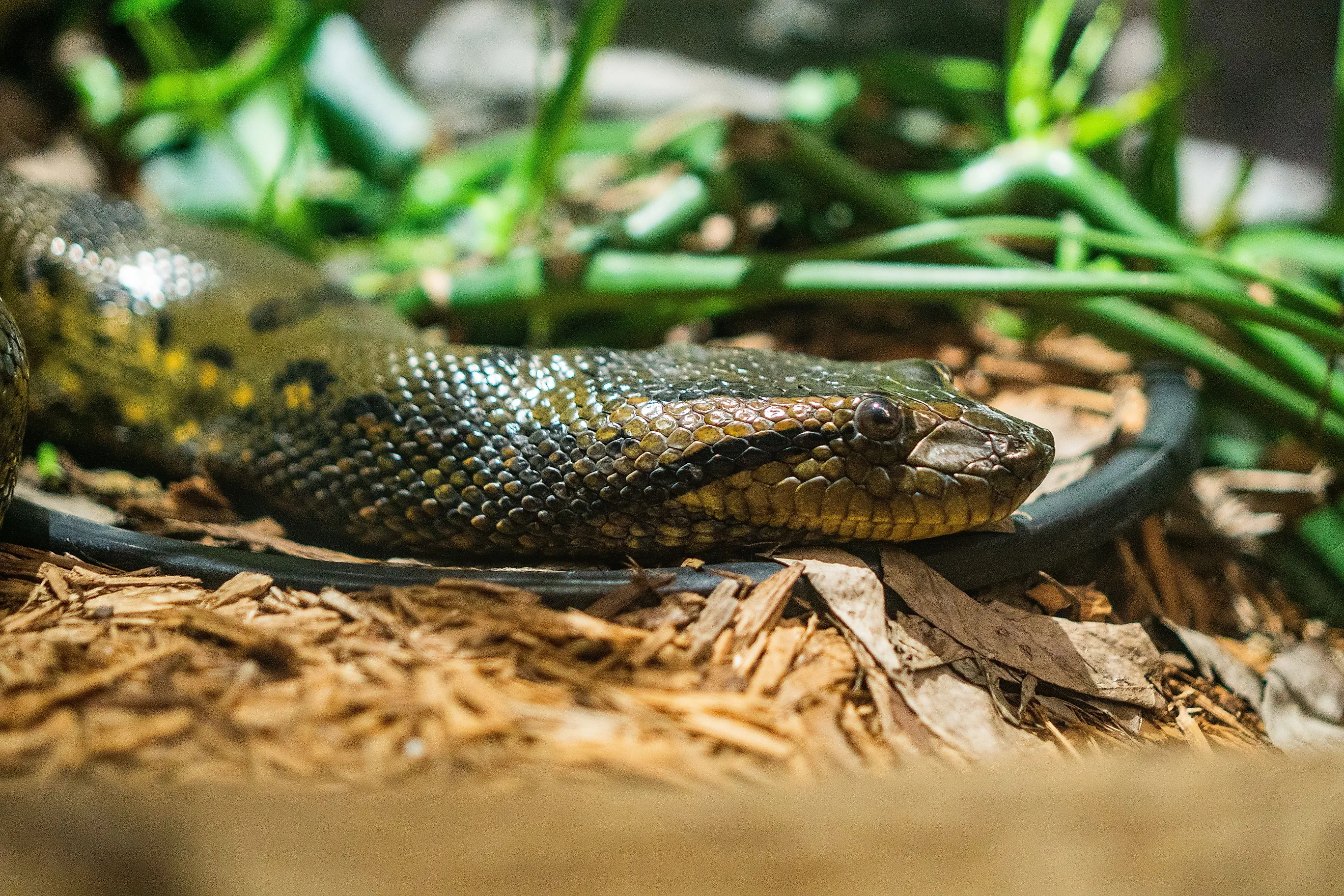
Green Anaconda
Female green anacondas can reach 30 feet long. Males average around 9 feet. That makes the green anaconda the world's largest snake by both weight and length, and one of the most extreme cases of sexual size dimorphism in any vertebrate. The olive-green skin, the size, and the preferred kill method (constriction) have unsettled humans on both sides of the Atlantic for centuries. Beyond the headline numbers, green anacondas have a hunting style, a mating ritual, and a swimming ability that all warrant a closer look across their native range in South America, Central America, and the Caribbean.
Taxonomy

In 2024, an international team led by University of Queensland biologist Bryan Fry split the species in two. What had been treated as a single green anaconda (Eunectes murinus) is now considered two species, with the northern green anaconda (Eunectes akayima) recognized as genetically distinct from its southern cousin. The two differ by about 5.5% genetically, which is significant for a snake (humans and chimpanzees, for comparison, differ by about 1.2%). The northern species takes its name from akayima, the Carib word for "great snake."

The genus Eunectes, established by Johann Georg Wagler to separate the larger anacondas from the smaller boas, comes from the Greek for "good swimmer." Four species share the genus alongside the two greens: the yellow anaconda (E. notaeus), the dark-spotted anaconda (E. deschauenseei), and the Bolivian anaconda (E. beniensis). All sit within the family Boidae, which also includes the boa constrictor.
Physical Traits

Adult females typically average around 15 feet, with the largest specimens stretching past 25 feet and into the 28-30 foot range. Adult males are dramatically smaller, around 9 feet on average. The average weight runs between 70 and 150 pounds, although the largest females can exceed 250 pounds. The female's outsized body works as a reproductive advantage, since it can carry more offspring at once. Both sexes retain a small horny claw on the body, a vestigial limb left over from the boa lineage's deep evolutionary past.
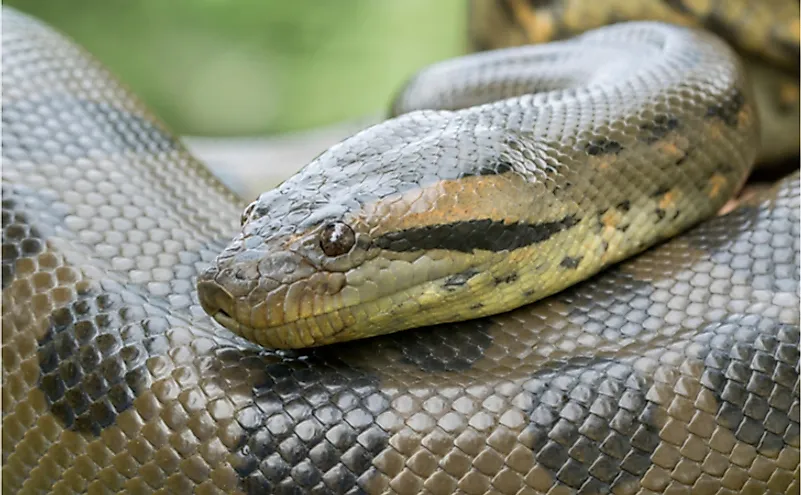
"Green" is a slight oversimplification. The base body is olive-green with darker spots along the spine and sides, the side spots ringed by yellow markings. The belly is yellow and black. A black stripe runs along each eye to the jaw. The skin is loose and stretches when the snake is in the water. The eyes and nostrils sit on the top of the head, allowing the snake to lie almost entirely submerged with only its eyes and nostrils above the surface, and the snake can stay underwater for up to 10 minutes. Heat-sensing pits along the sides of the head help locate warm-blooded prey, much as in venomous pit vipers, although the green anaconda is nonvenomous and relies on sharp recurved teeth for grip rather than fangs for envenomation. One skeletal quirk separates the species from the rest of the Boidae: it lacks a supraorbital bone in the skull. Wild lifespan runs about 10 years; captive specimens have lived more than 20.
Range and Habitat

Water defines the green anaconda's territory. The species spends the majority of its time submerged in slow-moving rivers, oxbow lakes, swamps, and the seasonally flooded Llanos grasslands of Venezuela. The Amazon Basin, the Orinoco Basin, and the wetlands of the Brazilian Pantanal hold the bulk of the population, with the range extending across Ecuador, Guyana, French Guiana, Colombia, Venezuela, Peru, Trinidad, and Paraguay. A handful of green anacondas have turned up in Florida, almost certainly the result of escaped or released pets rather than natural dispersal. When it does leave the water, the snake usually climbs into a low tree branch or pushes into thick streamside vegetation, where the olive-green coloring works as effective camouflage.
Food

Constriction does not kill by suffocation or by crushing bones. A 2015 study in the Journal of Experimental Biology by Dickinson College biologist Scott Boback established that constriction kills by cutting off blood supply to the brain, causing rapid ischemia and unconsciousness within seconds, which is far faster than asphyxiation alone would manage. Green anacondas often shortcut even that. They drag prey underwater and let it drown.
The animal is an opportunistic carnivore with a slow metabolism that can survive on one meal every few weeks. Smaller, younger anacondas eat fish, birds, and small mammals. Adults take much larger prey: capybaras, deer, caimans, and (occasionally) alligators and even jaguars. Hunting is mostly nocturnal, from ambush in shallow water near the bank. The snake bites in with its recurved teeth, then throws coils around the body. Once the prey is dead, the lower jaw separates at an unfused mandibular ligament and the head expands to swallow the meal whole. Green anacondas are large enough that swallowing a human is anatomically possible, but no confirmed case of one doing so has been documented. The species sits at the top of its food web; only caimans and jaguars pose a serious threat to adults, and juveniles are vulnerable to foxes, larger caimans, and adult anacondas of their own species.
Reproduction

The breeding ball is the most striking moment in the green anaconda's year. As many as 12 or 13 males coil around a single female in the shallows, all of them attempting to mate, the entire knot of snakes wrestling and rearranging itself for hours, sometimes for weeks at a time. The female's much larger body anchors the whole structure and prevents males from accidentally mating with each other. Females sometimes consume a smaller male during or after the event, one of the better-documented examples of sexual cannibalism in vertebrates.
Outside breeding season, the species is solitary. Females release pheromones to signal receptivity in the spring of breeding years (which begin around age three to five and recur every other year). Males locate the female by tasting the air with the forked tongue. Gestation lasts about seven months, and the female gives birth in the water to between 24 and 36 live young, each about two feet long and capable of swimming and hunting from the moment they are delivered.
Threats

The IUCN currently lists the green anaconda as Least Concern, but the last formal assessment was in 2014 and conservation biologists have raised serious concerns since. Roughly 17% of the Amazon rainforest has now been cleared, and ecologists Thomas Lovejoy and Carlos Nobre have warned that crossing a tipping point of about 20 to 25% deforestation could push the eastern Amazon into a self-reinforcing dieback. That same forest is the heart of the green anaconda's range.
The illegal pet trade pulls additional pressure on the species, and explains the small number of green anacondas that turn up in Florida. Hunting persists in some areas where ranchers worry (incorrectly) that the snake is a meaningful threat to livestock or to people. Confirmed attacks on humans are extremely rare, and the snake is not aggressive toward people in normal circumstances.
A Snake Most People Will Never See
Most people who travel through anaconda country never see one. The snake spends most of its life submerged or hidden in dense streamside vegetation, and most of its range overlaps with regions that have very little human activity. The encounters that do happen tend to be a result of habitat loss, the pet trade, or hunting pressure. The species' Least Concern status is real for now, but it depends on the rainforest holding together.