Why Are Wetlands Important?
Wetlands cover only about 6% of the Earth's land surface, but they do an outsized share of the work that keeps the planet livable. They filter the water that human and animal populations drink, absorb the floods that would otherwise hit cities, store more carbon per acre than almost any other ecosystem, hold roughly 40% of the world's plant and animal species, and feed hundreds of millions of people directly through rice agriculture and fisheries. The Ramsar Convention's Global Wetland Outlook 2025 values the ecosystem services wetlands provide at around $39 trillion a year, which is close to 36% of global GDP. Despite that, wetlands have been disappearing faster than any other major ecosystem, and the case for understanding why they matter has become more urgent rather than less.
What Counts as a Wetland

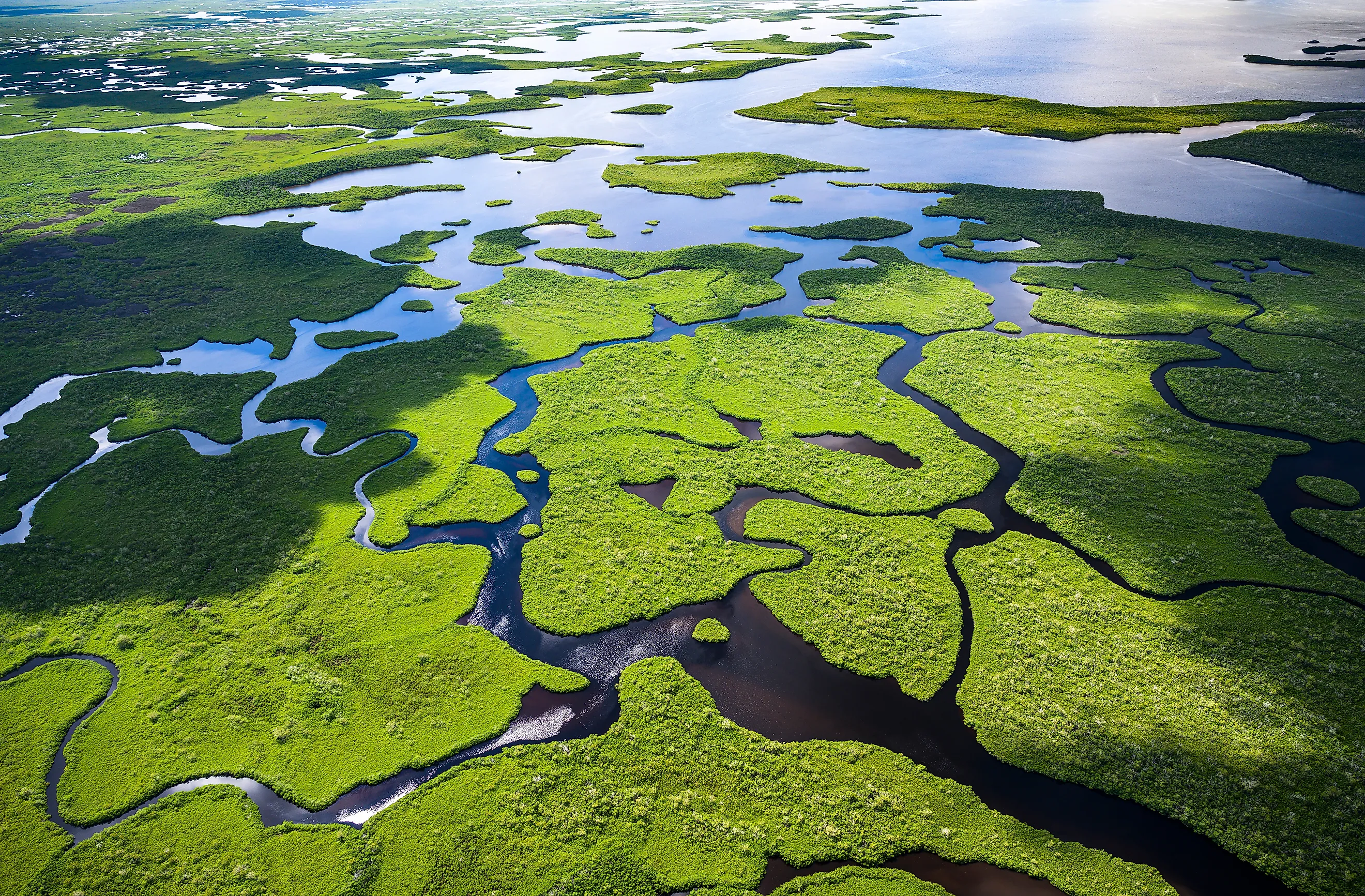
The Ramsar Convention, the 1971 international treaty that governs global wetland policy, defines a wetland as an "area of marsh, fen, peatland or water, whether natural or artificial, permanent or temporary, with water that is static or flowing, fresh, brackish or salt, including areas of marine water the depth of which at low tide does not exceed six metres." That definition deliberately covers a broad range of habitats. Inland wetlands include freshwater marshes, swamps, bogs, fens, peatlands, riverine floodplains, oxbow lakes, and seasonal pools. Coastal and marine wetlands include mangroves, salt marshes, tidal flats, estuaries, lagoons, seagrass beds, and shallow coral reefs. The defining feature of any wetland is that water sits at or above the soil surface for a meaningful part of the year, supporting hydrophytic vegetation and the development of hydric soils.
Estimates put global wetland coverage at roughly 1,800 million hectares, divided among inland, coastal, and shallow marine systems. The largest inland wetland on Earth is the West Siberian Lowland in Russia, which covers more than 2.5 million square kilometers of peatland. The largest tropical wetland is the Pantanal in South America. The most productive coastal wetlands are the world's mangrove belts and salt marshes, which run discontinuously around tropical and temperate coastlines.
Wetlands Hold a Disproportionate Share of the World's Species

Wetlands are the most biologically productive ecosystems on Earth per unit area. Around 40% of all known plant and animal species depend on wetlands at some point in their life cycle, even though wetlands are a small fraction of total habitat. The reason is that wetlands sit at the boundary between aquatic and terrestrial environments, and the daily and seasonal exchange of water, sediment, and nutrients across that boundary supports both kinds of life simultaneously.
The Sundarbans, the mangrove forest at the mouth of the Ganges and Brahmaputra rivers in India and Bangladesh, is home to the only mangrove-adapted population of Bengal tigers, along with saltwater crocodiles, fishing cats, spotted deer, several hundred bird species, river dolphins, and an extensive invertebrate fauna. The Pantanal in Brazil holds the world's highest density of jaguars and the largest remaining populations of giant otters and hyacinth macaws. The Florida Everglades supports the only place in the world where alligators and crocodiles share habitat. Northern peat bogs are breeding grounds for hundreds of millions of migratory waterfowl, and tropical floodplain forests like the Amazonian várzea hold fish diversity rivaling coral reefs.
The pressure on this biodiversity is severe. The 2025 Global Wetland Outlook reports an 83% average decline in monitored wetland-dependent species populations between 1970 and the most recent assessment, drawing on the Living Planet Index. That is roughly twice the average decline measured for terrestrial species over the same period.
Wetlands Filter the World's Water

Wetlands are sometimes called the kidneys of the landscape, and the analogy is closer to literal than figurative. As water moves through a wetland, it slows down, drops sediment, and is held in close contact with rooted plants and microbial communities that strip out nitrogen, phosphorus, and many organic and inorganic pollutants. Constructed wetlands are now used as low-cost wastewater treatment systems in thousands of municipalities worldwide, and natural wetlands have been credited with measurable reductions in nutrient loading to downstream rivers, lakes, and coastal zones.
The function matters most where it is missing. Algal blooms in Lake Erie, hypoxia in the Gulf of Mexico, and the eutrophication of the Chesapeake Bay are all driven, in significant part, by the historic loss of upstream wetlands that once intercepted agricultural runoff before it reached the open water. Restoring even a fraction of that wetland buffer is among the most cost-effective tools for managing these systems.
Wetlands Buffer Floods and Storms
Wetland soil and vegetation behave like a sponge. They absorb large volumes of water during storms and high-flow events and release it slowly back into the watershed afterward, reducing both flood peaks downstream and the severity of dry-season low flows. Inland floodplain wetlands are the most direct example: a river with intact floodplain wetlands can spread a storm pulse out across a wide area, while the same river hemmed in by levees and drained farmland sends the pulse downstream concentrated and destructive.
Coastal wetlands provide a parallel function against storm surge. Mangrove belts attenuate wave energy through the resistance of their dense root systems, and salt marshes do the same for shallower surges. After Hurricane Sandy in 2012, a peer-reviewed analysis published in Scientific Reports in 2017 estimated that coastal wetlands prevented around $625 million in direct flood damages along the US Northeast coast. Globally, the same kind of assessment values the storm protection function of coastal wetlands in the tens of billions of dollars per year.
Wetlands Store Enormous Amounts of Carbon

Wetlands, particularly peatlands, are the densest carbon storehouses among terrestrial ecosystems. Peatlands cover roughly 3% of the world's land surface but hold about twice as much carbon as all of the world's forests combined. The carbon is locked up in waterlogged organic soils that have accumulated over thousands of years, and as long as those soils stay wet, the carbon stays put. The moment a peatland is drained or burned, the carbon starts converting back to atmospheric CO₂ and methane.
This makes peatland conservation a climate issue of disproportionate importance. The 2015 Indonesian peat fires, which burned through drained tropical peatlands cleared mostly for palm oil, released roughly 0.6 to 1.1 billion tons of CO₂, briefly exceeding the daily emissions of the entire United States economy. Coastal mangrove forests, salt marshes, and seagrass beds store what is now called "blue carbon," and although they cover much smaller areas than peatlands, their per-hectare carbon storage is among the highest anywhere on Earth. The Global Wetland Outlook 2025 warns that many degraded peatlands now emit greenhouse gases rather than store them, and notes that restoring wetlands is one of the few ecosystem-based interventions large enough to materially affect the global carbon budget.
Wetlands Feed and Employ Hundreds of Millions of People

Wetlands are the primary engine of human food production in much of the developing world. Rice, the staple crop for more than half the global population, is grown almost entirely in flooded paddies, which are functionally human-managed wetlands. Asian rice production alone supplies somewhere around 50% of the calories consumed by Asia's roughly 4.7 billion people. Inland and coastal wetlands also support the great majority of the world's freshwater fisheries and a significant share of marine ones, since most commercially important marine fish use estuaries and mangrove systems as nursery grounds.
Direct dependence on wetland resources runs into the hundreds of millions. The lower Mekong floodplain supports an inland fishery that feeds around 60 million people across Cambodia, Laos, Thailand, and Vietnam. The Niger Inland Delta in Mali supports more than a million herders, fishers, and farmers in a country where alternatives are scarce. The Sundarbans alone provides livelihoods for several million people through fishing, honey collection, and woodcutting. Worldwide, the Ramsar Convention estimates that more than a billion people derive direct livelihood benefits from wetland ecosystems.
How Much Have We Lost

The cumulative loss has been severe. The Ramsar Convention's Global Wetland Outlook 2025 estimates that approximately 22% of the world's wetlands, around 411 million hectares, have been lost since 1970. The current annual loss rate is 0.52%, which is roughly three times faster than the rate of global forest loss. Older studies looking back further estimate that more than half of the world's natural wetlands have disappeared since 1900, with some inland wetland categories suffering losses above 70%. Around 25% of the remaining wetlands are in poor ecological condition, and that share is rising in every region surveyed, with the steepest declines in Africa, Latin America, and the Caribbean.
The drivers are familiar: drainage for agriculture, conversion to urban or industrial land, dams and water diversion that change the hydrology of downstream wetlands, pollution from upstream sources, invasive species, and the accelerating effects of climate change on rainfall, temperature, and sea level. The 2025 outlook warns that on current trajectories, another fifth of the world's remaining wetlands could vanish by 2050.
Why Wetland Conservation Matters Now

Wetlands are exceptional in how much value they pack into a small footprint. Six percent of land area, 40% of species, $39 trillion a year in services, and a carbon stock that no other terrestrial ecosystem comes close to matching. They are also exceptional in how poorly that value is captured by the markets and policies that decide land use. A drained peatland produces income from a palm oil plantation; an intact peatland produces global benefits that nobody pays for. The same logic applies to every coastal mangrove cleared for shrimp farming and every floodplain marsh drained for cropland.
Reversing this requires three things, all of which are within reach. The first is recognizing wetland value in land-use decisions, which means treating wetlands as infrastructure rather than as undeveloped land waiting for a better use. The second is funding restoration at a scale commensurate with the losses, which the 2025 Outlook estimates would require tens of billions of dollars per year against the trillions in services at stake. The third is enforcement. Roughly 12% of formally designated Ramsar Sites, the gold standard of international wetland protection, are currently in declining ecological condition, which suggests that designation alone does not save a wetland without ongoing management. The science on why these places matter is settled. The harder work is the policy and the money to act on it.