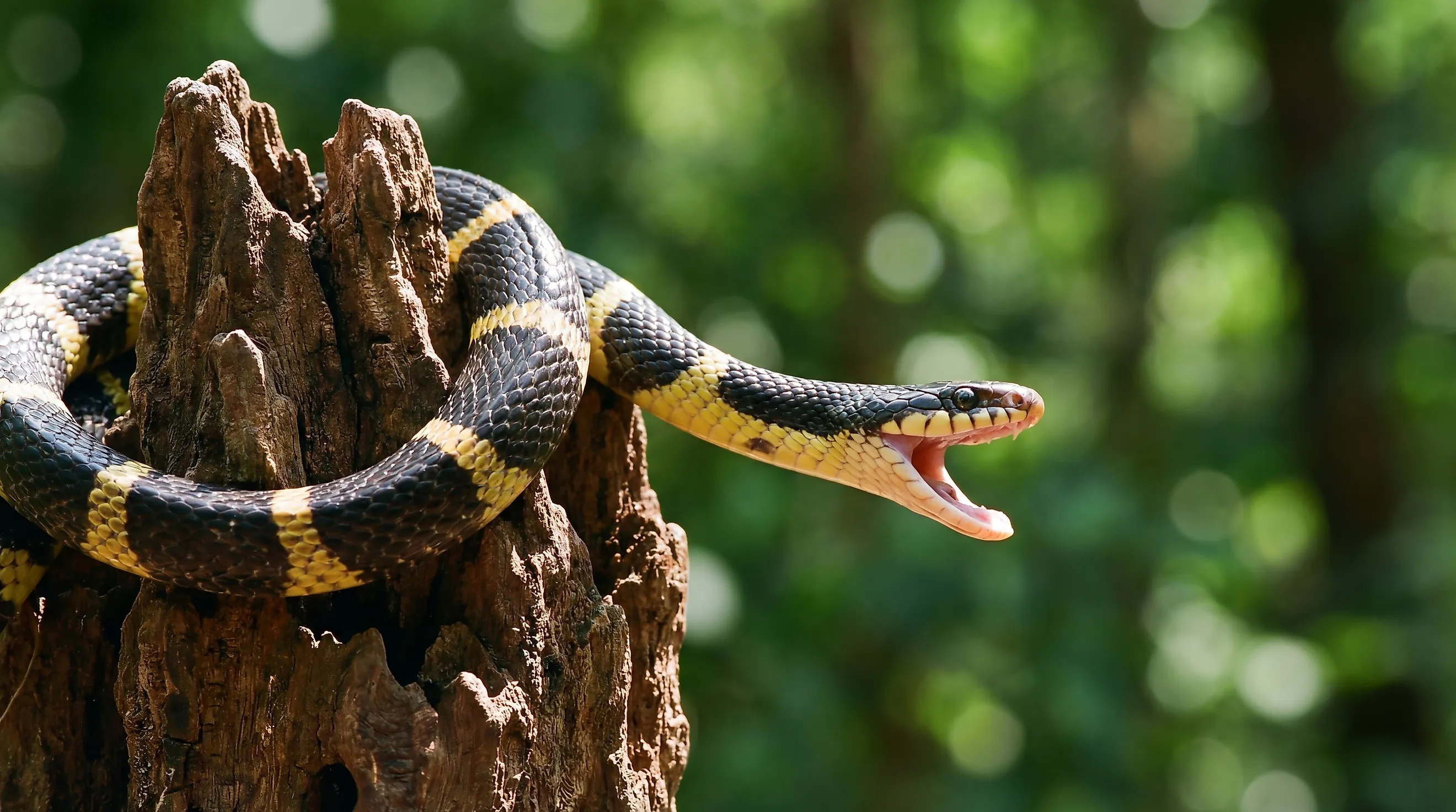
Krait
Kraits are highly venomous snakes in the genus Bungarus, part of the family Elapidae. They are found across the tropics and subtropics of South and Southeast Asia and into southern China. Eighteen species are currently recognized, eight or nine of them in the Indian subcontinent. Most species have bold banded patterns that may serve as warnings to predators, and most are nocturnal and shy. Krait bites tend to leave little local swelling or bruising, which is part of what makes them so dangerous: people often do not realize they have been bitten until the venom has begun to take effect.
Kraits are also among the most clinically important snakes on the Indian subcontinent because their neurotoxic venom is unusually potent. Despite their public health significance and their place in regional ecosystems, the genus is still understudied. This article covers the basics: what kraits look like, where they live, how they hunt and reproduce, what their venom does, and the threats they face.
How Kraits Got Their Name

Kraits are close cousins of cobras, both members of the family Elapidae. Molecular work places the split between the krait and cobra lineages roughly in the late Miocene, around 10 million years ago. Both the genus name and the common name come from India. Bungarus derives from the Telugu word bangaramu, meaning "gold," apparently in reference to the bright yellow bands of the banded krait (Bungarus fasciatus). The English word "krait" comes from the Hindi and Urdu karait, used for the common Indian krait (Bungarus caeruleus), which is mostly black or bluish black with thin white crossbands. The two names together reflect the two most familiar species in the part of India where the genus was first described.
Physical Description

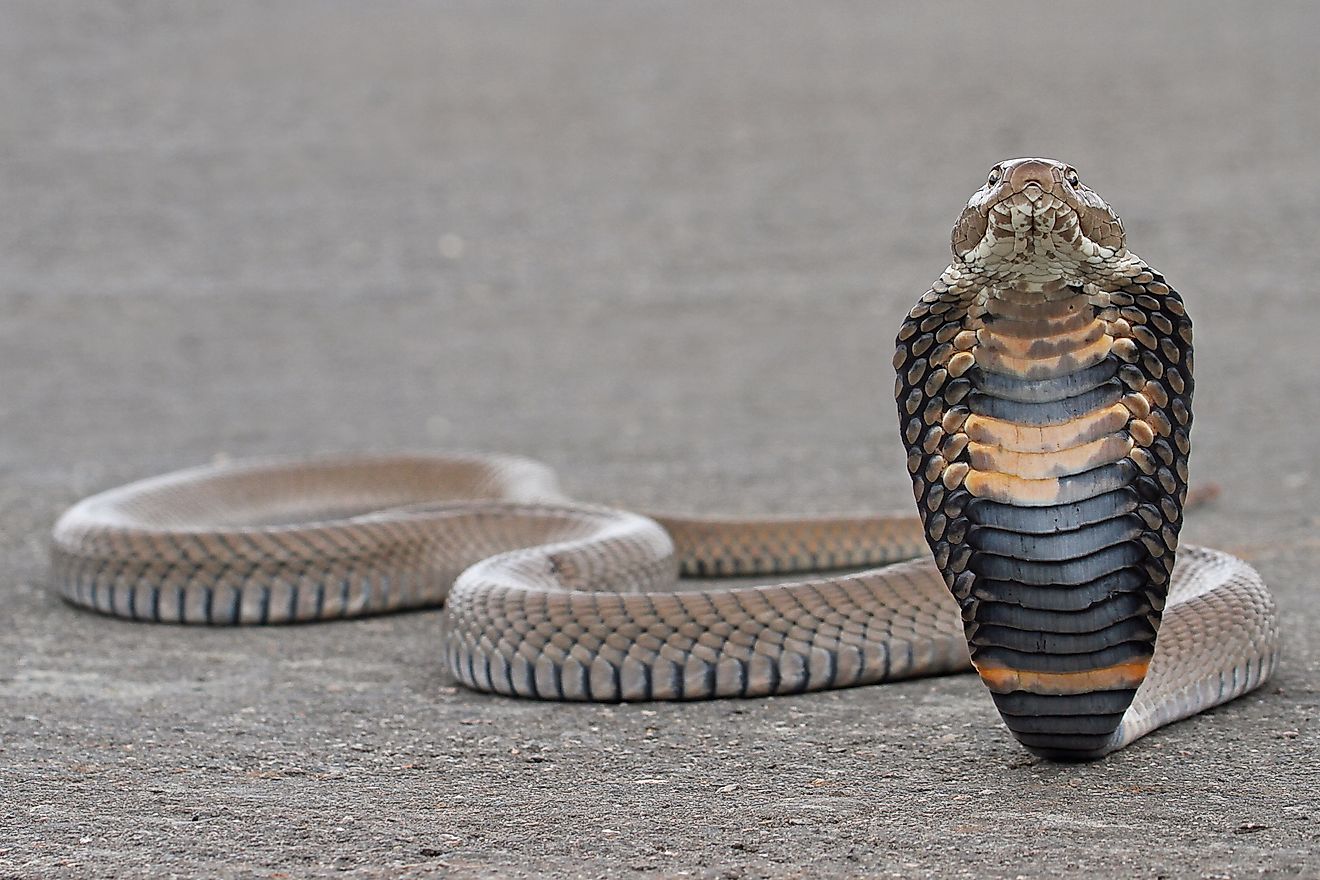
Most kraits are medium-sized snakes, with adults running roughly 3 to 5 feet long. The banded krait can exceed 7 feet, making it the longest member of the genus. Kraits have long, slender bodies with smooth, glossy scales that give them a polished look. The cross-section is distinctly triangular, and a row of enlarged hexagonal scales runs along the dorsal ridge of most species, a useful field mark. Color patterns vary by species but usually feature crossbands of black and white or black and yellow; some species have a dark body with a brightly colored head and tail.
The head is short and flat, barely distinct from the neck, with small black eyes and round pupils. Several species carry diagnostic facial markings, such as the inverted V on the head of the banded krait or the bright red head of the red-headed krait. Like all elapids, kraits have a pair of short, fixed front fangs that deliver the genus's potent neurotoxic venom.
Range And Habitat

Kraits are widely distributed across South and Southeast Asia and into Indochina. Their range stretches from Iran in the west, through the Indian subcontinent (India, Bangladesh, Nepal, Pakistan, and Sri Lanka), and east into Southeast Asia, including Myanmar, Vietnam, Laos, Indonesia, Thailand, Cambodia, Malaysia, and the island of Borneo.
Kraits use a wide range of habitats, from cultivated fields and dry scrubland to grassy meadows, woodland, and the moist edges of streams, canals, and irrigated paddies. They are often found near villages and farms, where they shelter in rodent burrows, termite mounds, and rubble piles. The proximity to human settlements is a large part of why krait bites are a public health problem.
Key Krait Species
A few of the most widely known species:
Banded krait (Bungarus fasciatus): the longest of the kraits, with bold alternating bands of black and yellow of roughly equal width. Found across the Indo-Chinese subregion, the Indonesian archipelago, the Malay Peninsula, and southern China.
Common Indian krait (Bungarus caeruleus): a black or bluish-black snake with thin white crossbands. One of India's "Big Four" venomous snakes (along with Russell's viper, the spectacled cobra, and the saw-scaled viper) and the cause of the second-highest number of snakebite deaths in India each year, after Russell's viper.
Malayan krait (Bungarus candidus): also called the blue krait, recognizable by wide dark blue-black bands alternating with yellowish-white bands of similar width. Found in mainland Southeast Asia, including Cambodia, Malaysia, Laos, Indonesia, Thailand, and Vietnam.
Red-headed krait (Bungarus flaviceps): a striking, rarely seen species with a bright red head and tail and a black body crossed by narrow bluish-white stripes. Lives in lowland rainforest in southern Myanmar, Borneo, Peninsular Malaysia, and parts of Indonesia.
Behavior And Diet

Kraits are almost entirely nocturnal. They are seldom seen in daylight and become active only after dark. During the monsoon season, they often enter houses in search of shelter or prey, and they sometimes bite people who roll onto them in their sleep or accidentally brush against them. The bites typically happen because exposed body parts are mistaken for prey.
By day, kraits are remarkably docile. A disturbed krait usually tries to escape; if cornered, many species coil up tightly with the head tucked under the body. Even handled animals are often slow to bite. Some species become more defensive when repeatedly disturbed, and a few thrash hard during attempts at relocation. The general pattern, though, is a snake that would much rather not engage.
At night, kraits forage slowly along the forest floor, hunting through leaf litter for prey. They will take small rodents, frogs, and lizards, but their preferred food is other snakes, including smaller kraits of their own species. The technical term for snake-eating is ophiophagy, and kraits are among the most committed snake-eaters in their range, helping regulate populations of other reptiles in the process.
Reproduction

Kraits are oviparous (egg-laying) and breed during the warm months, with timing varying by region. Most species lay during or just after the monsoon. Clutch size varies from about 2 to 14 eggs depending on the species, deposited in concealed locations such as rodent burrows or leaf litter, where the eggs are protected from predators and from temperature swings.
The choice of nesting site reflects the species' adaptation to tropical climates: moisture is essential for embryonic development. Several krait species show parental care, with the female remaining with the clutch until the eggs hatch about 1.5 to 2 months later. Hatchlings are roughly 12 inches long, fully venomous from the moment they emerge, and independent from birth.
Venom

Krait venom is among the most potent of any snake group. It is a neurotoxic cocktail dominated by two main components. Beta-bungarotoxins are presynaptic neurotoxins that destroy motor nerve endings by depleting synaptic vesicles and disrupting acetylcholine release; the damage is essentially permanent. Alpha-bungarotoxin is a postsynaptic neurotoxin that binds the nicotinic acetylcholine receptors at the neuromuscular junction. The combined effect is flaccid paralysis followed by respiratory failure when the diaphragm fails. Patients usually develop abdominal cramping, drooping eyelids (ptosis), difficulty breathing, tremors, and progressive weakness, ending in complete paralysis if untreated.
Krait bites are deceptive. They are often nearly painless, the small fangs leave little visible mark, and bites that happen at night while the victim is asleep can go unnoticed for hours. The combination of a missed bite and slow-developing symptoms is why kraits cause so many deaths in the region: by the time the victim or family recognizes the problem, paralysis is already setting in. With prompt medical care, most patients survive. Treatment involves polyvalent antivenom (the standard Indian product covers all four "Big Four" species) and mechanical ventilation to support breathing until the venom clears.
Threats

Kraits face the same pressures as most large Asian snakes. Habitat loss is the largest threat: expanding farmland, new settlements, road construction, and deforestation have all reduced and fragmented the ranges these snakes depend on. Kraits crossing roads at night are frequently killed by traffic. They are also killed on sight by people who fear all snakes equally, regardless of species. A smaller but real pressure comes from collection for skins, traditional medicine, and the exotic pet trade.
Why Kraits Matter

Most krait species are listed as Least Concern on the IUCN Red List, but local populations in heavily developed areas are clearly under pressure. Kraits matter ecologically as predators of smaller snakes and rodents, and their decline in any region typically signals broader ecosystem disruption. They also matter scientifically. Beta-bungarotoxin and alpha-bungarotoxin have been used for decades as standard tools in neuroscience research; alpha-bungarotoxin in particular was central to the work that first identified and characterized the nicotinic acetylcholine receptor. Continued research into krait biology and venom composition matters not just for ecology but for improving antivenom design and saving the tens of thousands of lives that kraits and other Big Four species claim each year.