Okapi
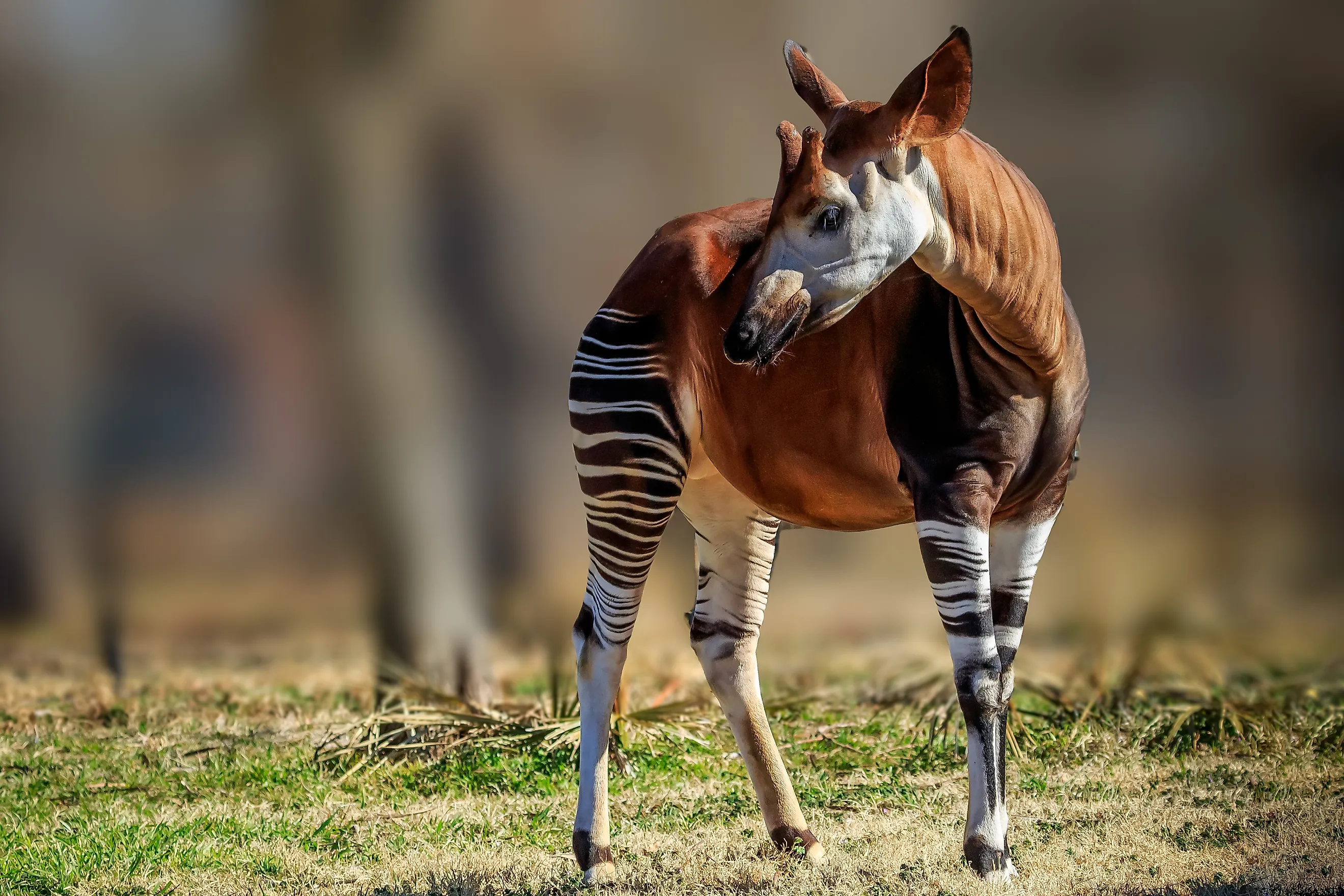
The okapi, native to the Democratic Republic of the Congo, looks like a creature assembled from several different animals. It has the striped hindquarters of a zebra, the compact build of a horse, and the elongated face of a giraffe. When European naturalists first received pieces of its hide in the late 1890s, they assumed it belonged to a new species of forest horse or zebra. A full skeleton recovered in 1901 by Sir Harry Johnston told a different story: the okapi was a giraffid. Long before that, the Mbuti people of the Ituri Forest were already familiar with the animal and knew it as the o’api. Today, the okapi is the only living relative of the giraffe, which is why it is sometimes called the forest giraffe.
Evolution Of The Okapi

During the Miocene epoch, the ancestors of the family Giraffidae diversified across Africa and Eurasia. Early giraffids were medium-sized forest herbivores without the towering necks and long limbs of modern giraffes. As Africa’s climate shifted and rainforests gave way to grasslands and savannas, the family split along two ecological paths.
One lineage moved into the open country, where feeding on high branches offered both food and a vantage point for spotting predators. Over time, this branch evolved the elongated legs and neck that define the modern giraffe.
The okapi’s ancestors stayed in the forest. A long neck would have been a liability among dense vines and low branches, so the okapi remained compact and agile. Because the Congo’s rainforests have remained relatively stable for millions of years, the okapi’s body plan has changed very little. Biologists sometimes describe it as a living fossil because it closely resembles ancestral giraffids such as Palaeotragus, which lived roughly 10 million years ago.
Taxonomy Of The Okapi

When Johnston first sent fragments of okapi skin to London, scientists assumed they belonged to a forest-dwelling zebra or horse. Only after a full skull and skeleton arrived did researchers recognize that the okapi was the closest living relative of the giraffe. It is classified in the Phylum Chordata and the Class Mammalia, and as an even-toed ungulate it belongs to the Order Artiodactyla and the Family Giraffidae. Its genus is Okapia and its species is Okapia johnstoni, named in Johnston’s honor.
At first glance, the okapi and the giraffe seem to share little. Closer inspection reveals several giraffid traits. Both have lobed canine teeth that help strip leaves, long dark prehensile tongues they use to grasp vegetation and groom themselves, and a pacing gait in which the two legs on the same side of the body move together.
Physical Description Of The Okapi

The okapi is a medium-sized ungulate that stands about 1.5 meters (5 feet) tall at the shoulder and weighs between 200 and 350 kilograms (roughly 440 to 770 pounds), with females generally heavier than males. Most of the body is covered in a dense, oil-rich coat that ranges from deep chocolate to purplish brown. The oil gives the fur a water-repellent quality, which matters in a habitat where rain falls nearly every day. Water beads off the coat rather than soaking in, which helps the okapi stay dry and reduces the risk of fungal skin problems.
The okapi’s most recognizable feature is the set of horizontal white stripes on its hindquarters and upper legs. These markings recall a zebra’s but serve a different purpose. In the dappled light of the forest understory, the stripes break up the animal’s outline, so what a predator sees is closer to a play of sunlight and shadow than a distinct body. The same pattern is thought to help calves follow their mothers through dense cover.
Other notable features include a prehensile tongue up to 18 inches long and large, independently rotating ears. Because visibility in the forest is often limited, hearing matters more than sight for detecting danger, and the okapi relies on subtle sounds to locate predators long before it can see them.
Male okapis carry short, backward-slanted ossicones, bony projections covered in skin and fur from birth. Females lack ossicones and instead have small knobby bumps on the forehead. The backward slant keeps the ossicones from catching on vines when the animal moves through thick undergrowth.
Range And Habitat

The okapi is endemic to the DRC. It occupies the central, northern, and eastern rainforests, with the Ituri Forest serving as its core habitat. The species prefers primary rainforest, where the canopy has not been logged or cleared, and it is generally found at elevations between 1,600 and 5,000 feet. These upland forests keep okapis above the softer, swampier lowlands and away from the open savanna, where their build leaves them at a disadvantage against fast predators.
Humidity in okapi habitat typically sits between 80 and 90 percent, and rainfall is high and consistent. That climate supports year-round vegetation growth, which in turn supports the okapi’s browsing diet. The same conditions make fieldwork difficult. Terrain is dense, visibility is poor, and okapi trails are narrow, so much of what biologists know about the species has been gathered indirectly through camera traps, dung analysis, and observations at protected sites such as the Epulu Station.
Okapi Behavior

Okapis are solitary for most of their lives, which sets them apart from the herd-living ungulates they are often compared to. For a long time they were assumed to be silent, but researchers have since documented low-frequency infrasonic calls that travel well through dense vegetation. Mothers use these calls to communicate with hidden calves, and males use them to locate potential mates without attracting leopards, their main natural predator.
Chemical signals also play a significant role. Scent glands on the feet leave a waxy substance on the forest floor as the okapi walks, which communicates identity, recent presence, and reproductive condition to other okapis passing through. Males reinforce territorial boundaries by spraying urine and rubbing their necks against trees. Okapis are active mainly during the day and spend most of their time on the move, feeding selectively across a wide range of plants.
Food And Diet

Okapis are specialized browsers that feed on more than 100 plant species, including leaves, buds, shoots, fruits, and fungi. Many of the plants in the Ituri Forest contain natural toxins that deter herbivores, but the okapi’s four-chambered stomach, similar in structure to a cow’s or a giraffe’s, allows it to break down these compounds during fermentation. Okapis also supplement their diet in unusual ways. They consume charcoal from lightning-struck trees and red clay from riverbanks, both of which absorb residual toxins while providing salts and trace minerals that leaves alone cannot supply. Bat guano is another occasional source of nutrients.
Reproduction

Mating is effectively the only time okapis actively seek one another out. A brief courtship involves circling and mutual sniffing, after which the pair separates. Gestation lasts around 14 to 15 months. Newborn calves weigh up to 60 pounds and can stand within 30 minutes of birth, but their early lives are anything but active. Calves spend the first several weeks in a concealed nest in the forest, remaining motionless for up to 80 percent of the time and not defecating at all during their first month. Both behaviors reduce the scent trail that predators could follow. The mother returns only to nurse and uses infrasonic calls to confirm that the area is safe. At about two months old, the calf begins to follow its mother as she browses.
Importance To The Ecosystem

The okapi is a flagship species for rainforest conservation in the DRC. Its image appears on the national currency and on the insignia of the country’s wildlife protection agency, the ICCN. For the Mbuti people of the Ituri, the okapi has long been a familiar forest animal and features in local oral tradition. Ecologically, the okapi contributes to the forest by feeding across a wide variety of plants and traveling long distances between feeding sites. Seeds that pass through its digestive tract are dispersed in its dung, which helps maintain plant diversity across the range.
Threats And Conservation

The okapi is classified as endangered by the IUCN. Population estimates are uncertain because of how difficult the species is to survey, but researchers believe numbers have declined by roughly 50 percent over the last 25 years. The pressures are almost entirely human. The DRC’s rainforests sit above significant deposits of coltan and gold, and illegal mining operations bring both habitat destruction and large informal populations that rely on bushmeat. The Okapi Wildlife Reserve headquarters in Epulu was attacked by a Mai-Mai militia group in June 2012, and fourteen captive okapis held at the station were killed during the raid along with several staff members. Poaching for meat and hides continues in the reserve and in surrounding forests.

Conservation efforts focus both on the animals and on the communities living around the reserve. The Okapi Conservation Project, working alongside the ICCN, supports anti-poaching patrols, snare removal, and habitat monitoring, while also investing in sustainable agriculture, healthcare, and clean water for nearby villages. Reducing reliance on forest resources is a central part of the strategy, since local pressure on the habitat is directly tied to local livelihoods.
The Forest Giraffe
The okapi is one of the most biologically distinctive mammals on the African continent. It preserves a body plan that has remained largely unchanged for roughly 10 million years, and it is the only surviving relative of the giraffe, which makes it an important reference point for understanding giraffid evolution. It is also one of the clearest examples of how closely a species can be tied to a single landscape. Everything about the okapi, from its waterproof coat to its infrasonic calls to its reliance on riverbank clay, is shaped by the specific conditions of the Congo rainforest. Its future depends on the future of that habitat, and on the continued work of the rangers, researchers, and communities who share the Ituri with it.