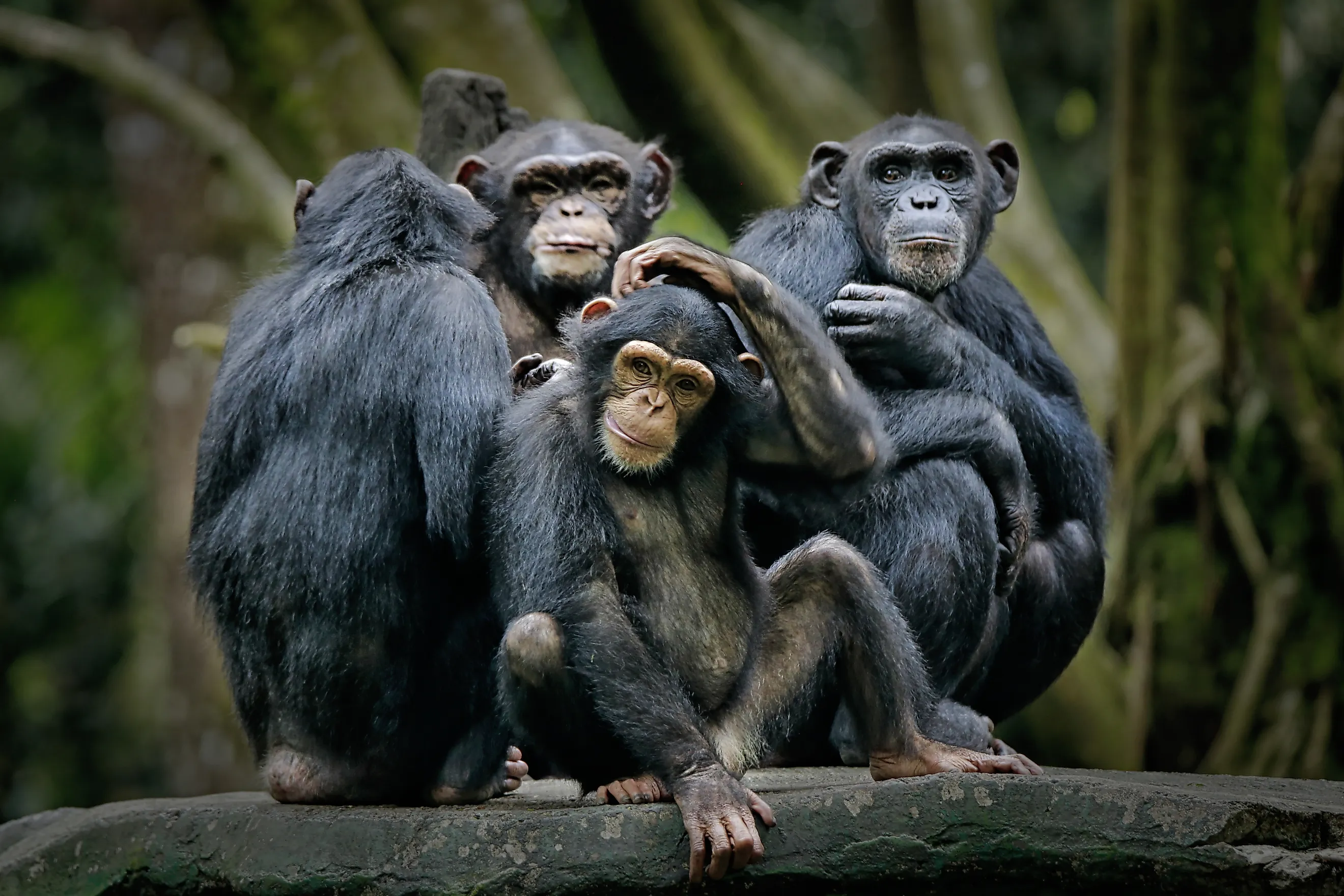
Chimpanzee
The chimpanzee, or Pan troglodytes, is our closest living relative alongside the bonobo. As members of the Hominidae family, humans and chimps split from a common ancestor roughly 6 to 7 million years ago and still share about 98.8% of their DNA. That evolutionary closeness has made chimpanzees a primary subject of research in primate cognition, social behavior, and human evolution. Four subspecies live across equatorial Africa in habitats ranging from rainforest to open savanna. All subspecies are classified as endangered, with some populations facing critical declines.
Taxonomy and Subspecies

The genus name Pan comes from the Greek god of wild places, while the species name troglodytes is Greek for "cave dweller," a label carried over from early European naturalists who misunderstood where the animals lived. Chimpanzees sit in the Phylum Chordata, Class Mammalia, and Order Primates. Four subspecies are recognized: the central, western, eastern, and Nigeria-Cameroon chimpanzee. They share most traits but differ in body size, vocalizations, coloration, and preferred habitat.
Evolutionary History

Early primate-like mammals called plesiadapiforms resembled modern tree shrews and squirrels, though the fossil record is fragmented enough that much about them remains open. True primates appear in the Eocene Epoch across Africa, Europe, Asia, and North America. These early primates resembled lemurs, and many lineages went extinct by the end of the epoch. The survivors gave rise to the anthropoid monkeys, which diversified during the late Eocene and the Oligocene.
Monkeys appeared in both the New and Old Worlds, though where the New World group originated is still debated. New World monkeys are classified as Platyrrhini and Old World monkeys as Catarrhini. The African catarrhines gave rise to apes around 25 million years ago. Apes split into lesser and great apes, with the great ape genera being Pan, Gorilla, Pongo, and Homo: chimpanzees and bonobos, gorillas, orangutans, and humans.

Humans and chimpanzees shared a common hominoid ancestor roughly 6 to 7 million years ago. Some populations adapted to more open habitats and eventually contributed to the evolution of the genus Homo, while others remained in the forests of Central and West Africa and gave rise to modern chimpanzees. The split between chimpanzees and bonobos is more recent. Genetic and geological evidence point to a divergence around 1.5 to 2 million years ago, most likely linked to the formation of the Congo River. As the river widened, ancestral Pan populations could no longer cross it. Those north of the river became common chimpanzees, and those south of it became bonobos in a process called allopatric speciation.
Physical Characteristics

Chimpanzees have stocky bodies with arms longer than their legs. Coarse black hair covers most of the body, leaving the face, ears, palms, and soles bare. The long arms let them swing through the forest canopy, a movement called brachiation. On the ground, they knuckle-walk. Their hands have opposable thumbs for gripping small objects, and their feet have opposable big toes that help with climbing. Chimps have long pelvises with extended ilia, round heads with forward-facing eyes, small noses, and pronounced brow ridges. Adult males carry sharp canine teeth.
Males are typically larger and more muscular than females. They weigh 40 to 70 kilograms (about 88 to 154 pounds) and stand up to roughly 1.6 meters, or a little over 5 feet, when upright. Chimpanzees are significantly stronger than humans relative to their size, a trait that matters when they defend territory or contest rank within the group. With age, skin pigment darkens and hair grays.
Behavior

Chimpanzees live in groups called communities or unit groups. A community forms around bonds between adult males and can include more than 100 members. Home ranges vary from a few square kilometers in dense forest to hundreds of square kilometers across the savanna. Males stay in the community they were born into for life. Females usually leave around age 11 to join a neighboring group.
Neighboring communities are often hostile. Intruders may be attacked, and adult males have been observed committing infanticide and, rarely, cannibalism. Chimpanzees also cooperate in conflict and form alliances. This can result in social exchange, with grooming and meat-sharing associated with mating access.

Chimpanzees are highly intelligent. Some captive individuals have been trained to use sign-based or symbolic communication systems. In the wild, they communicate with grunts, roars, screams, and hoots, and excited males stamp or sway while standing erect. They also use tools: stones to crack nuts, sticks shaped into probes for fishing termites out of mounds, and leafy twigs to inspect or feel out unfamiliar objects.
Breeding

Chimpanzees breed year-round. Females cycle about every 36 days and typically give birth every four to six years after a gestation of roughly eight months. Single births are the norm, and twins are rare. First-time mothers often learn by watching experienced ones. A mother carries her infant almost continuously for the first several months, and the baby usually starts to walk around six months of age. When the next infant arrives, the older sibling becomes more independent.
Range and Habitat

Chimpanzees are native to West and Central Africa. Their range runs through the equatorial belt, from the Atlantic coast in the west to the shores of Lake Tanganyika in the east. They prefer dense tropical rainforest but also live in open woodlands, mosaic savannas, and higher-elevation montane forests. Home ranges tend to be smaller in the Congo basin, where food is abundant year-round, and larger in drier, more seasonal habitats.
Dietary Habits

Fruit makes up the bulk of a chimpanzee's diet, supplemented by leaves, flowers, seeds, and bark. They are also opportunistic hunters and will pursue smaller monkeys, bushpigs, and young antelopes when the chance arises. Alpha males often share meat with allies and receptive females within the community's dominance hierarchy. High-protein insects such as ants and termites round out the menu.
Importance

Chimpanzees play an important ecological role as seed dispersers in African forests. They eat large amounts of fruit and travel long distances, dispersing seeds that help regenerate the African rainforest. Many seeds germinate at higher rates after passing through a chimp's digestive tract. Without chimpanzees, plant diversity in these forests would drop noticeably.
Chimpanzees have also been central to comparative research on human biology. Research into their genetics and behavior has shaped work in medicine, psychology, and anthropology. Studies of chimps have contributed to what we know about the origins of language, aggression, cooperation, and aspects of the human immune system.
Threats and Conservation

Despite their close relationship with humans, chimpanzees are listed as endangered on the IUCN Red List. Estimates of the remaining wild population range from about 170,000 to 300,000, down from populations that were once significantly higher. Habitat loss is the leading pressure, driven by commercial logging, agricultural expansion, and mining. As African forests fragment, chimpanzee populations become more isolated and encounters with humans grow more frequent.

Poaching is another serious threat. Adult chimpanzees are killed for bushmeat, and infants are captured for the exotic pet trade, a process that typically requires killing the mother and other group members.
Chimpanzees are also vulnerable to human diseases. Respiratory infections and the Ebola virus have wiped out entire communities in the wild. As human activity pushes deeper into forest habitats, the risk of disease transmission in both directions rises. Conservation work focuses on protected corridors linking fragmented forests, stronger anti-poaching enforcement, and community-based education programs.
Chimpanzees in Research and Conservation

Decades of field and laboratory research have documented chimpanzees as highly intelligent and socially complex primates. Scientists study their problem-solving, social dynamics, and infant care as part of broader research into primate and human evolution. Chimpanzee populations continue to face pressure from habitat loss, hunting, and disease transmission, and long-term outcomes for the species depend on the scale and success of ongoing conservation efforts.