Burmese Python
The Burmese python (Python bivittatus) is one of the largest snakes on Earth. Wild adults regularly top 16 feet, and a 19-foot, 125-pound female pulled from Big Cypress National Preserve in July 2023 is the longest reliably documented in Florida. The species is native to South and Southeast Asia, where it has been hunted, traded, and held in cultural and religious significance for centuries. It is better known now for the breeding population that has spread across the Florida Everglades since the late 20th century. The invasion was seeded by escaped and released pets and has become one of the most studied reptile invasions in modern history.
Taxonomic Classification

The Burmese python belongs to the family Pythonidae, the group of nonvenomous constricting snakes native to Africa, Asia, and Australia. Its full classification places it in the genus Python alongside relatives like the reticulated python and the African rock python. Until 2009, the Burmese python was considered a subspecies of the Indian python (Python molurus) under the name Python molurus bivittatus. Genetic and morphological research published that year supported elevating it to full species status, and most authorities now treat the two as separate species. Smaller island populations, sometimes called "dwarf" Burmese pythons and found on islands such as Java and Bali, are generally treated as regional variants. Some authors have proposed taxonomic distinctions for these populations, though the proposals are not widely accepted.
Range and Habitat

The Burmese python's native range stretches from eastern India, Bangladesh, and Myanmar in the west, eastward through southern China, Thailand, Laos, Cambodia, and Vietnam. Additional populations occur in parts of Indonesia. The snake favors lowland habitats near water. Marshes, swamps, mangrove forests, river valleys, and the edges of rice paddies all hold populations across the native range. Juveniles spend a fair amount of time in trees; heavier adults stay closer to the ground. Even large specimens swim well and have been observed crossing wide stretches of open water.

The species occupies a broader range of habitats than many comparable snakes. Forested foothills, agricultural margins, and open grasslands all support populations, and the snake tolerates landscapes modified by humans. That tolerance is part of what made the Florida invasion possible. The earliest verified Florida sightings date to the late 1970s, but a reproducing population in Everglades National Park was not officially recognized until 2000. Since then, Burmese pythons have spread across most of the southern peninsula, with documented populations in Everglades National Park, the Florida Keys, and as far north as Lake Okeechobee. Cold winters historically limited their northward spread, though the long-term limits of that constraint remain under study by University of Florida researchers and the US Geological Survey.
Physical Description

Adult Burmese pythons typically reach 10 to 16.5 feet (3 to 5 meters) in length, with females growing larger than males on average. The longest reliably documented wild specimen in Florida, captured in Big Cypress National Preserve in July 2023, measured 19 feet (5.8 meters) and weighed 125 pounds (57 kilograms). The species reaches even greater mass in captivity. A female named "Baby," kept at Serpent Safari in Gurnee, Illinois until her death in 2006, was confirmed by Guinness World Records as the heaviest snake on record at 403 pounds (183 kilograms) and 18 feet 10 inches. The body is heavy and muscular, with a relatively small head set off from the neck.

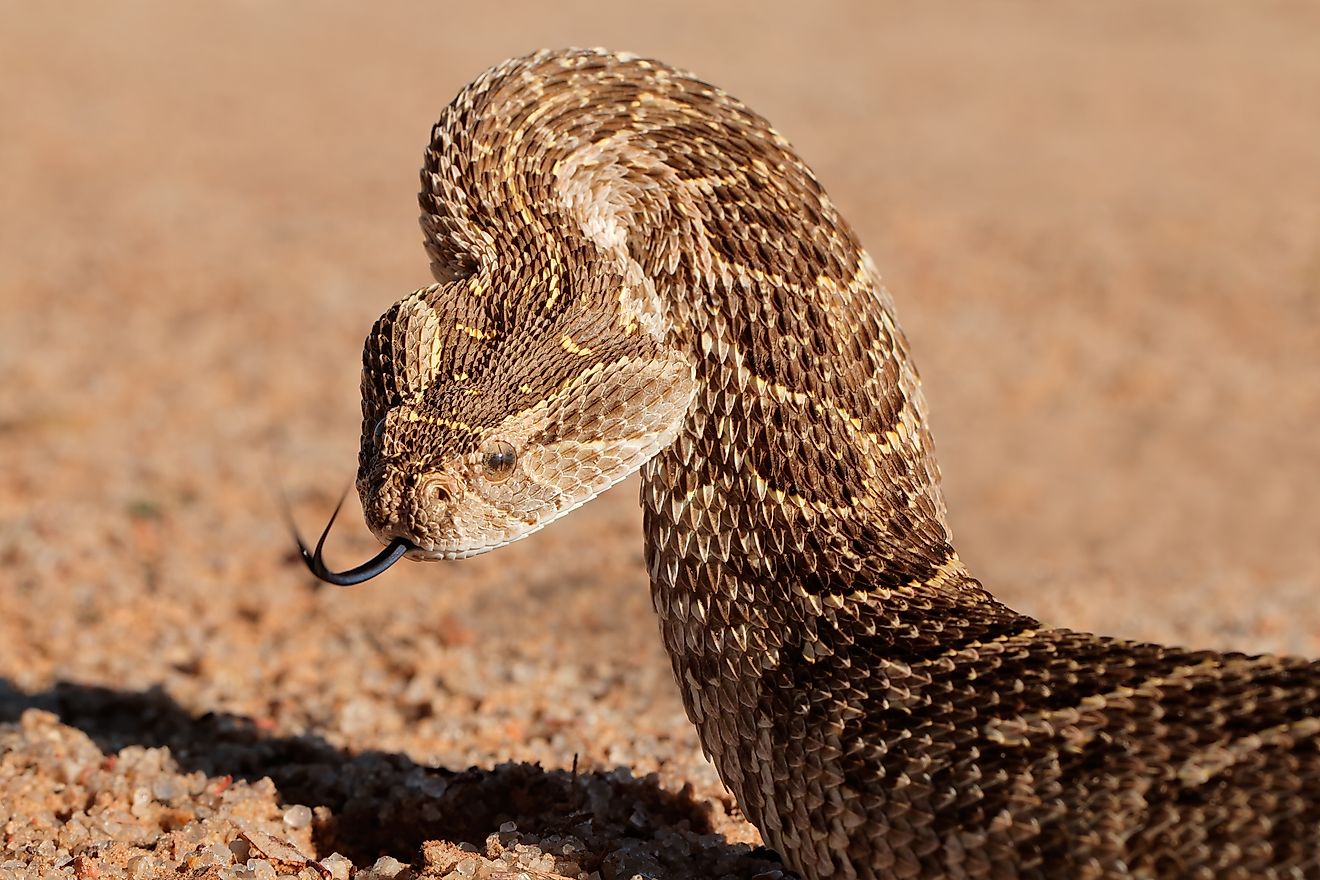
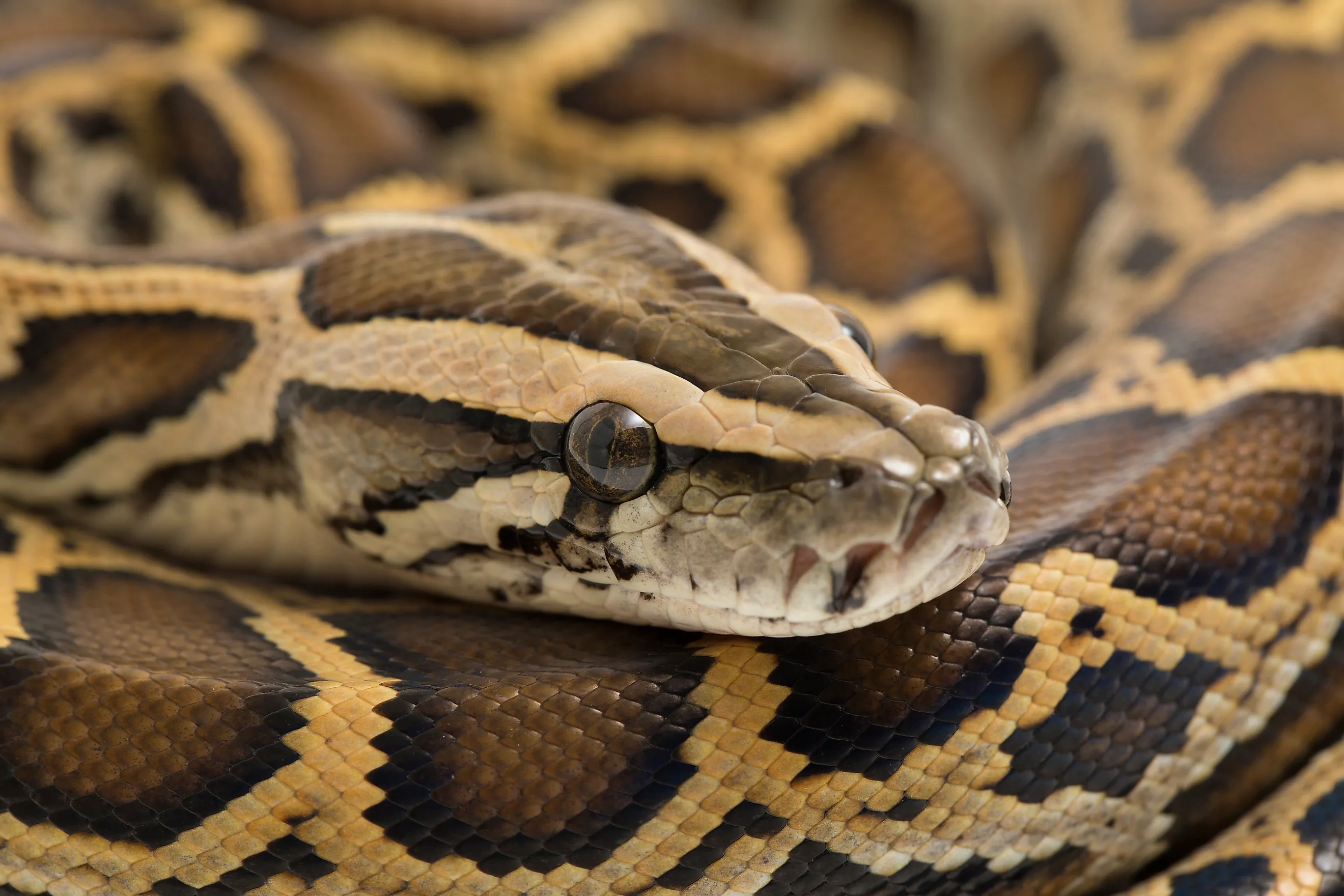
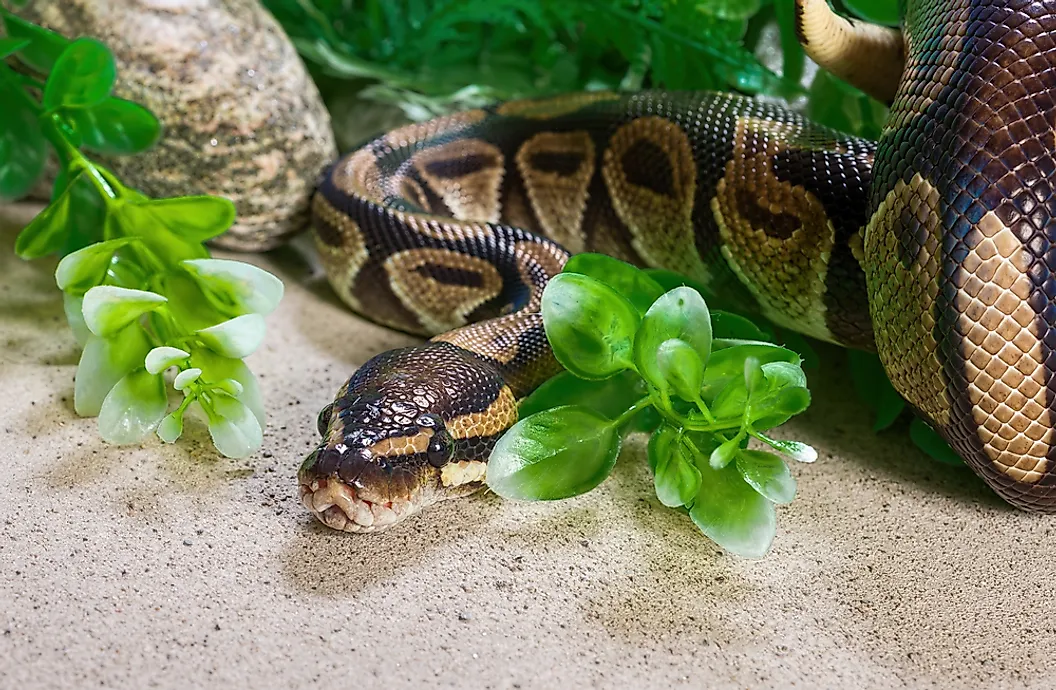
Wild Burmese pythons display a distinctive pattern of dark brown blotches outlined in black, set against a tan or yellowish background. The head carries a characteristic arrowhead-shaped mark and a dark line running from the eye back along the side of the face. Captive breeders have produced a wide range of color morphs over the past several decades, including albino, granite, caramel, and labyrinth patterns. Many of the snakes now living wild in Florida show evidence of mixed pet-trade ancestry.
The snake's sensory equipment includes well-developed heat-sensitive pits along the upper and lower jaw, allowing it to detect warm-blooded prey in complete darkness. Its tongue, flicked rapidly through the air, picks up scent particles processed through the vomeronasal or Jacobson's organ in the roof of the mouth. Vision is reasonable but secondary, and hearing is limited to low-frequency vibrations carried through the ground.
Behavior

Burmese pythons are primarily nocturnal and ambush-oriented. They spend long periods motionless in cover, waiting for prey to pass within striking range, then deliver a sudden bite followed by constriction. Once the prey stops moving, the snake swallows it head-first, working it down its throat using a combination of jaw flexibility and rhythmic muscular contractions. A large meal can sustain an adult for weeks or even months. Digestion raises the snake's metabolic rate substantially during that period, with documented mass increases of roughly 35 to 150 percent across the heart, liver, small intestine, and kidneys before the organs return to baseline once the meal has been processed.
Outside of feeding and breeding, Burmese pythons spend most of their time alone. They are generally non-aggressive toward humans unless provoked or surprised at close range, and bites from wild specimens are rare. The species is widely kept in private collections, where its docile temperament has historically made it one of the more commonly sold large constrictors. That same temperament, combined with a hatchling size that fits in a small enclosure, contributed to the species' initial popularity and to the eventual release of unwanted adults from which the Florida population grew.
Food

The Burmese python's diet is broad and shifts with the size of the snake. Hatchlings and juveniles feed largely on small mammals, lizards, frogs, and birds. Adults take much larger prey, including raccoons, opossums, deer, alligators, wild pigs, and domestic livestock on rare occasions. Documented Florida prey includes white-tailed deer fawns and adult bobcats. In a widely reported 2018 study published in Herpetological Review, an 11-foot female found in Collier-Seminole State Park in 2015 had consumed a 35-pound white-tailed deer fawn that exceeded the snake's own 31.5-pound body mass, the largest predator-to-prey ratio documented for any python species at the time.
The hunting strategy depends on stillness and surprise. Ambush sites tend to cluster near game trails, water edges, and areas where prey concentrates. After a successful kill, the python may remain at or near the kill site for several days, particularly if the meal is large enough to limit mobility. Cannibalism has been documented in both wild and captive populations, though it is uncommon.
Reproduction

Burmese pythons reach sexual maturity between four and five years of age in the wild, sometimes earlier in captivity. Breeding takes place in late winter and spring, and males locate females by following pheromone trails. After mating, the female gestates for two to three months before laying a clutch that typically contains 30 to 50 eggs, with exceptional clutches reaching over 100. The Burmese python is one of the relatively few snake species capable of facultative endothermy, in which the female coils around her clutch and produces metabolic heat through rapid muscular contractions to maintain incubation temperature. She remains with the eggs for the entire incubation period and does not feed during that time.
Hatchlings emerge at about 18 to 24 inches (45 to 60 centimeters) in length and are entirely independent from the moment they break free of the egg. Survival rates in the wild are low, with hatchlings often falling to predators including birds of prey, larger snakes, and small carnivores. Those that do survive grow rapidly during their first few years, sometimes doubling in length annually under favorable conditions. Lifespan in the wild typically ranges from 20 to 25 years, with longer lifespans recorded in captivity.
Importance to the World
In its native range, the Burmese python plays a regulating role in mammal and bird populations and serves as occasional prey for tigers, leopards, and large birds of prey when the snake is small enough to be taken. Communities across South and Southeast Asia have used python skin, meat, and fat for various purposes over many centuries, and the snake holds religious or cultural significance in some local traditions, appearing in regional folklore that stretches back hundreds of years.
The species also carries economic weight through the legal and illegal trade for skins, meat, and live animals. CITES Appendix II protections have applied to the species since the late 20th century, restricting international commercial trade and requiring permits for legal export. Despite those restrictions, illegal trade continues across parts of the native range, with seizures of live snakes and processed skins reported regularly by enforcement agencies in Asia and at international ports of entry.
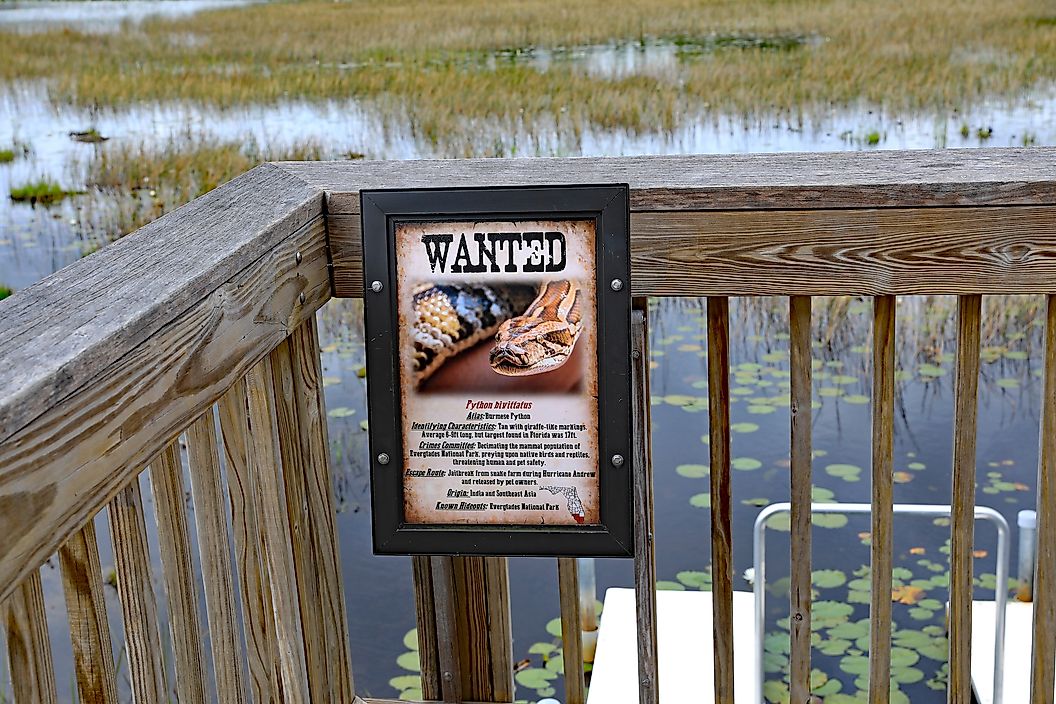
In Florida, the python has become a focal case in invasive-species research. A widely cited 2012 USGS-led study documented sharp declines in mid-sized mammal populations across Everglades National Park since the python population established itself, with raccoon road-survey detections down 99.3 percent, opossum detections down 98.9 percent, and bobcat detections down 87.5 percent compared with pre-invasion data. The state-run Florida Python Challenge, a public hunt program managed by the Florida Fish and Wildlife Conservation Commission, first ran in 2013 and has been held annually since 2020. The combined removal effort across the FWC's Challenge events, contractor program, and partner districts has accounted for more than 22,000 pythons taken from the wild since 2000, making it one of the most visible invasive-species management efforts in the United States.
Threats

Within its native range, the Burmese python faces pressure from habitat loss, hunting for skins and meat, and capture for the pet trade. The International Union for Conservation of Nature has listed the species as Vulnerable on its Red List since 2012, with population declines estimated at more than 30 percent across the first decade of the 21st century. Conservation efforts in the native range include captive breeding programs, anti-poaching enforcement, and habitat protection within national parks across the snake's distribution. The contrast between the snake's vulnerable status in Asia and its invasive status in Florida is one of the more unusual situations in modern reptile conservation, and it reflects how dramatically the same species can fare across different ecosystems.
The Future of the Burmese Python

Few species illustrate the consequences of the global pet trade more clearly than the Burmese python. In the wetlands and rice paddies of South and Southeast Asia where the species evolved, populations are shrinking under pressure from poachers, traders, and the steady erosion of native habitat. In the marshes of southern Florida, where the same species has no natural predators and an effectively unlimited prey base, populations have grown into one of the most studied invasive populations in the world. Both stories trace back, in part, to the same human industry that exported tens of thousands of hatchlings out of Asia for the international pet market across the late 20th century, and to the released or escaped adults that founded the Florida population. Whether managers can keep the Florida invasion contained and whether the native populations recover under stricter trade enforcement will define the next chapter for one of the largest snakes on Earth.