Siberian Tiger
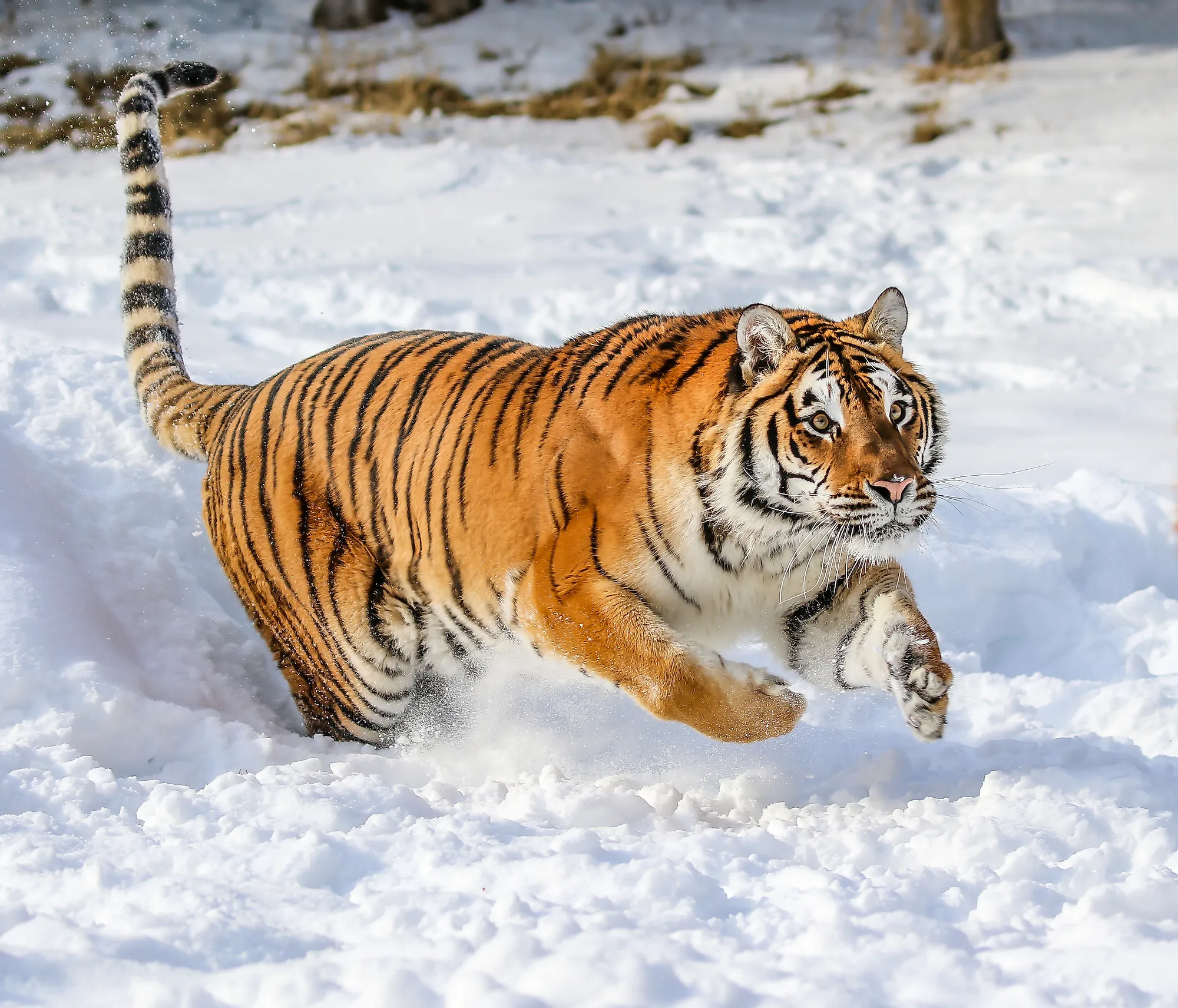
The Siberian tiger is the largest cat alive today. Adult males average around 400 pounds with the heaviest individuals weighing well over 500. Body length runs roughly nine to ten feet including the tail. The cats live in the snowy birch forests of the Russian Far East with smaller numbers across into northeast China. They are the only tigers that regularly hunt in deep snow. Fewer than a thousand remain in the wild today.
Taxonomy

Siberian tigers belong to the Phylum Chordata, Order Carnivora, Family Felidae, and the Genus Panthera. In 2017, the Cat Classification Task Force of the IUCN Cat Specialist Group revised tiger taxonomy. Genetic and morphological research collapsed the previous nine subspecies into two recognized subspecies. These are Panthera tigris tigris (which includes the Bengal, Caspian, Malayan, Indochinese, South China, and Siberian populations) and Panthera tigris sondaica (which includes the Sumatran, Javan, and Bali tigers).
However, subsequent whole-genome sequencing research suggests that the six living tiger populations are genetically distinct enough that some authorities still maintain separate subspecies names. Many conservationists and regional governments continue to use the scientific name Panthera tigris altaica for the Siberian tiger to mark its distinct population history relative to the Bengal or Malayan tigers.
The name Panthera tigris altaica reflects the genus and geographic history of the cat. Panthera traces back to a Greek word that has been variously interpreted as "all-beast" or "hunter". Tigris is from the Greek word for tiger and is sometimes connected to an old Persian root meaning "arrow" in reference to the tiger's speed. Altaica refers to the Altai Mountains of Central and East Asia where the tiger's ancestors once roamed.
Evolution

Fossil evidence suggests that the earliest tiger ancestors appeared in Asia around two million years ago during the Pleistocene epoch. Early tiger fossils have been found across South Asia and modern tigers likely evolved from those ancient populations. Genetic studies show that all living tiger populations including the Siberian tiger share a common ancestor that lived less than 100,000 years ago. The Siberian tiger diverged as a distinct population by adapting to the frigid climate of the Russian Far East. As a result it has a larger body and thicker fur than other tigers. Its stripes are also paler and no two Siberian tigers carry exactly the same pattern. These features help the cat retain heat and stay camouflaged in the snow.
Physical Description

In addition to paler stripes and thicker fur the male Siberian tiger averages 195 centimeters in length and weighs around 389 pounds (176 kilograms). Exceptional individuals have grown more than 3 meters in length and weighed more than 660 pounds (300 kilograms). Females are smaller and weigh less than males. Siberian tigers also have thick neck manes and more fur on their paws than other tigers as added insulation against the cold. Adult tigers have 30 teeth in total. The four large canines are used to hold and kill prey while the incisors strip meat from bone.
Behavior and Habitat

Siberian tigers are territorial and prefer solitude. They spread out over large areas to find food and mark rocks and trees to establish their territory. Males are typically more aggressive in defending it but allow females to overlap on theirs. Tigers often frighten people because of their sheer size but tiger attacks are rare. When they do happen it may be because a female is protecting her young or because an old or sick tiger can no longer hunt in the wild.
Siberian tigers live in the eastern region of Russia mainly in the birch forests. Smaller populations are also found in northern China and possibly North Korea. The cats survive the cold well and their habitat is generally far from human populations. There is also more room for them to roam in the woods of Russia but illegal logging and timber exports to China are major threats to that habitat.
Diet

Siberian tigers don't eat every day. They feed in irregular cycles taking large meals when prey is available. A single tiger can eat up to 50 kilograms in one feeding which works out to roughly 9 kilograms per day on average across feedings. Wild boar make up about half of the tiger's diet and the cats also hunt deer, elk, lynx, and bears. When larger prey are scarce Siberian tigers will hunt rabbits, rodents, and fish. Tigers use their excellent night vision (often cited as around six times better than human vision) along with strong senses of smell and hearing. They can run up to 50 miles per hour in short bursts but cannot sustain those speeds for long which is why only about one in ten chases ends in a kill.
Reproduction
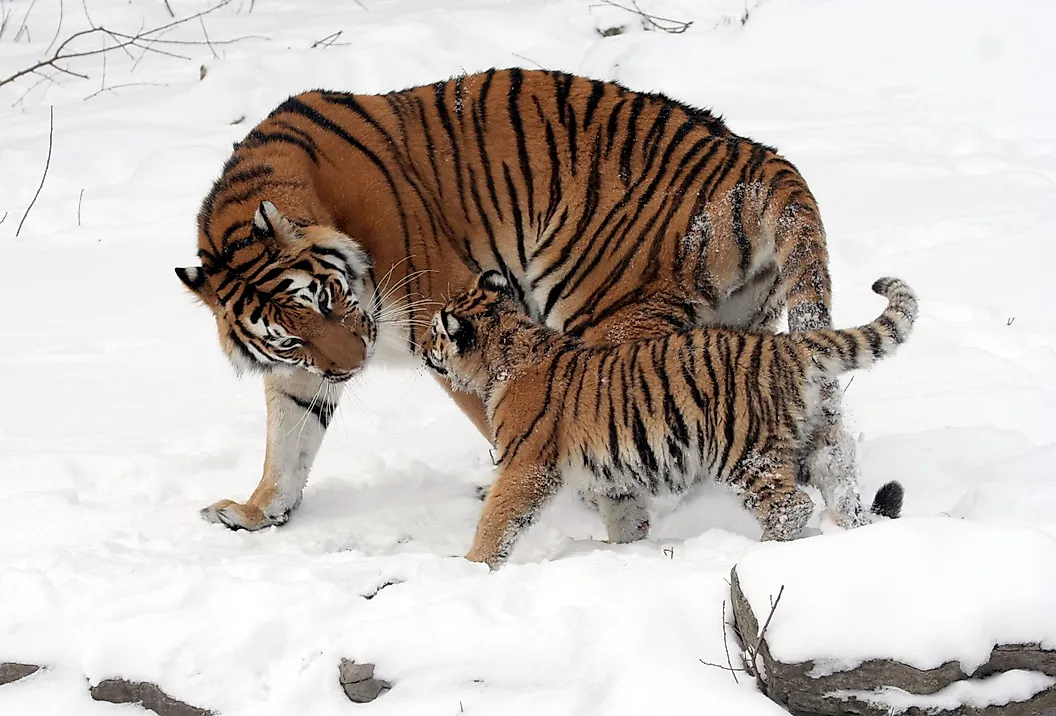
Siberian tigers come out of solitude to interact during the breeding season. Mating typically happens during the winter months between November and April though it can happen year-round. When a female is ready to mate she roars or moans and increases her urine scent-marking. Female tigers are induced ovulators which means mating triggers the release of an egg. Mating occurs multiple times an hour over several days to ensure fertilization. Males and females are both polygamous and will mate with several different partners over their lives.
The gestation period for a Siberian tiger is three to three and a half months and a typical litter consists of 2 to 4 cubs. Before giving birth the female will find a den in a protected place such as a cave or rock crevice. Males do not help rear the young. Cubs are born blind and toothless. Their eyes open between 6 and 14 days and they begin eating meat from as early as six weeks. Between the ages of 6 and 18 months cubs learn to hunt and they can typically hunt on their own by age two. The cub mortality rate runs around 50% due to extreme weather, predation, and starvation.
Importance
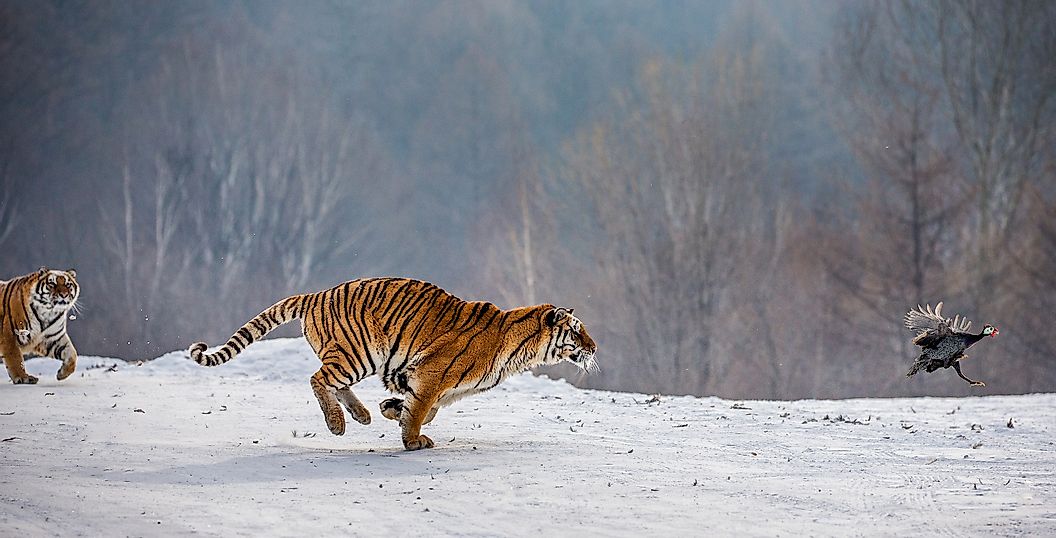
Siberian tigers are apex predators that help maintain the balance of their ecosystem by keeping prey populations in check. By limiting herbivore numbers they prevent overgrazing and allow the forest to regenerate. A healthy forest in turn supports birds, insects, and other species and stores more carbon. The Udege and Nanai people of the Russian Far East consider the tiger the "Amba" or Grandfather of the Forest and revere it as a protector of the woods. In Korea the tiger is sometimes seen as a messenger of the mountain spirits and a guardian. In China the tiger represents one of the zodiac animals.
Threats and Conservation
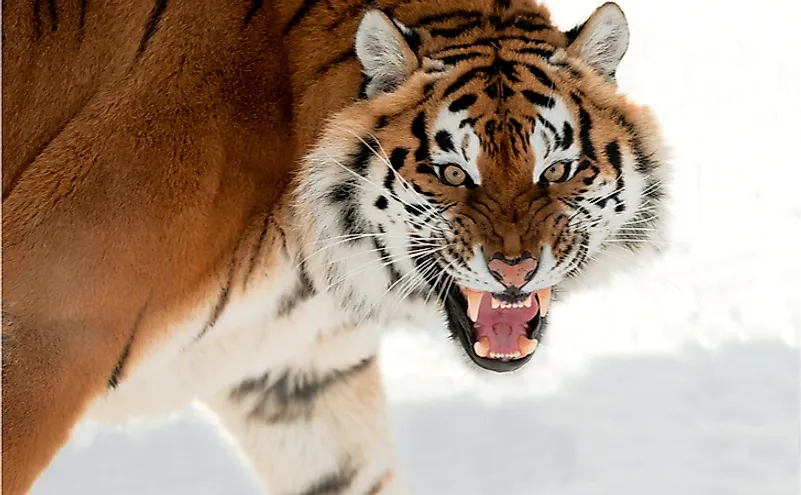
The Siberian tiger is listed as endangered. The most recent surveys put the wild population at roughly 480 to 540 individuals across the Russian Far East with a small number of cats also ranging into northeast China and possibly North Korea. The IUCN Red List 2022 assessment estimated 265 to 486 mature individuals in Russia. Several hundred more live in zoos worldwide. Humans are the biggest threat. Poaching for the body-parts trade continues despite a hunting ban that has been in place in Russia since 1947. When tigers run short of wild prey they sometimes turn to livestock which puts them in conflict with people. Conservation teams patrol tiger territories looking for poachers and penalties have been increased. Eco-corridors have also been added to keep habitats from fragmenting further. The Narvinsky Tunnel in Russia for example runs for half a kilometer and lets the cats cross a busy road safely. Population trends since the 1990s have been cautiously positive even as poaching and logging keep the species at risk.
Ensuring a Future for the Siberian Tiger
The Siberian tiger is in trouble and it will take long-term effort to keep the population on its current path. The recovery from a low of around 30 cats in the 1940s to several hundred today is real progress. The threats of illegal hunting, poaching, and habitat loss have not gone away. Continued anti-poaching enforcement, expanded eco-corridors, and protected forest are what will keep the species going.