Poison Dart Frog
The poison dart frogs are a group of small amphibians known for the high toxicity of their skin secretions. Native to the tropical rainforests of Central and South America, these frogs play an important role in their forest ecosystems by keeping insect populations in check. For centuries, indigenous peoples of the Pacific lowlands of Colombia have used the secretions of a few species to poison the tips of blowgun darts for hunting. Their bright colors, varied behavior, and unusual reproductive habits make poison dart frogs one of the most distinctive amphibian groups in the world.
Taxonomic Classification

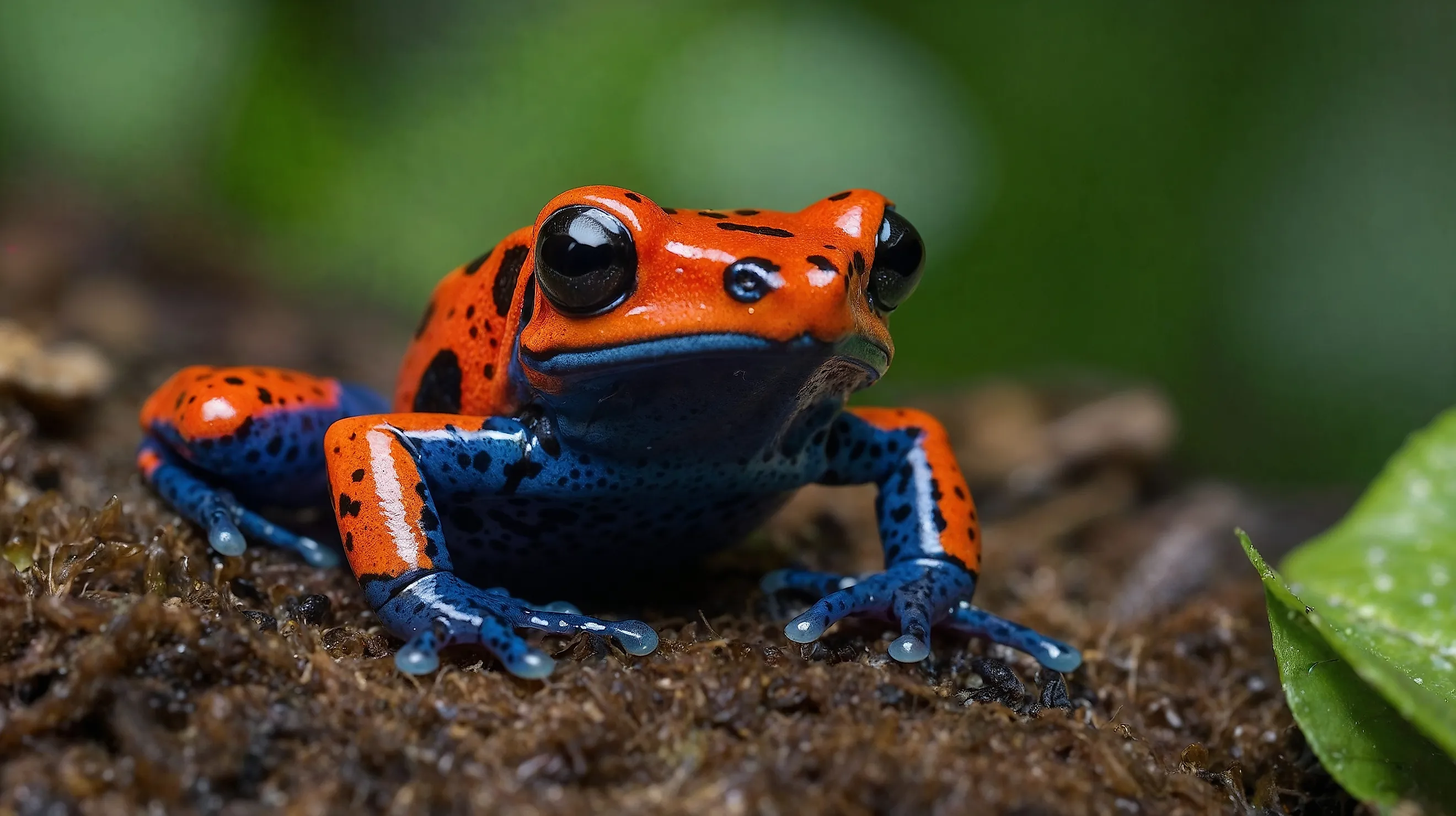
Poison dart frogs are amphibians of the family Dendrobatidae, identified by their bright colors and active daytime habits. The vivid coloration is an example of aposematism: a visual warning to predators that the animal is unpalatable or toxic. Not every dendrobatid is dangerous; toxicity varies widely across the family, and many species carry only weak alkaloids or none at all. The most potently toxic species belong to the genus Phyllobates, and only three of them, all native to western Colombia, are known to have been used for poisoning blowgun darts.
Range And Habitat

Poison dart frogs occur from southern Nicaragua and Costa Rica through Panama and into northern South America, including Colombia, Venezuela, Ecuador, Peru, the Guianas, and northwestern Brazil. A small introduced population of strawberry poison frogs (Oophaga pumilio) has also been recorded on the island of Hawaii's Manoa Valley, the result of a 1932 release. Poison dart frogs prefer humid tropical climates, particularly the leaf-littered floors of lowland and mid-elevation rainforests near streams and small pools.
Physical Description

Most poison dart frogs are small, ranging from about 1.5 centimeters (0.59 inches) to 6 centimeters (2.4 inches) in adult length, with an average weight of about 28 grams. The bright skin warns predators of the alkaloid toxins held in glands beneath the surface, which the frog can release if attacked. There are more than 200 species in the family Dendrobatidae, distributed across roughly 16 genera.

The largest species in the family is the golden poison frog (Phyllobates terribilis), endemic to a small range of lowland rainforest on Colombia's Pacific coast. Adults reach roughly 5 to 6 centimeters in length and can weigh close to 30 grams; females are typically larger than males. It is also the most toxic. Its skin secretions are rich in batrachotoxin, a steroidal alkaloid that blocks the inactivation of voltage-gated sodium channels in nerve and muscle cells, leading to paralysis and heart failure if it enters the bloodstream. A single wild adult is estimated to carry enough toxin to kill ten to twenty adult humans, or about 20,000 mice. The species is listed as Endangered on the IUCN Red List.
Diet

Poison dart frogs hunt during the day, using sharp eyesight and sticky tongues to catch ants, termites, mites, beetles, and other small invertebrates. The frogs do not synthesize their toxins themselves. Instead, they sequester alkaloids from their prey, particularly from certain ants, mites, and small beetles. Researchers have suggested that beetles in the family Melyridae may be a key dietary source of batrachotoxin in golden poison frogs.
Poison dart frogs raised in captivity, fed standard feeder insects such as fruit flies and crickets, lose toxicity over time and frogs bred in captivity are effectively non-toxic. Wild-caught animals retain measurable toxicity even after years in captivity, but their levels decline. The biological mechanism by which the frogs absorb, transport, and store these alkaloids without poisoning themselves is still being studied; recent research points to specialized binding proteins that ferry the toxins to the skin glands while sparing the frog's own neuromuscular system.
Reproduction

Reproductive behavior in poison dart frogs is unusual among amphibians. In several species, including those in the genus Dendrobates, females compete for mates rather than the other way around. A male advertises with calls; arriving females may compete physically for breeding access. The successful female taps or rubs the male, who then leads her to a chosen oviposition site, often a leaf surface or a sheltered spot on the forest floor. The pair clean the surface together before the female deposits eggs and the male fertilizes them externally.
Clutch size varies by species but is typically small, on the order of 5 to 40 eggs. Parental care is well developed compared to most frogs.

One or both parents guard the eggs and keep them moist with bodily secretions. Specific roles vary by species: in some, the male tends the clutch; in others, the female does; in still others, both share the work.

After roughly two weeks, the eggs hatch and tadpoles wriggle onto the back of an attending parent, who carries them to water: a forest pool, a stream backwater, or in some species the small water pocket at the base of a bromeliad. Metamorphosis takes a few months. Front legs typically appear first while the tail is reabsorbed, and the new frogs leave the water as miniature adults.
Significance For Humans

The common name "poison dart frog" comes from the practice of indigenous peoples in western Colombia who use the secretions of three Phyllobates species to poison the tips of blowgun darts. The Emberá Chocó and the Noanamá Chocó have used Phyllobates aurotaenia, Phyllobates bicolor, and the golden poison frog (P. terribilis) in this way, with the species used varying by region. The use is documented in the Río San Juan and Río Saija drainages on the Pacific slope of the Andes.

Methods differ by species. P. aurotaenia and P. bicolor, which are less toxic than P. terribilis, are typically impaled on a stick passed through the mouth and out a hind leg, then held near a fire so that secretions are released onto the dart tip. P. terribilis is so much more toxic that handlers do not need to kill the frog at all: the dart is simply rubbed across the skin of a living frog, often kept in a covered basket or wedged between two leaves while the dart is dressed. A single golden poison frog can supply enough toxin to coat 30 to 50 darts, which remain potent for about a year.

The toxin itself is also of interest to medicine. Compounds isolated from dendrobatid skin secretions have shown promise as templates for new painkillers and other drugs. Epibatidine, isolated from Epipedobates anthonyi (formerly E. tricolor), is a non-opioid analgesic that proved roughly 200 times as potent as morphine in animal studies. A synthetic derivative, ABT-594 (tebanicline), reached Phase II human trials before being dropped because of severe gastrointestinal side effects. Research on related dendrobatid alkaloids continues, with applications under investigation as muscle relaxants, cardiac stimulants, and appetite suppressants. Captive-bred poison dart frogs, which are non-toxic, are also widely kept by hobbyists and zoos.
Threats

Many dendrobatid species are in decline. Habitat loss from logging, agricultural expansion, and mining reduces and fragments the rainforests they depend on; pollution and pesticide runoff degrade the streams and pools used for breeding. The illegal pet trade is an additional pressure: wild-caught frogs are taken from forests and sold internationally, often for high prices. Wild specimens retain their toxicity, which can pose a hazard to handlers.

The chytrid fungus Batrachochytrium dendrobatidis (Bd) is also a serious threat. Bd causes chytridiomycosis, a skin disease that has driven amphibian declines and extinctions worldwide and has been documented in dendrobatid populations.
Conservation responses include habitat protection, captive-breeding programs, and managed export schemes that allow local communities to earn income from legally raised frogs without taking animals from the wild. In Colombia, the ProAves Rana Terribilis Amphibian Reserve in the Chocó region was established specifically to protect the golden poison frog and the surrounding lowland rainforest.
A Frog That Needs Protection
Despite the dramatic name, wild poison dart frogs are essentially no danger to people in normal circumstances. They are small, fast, and live in remote forest habitat where casual encounters are rare; captive-bred frogs are non-toxic. The greater concern is the other way around: the species are in decline, and the demand from the illegal pet trade still pulls toxic wild frogs out of their forests. Protecting the rainforests where these frogs live is the most reliable way to keep both the frogs and the ecological role they play intact.