Narwhal
Medieval sailors who pulled narwhal tusks out of the Arctic surf and sold them in Europe as unicorn horns made fortunes off a creature almost no buyer had ever seen. The narwhal is real, and its single spiraled tusk is actually a tooth that can grow past nine feet, with males developing them while females usually do not. The whale itself spends its entire life in the icy waters of the Arctic, diving to more than 4,500 feet to chase squid and Arctic cod, surfacing through cracks in the ice, and almost never crossing paths with humans.
Taxonomy Of The Narwhal

The narwhal (Monodon monoceros) is a toothed whale and the only living species in its genus. Its closest living relative is the beluga whale, and the two are the only living members of the family Monodontidae. Both belong to the order Cetacea, which also includes orcas, dolphins, and the great whales. The word "narwhal" derives from the Old Norse nárhvalr, meaning "corpse whale," apparently a reference to the mottled gray skin of older animals or to the species' habit of floating belly-up at the surface during summer. The scientific name comes from Greek and means "one tooth, one horn."
Evolution Of The Narwhal

Cetaceans evolved from land-dwelling mammals that returned to the sea around 50 million years ago. Researchers once placed the group with the extinct Mesonychids, an order of carnivorous ungulates, but later genetic and morphological work places whales firmly within the Artiodactyla, with hippos as their closest living terrestrial relatives.
The early relatives of narwhals and belugas were not Arctic animals. Fossil monodontids have been recovered from temperate and tropical seas, including the Mediterranean Basin near Tuscany and the Atlantic coast of Virginia and North Carolina. The Italian fossil, named Casatia thermophila ("heat-loving") and described in 2019 from a 4.5 to 5.1 million-year-old skull, lived in a Pliocene Mediterranean as warm as the modern tropics, alongside bull sharks and tropical sirenians. Its closest relatives among modern whales are the narwhal and beluga, supporting the hypothesis that monodontids only adapted to polar waters relatively recently.

As the planet cooled and Northern Hemisphere ice sheets expanded around three million years ago, the warm-water monodontids disappeared and northern lineages survived. Over time, narwhal ancestors lost most of their teeth, developed a suction-feeding method, and lost the dorsal fin (which would have been a hindrance under thick ice; in modern narwhals, only a low ridge remains). Molecular evidence places the split between the narwhal and beluga lineages at roughly five million years ago. The two species rarely meet in the wild, but a small number of hybrid skulls have been recovered from the Greenland coast, and a 2019 study confirmed at least one first-generation hybrid through DNA analysis of a hunted specimen.
Description Of The Narwhal

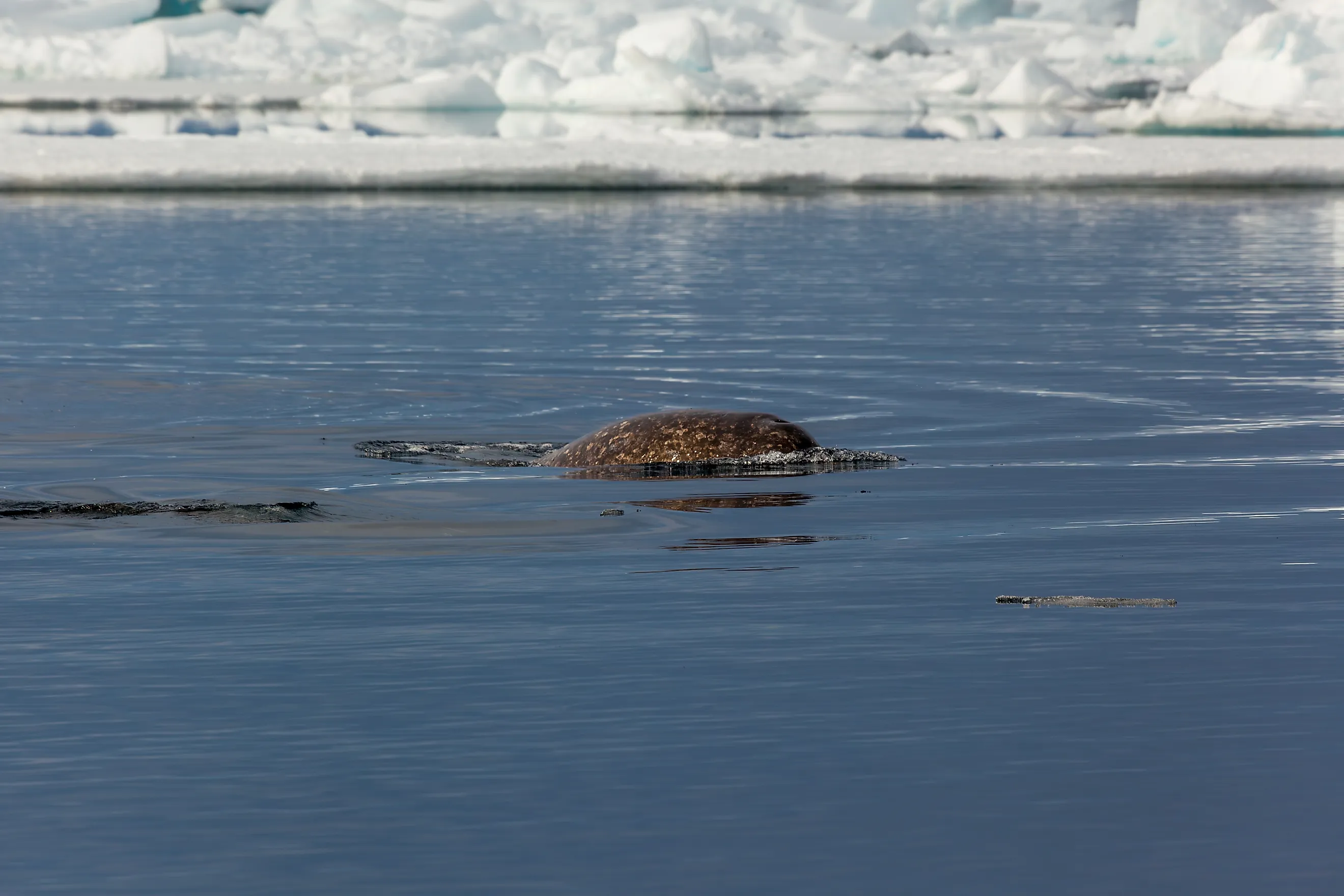
Adult narwhals have mottled gray bodies, slightly darker on top than underneath. Calves are born blue-gray, darken to nearly black-blue as juveniles, and become mottled gray and white as adults. Very old narwhals can appear almost entirely white. They lack a true dorsal fin (a low dorsal ridge takes its place), and adult flippers turn upward at the tips. Adults measure 11.5 to 16.4 feet (3.5 to 5 meters) in body length, with males larger than females. Adult males weigh roughly 3,500 pounds (1,600 kilograms); adult females, around 2,200 pounds (1,000 kilograms).
Narwhals have only two teeth, both at the tip of the upper jaw. In males, the left tooth typically erupts at age two or three and grows forward through the lip into the spiraled tusk that gives the species its fame. The tusk grows in a left-handed (counterclockwise) spiral, can reach about three meters (9.8 feet), and weighs up to 22 pounds (10 kilograms). The right tooth usually stays embedded in the gum, as do both teeth in most females. Roughly 3 percent of females develop a small tusk; some males grow two. Tusk length varies more than fourfold among adult males of similar body size, suggesting that the tusk is a strongly sexually selected trait. Charles Darwin proposed that males used the tusk to fight for mates. Modern researchers have documented additional functions: the tusk is heavily innervated and porous, and can detect changes in salinity and temperature; in 2017, drone footage from WWF Canada confirmed males using their tusks to flick and stun Arctic cod before swallowing them.
Habitat

Narwhals are restricted to the Arctic Ocean and the high-latitude reaches of the North Atlantic. Twelve discrete subpopulations are currently recognized, ranging through the waters of Canada, Greenland, Norway (around Svalbard), and Russia. The largest concentrations are in Baffin Bay and Davis Strait, between Baffin Island and western Greenland; other populations occur in northern Hudson Bay, the Greenland Sea, and around Svalbard and Franz Josef Land. Narwhals migrate seasonally, moving offshore into the dense pack ice during winter and returning to coastal inlets and fjords during summer when the ice breaks up.
Diet
Narwhals feed on a small set of Arctic prey species. Their winter diet is dominated by Greenland halibut (turbot), Arctic cod, and squid; in summer, they take more capelin, polar cod, and shrimp. They are exceptional divers. They routinely descend to between 800 and 1,500 meters (2,600 to 4,900 feet) on winter feeding dives and can hold their breath for around 25 minutes; the deepest recorded narwhal dive reached 1,776 meters (5,827 feet). Echolocation, a series of high-frequency clicks that returns acoustic information from objects in the water, is used to navigate the dark sub-ice environment and locate prey. Without functional cheek teeth, narwhals feed by suction, drawing prey into the mouth with the tongue and swallowing it whole.
Behavior
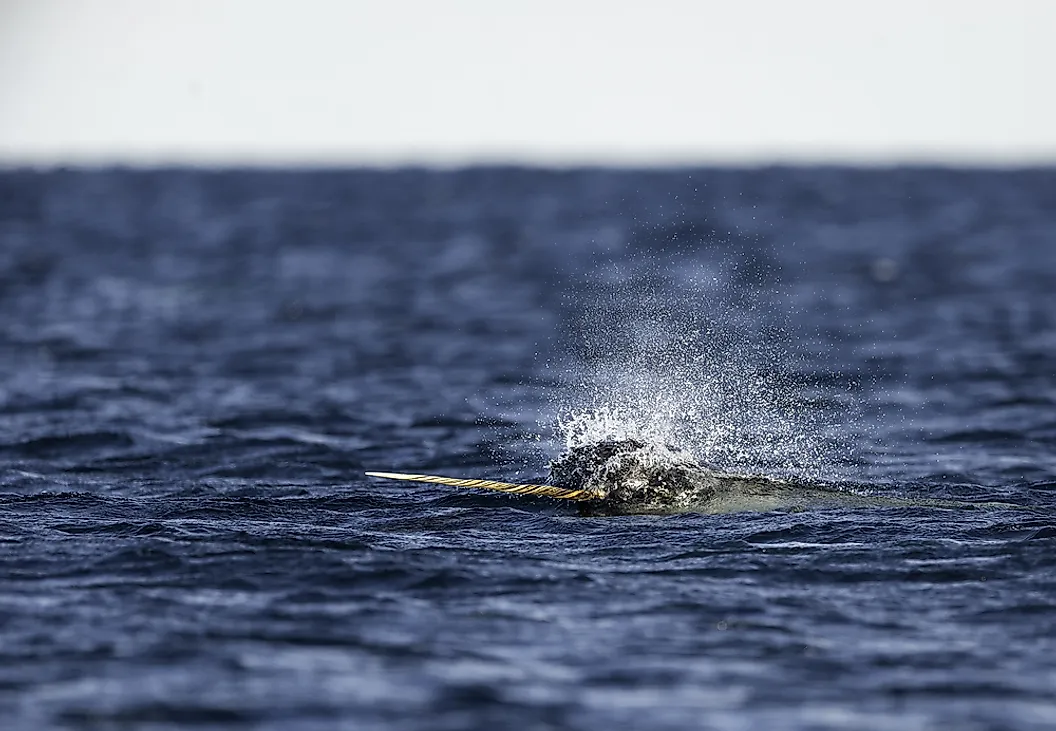
Narwhals are social animals. They typically travel in pods of 15 to 20, often segregated by sex or age (mothers and calves in some, adult males in others), and during seasonal migrations thousands can join into longer travelling groups that move along leads in the ice. Sociality has clear advantages: large groups locate breathing holes more easily and offer some protection against predators. Narwhals communicate with whistles, trills, and clicks. Their echolocation is among the most directional of any marine mammal, allowing them to track prey and to locate breaks in the sea ice in nearly complete darkness during the polar winter.
Reproduction
Narwhals are slow reproducers. Females reach sexual maturity around 8 to 9 years of age; males mature later, somewhere between 12 and 20 years. Mating takes place in March and April, in the dense pack ice of the wintering grounds. Gestation lasts about 14 to 15 months, and a single calf is born between late June and August during the spring migration to summering waters. Newborns are about five feet (1.5 meters) long. Calves nurse for at least a year, often longer; weaning may extend to two years or more, and females typically give birth only once every two to three years. Narwhals are long-lived: recent age estimates from aspartic-acid racemization in eye-lens nuclei suggest that some individuals reach 90 years or more.
Importance

Narwhals sit near the top of the Arctic food web. They help regulate Arctic squid and fish populations, and their long deep dives transport nutrients between the deep ocean and the surface. They are also sensitive indicators of Arctic ecosystem health: changes in narwhal distribution, body condition, or prey selection can flag broader changes in sea-ice extent, ocean temperature, and Arctic fish populations. The narwhal is also central to the culture of the Inuit, who have hunted them for thousands of years. Inuit families eat both the skin and underlying blubber together as maktaaq (also spelled muktuk), which is a traditional dietary source of vitamin C in a region where fresh produce does not grow. Narwhal meat feeds people and dogs, the sinew is used as thread, and the tusk has long traded as a high-value carving material.
Threats

Narwhals were hunted for centuries for their tusks, which reached medieval Europe through Norse trade routes and were sold as the horns of unicorns; tusks were among the most valuable commodities in late-medieval Europe. The IUCN currently lists the species as Least Concern based on a global population estimated at more than 120,000 mature animals, and Canada's Committee on the Status of Endangered Wildlife in Canada (COSEWIC) reassessed the species as Not at Risk in 2024. Population trends remain a concern in some subpopulations, and managed Inuit hunting is now regulated by quota in Canada and Greenland.
Climate change is the largest long-term threat. Loss and unpredictable behavior of sea ice has multiple effects on narwhals. Ice-entrapment events, in which a group becomes stranded in shrinking openings of refrozen ice without access to breathing holes, can kill dozens of animals at once and may be becoming more frequent as freeze-thaw cycles grow more erratic. Retreating sea ice also opens once-protected waters to killer whales, the narwhal's main natural predator; modeling suggests killer-whale incursions into northern Hudson Bay and Lancaster Sound have increased substantially since the 1990s. Greenland sharks also take narwhals at depth. Other pressures include incidental capture in turbot fisheries, underwater noise from shipping and seismic surveys, and the slow accumulation of pollutants such as mercury and PCBs in narwhal blubber.
The Narwhal's Ongoing Story In A Changing World
The narwhal is one of the strangest mammals on the planet, defined by a tusk that fueled European myth and by a life spent in some of the harshest waters on Earth. Losing the species would mean losing a piece of the Arctic's early-warning system and severing a connection that the Inuit have maintained for centuries. Protecting the narwhal's habitat means protecting one of the most fragile ecosystems on the planet, and keeping an ancient story going.