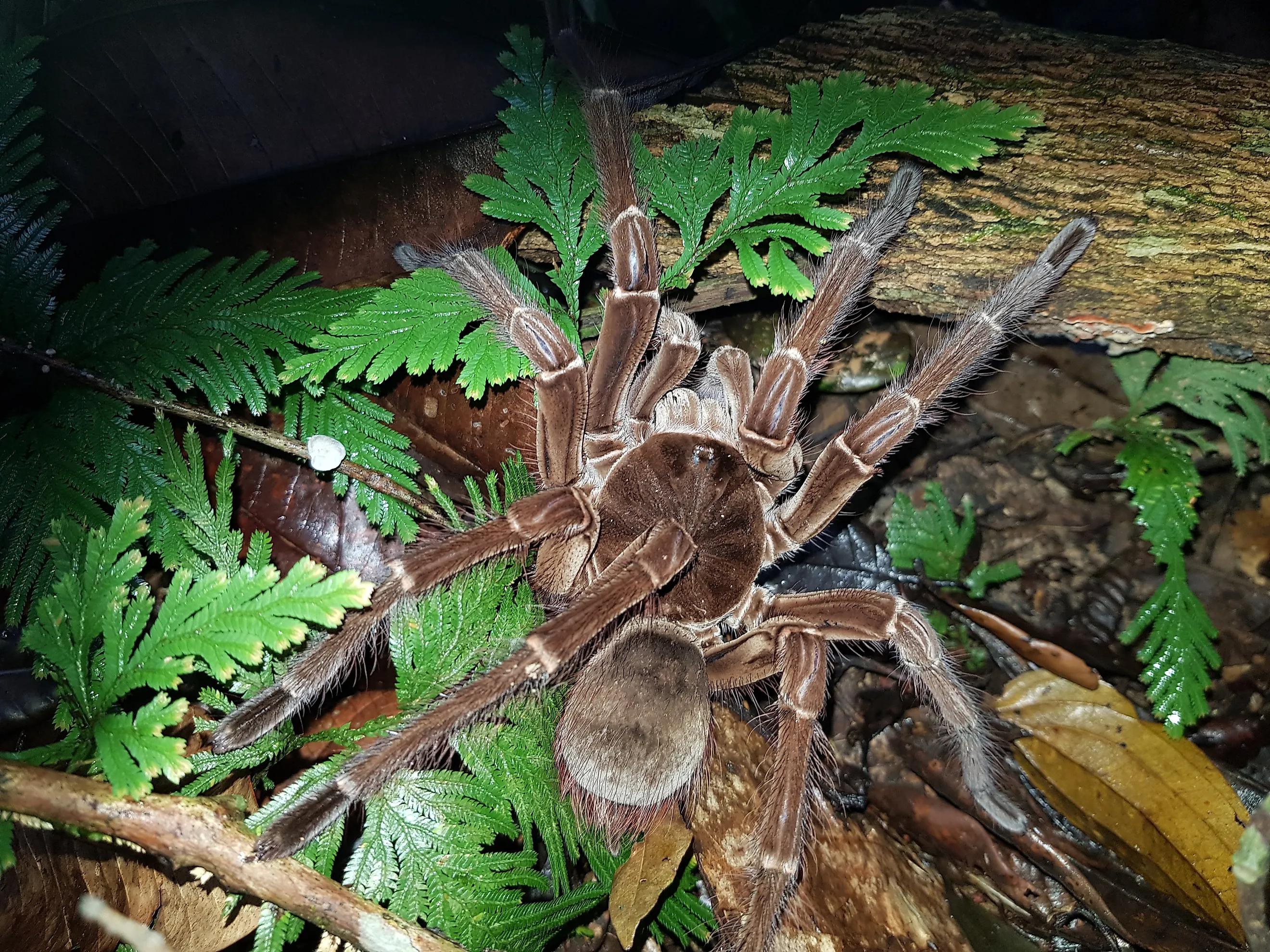
What Is the Largest Spider in the World?
"What is the largest spider in the world?" sounds like a simple question, and it has a simple answer until you ask the obvious follow-up: largest by what? Spiders can be measured by leg-span, by body length, or by sheer body mass, and depending on which yardstick you use, the title goes to a different species. Two spiders dominate the conversation: the Goliath birdeater of Suriname and the Amazon, which is the heaviest and the bulkiest, and the Giant Huntsman of Laos, which has the longest legs. A handful of other contenders push them close. Here is how the math actually works.
How We Measure a Big Spider
There are three measurements that come up in any "biggest spider" conversation, and they do not always agree.
Leg-span is the diagonal distance from the tip of one front leg to the tip of the opposite back leg when the spider is fully stretched out. It tends to favor spiders with proportionally long, thin legs.
Body length is measured from the front of the head (the chelicerae) to the back of the abdomen, ignoring the legs. This favors stocky, heavy-bodied spiders.
Mass is exactly what it sounds like, and it is the truest measure of how much spider you are actually dealing with. A 6-ounce spider is enormous regardless of how its legs are arranged.
The Goliath birdeater wins on body length and mass. The Giant Huntsman wins on leg-span. Everything else is a fight for second place.
Goliath Birdeater (Theraphosa blondi): The Heavyweight

The Goliath birdeater is a tarantula native to the rainforests of northern South America, including Suriname, Guyana, French Guiana, Venezuela, and northern Brazil. It tops out at a body length of around 5 inches, a leg-span of roughly 11 inches, and a mass that has been measured at up to about 6 ounces (175 grams). That is heavier than a baseball, packed into a hairy, eight-legged frame the size of a dinner plate.
The "birdeater" name is misleading. The species was named in the 18th century after an engraving showed one eating a hummingbird, and that image stuck. In practice, Goliaths mostly eat earthworms, large insects, and small vertebrates such as frogs and lizards. Birds are a rare and opportunistic meal at best. Females live up to 25 years in captivity, while males rarely make it past six.
Giant Huntsman (Heteropoda maxima): The Longest Legs

The Giant Huntsman has the longest legs of any known spider, with a leg-span that reaches roughly 12 inches (30 cm). Its body, by contrast, is small, only about 1.8 inches long. It is built for sprinting, not for bulk, and its legs splay sideways and twist forward in the crab-like walk typical of huntsmans.
Unlike the Goliath, the Giant Huntsman is not widespread. It is endemic to the cave systems of Khammouane Province in central Laos, where it was first collected in 2001 and formally described that same year by the German arachnologist Peter Jäger. Its long legs, pale yellowish-brown coloring, and full set of functional eyes suggest it lives close to cave mouths rather than deep in total darkness. Like the rest of the huntsman family (Sparassidae), it does not build a web, instead chasing prey down on foot.
This is also the species that gets confused with so-called "banana spiders." The huntsmans that occasionally turn up in shipments of fruit in Texas or Florida grocery stores are a different species, Heteropoda venatoria, the brown huntsman or pantropical huntsman. The Giant Huntsman of Laos has never been recorded as an accidental traveler.
Brazilian Salmon Pink (Lasiodora parahybana): The Closest Rival

The Brazilian salmon pink birdeater is the spider that comes closest to taking the title from the Goliath. Native to the Atlantic Forest of northeastern Brazil, it can reach a leg-span of around 10 to 11 inches and a body mass over 100 grams. Some captive specimens have been measured rivaling Goliath dimensions, which is why arachnologists usually rank it as the second-largest spider by both leg-span and mass.
It is also one of the more commonly kept tarantulas in captivity, partly because it grows quickly and partly because it tolerates handling better than most species its size. Like the Goliath, it eats large insects, small lizards, and the occasional small mammal.
Burgundy Goliath Birdeater (Theraphosa stirmi)

Often confused with its more famous cousin, the Burgundy Goliath is a separate species described in 2010, found along the border between southern Guyana and northern Brazil. It is slightly smaller than T. blondi on average, with a leg-span typically around 9 to 10 inches and a body length close to 4.5 inches. The two species are so similar that for years many spiders sold in the pet trade as Goliath birdeaters were actually T. stirmi.
Honorable Mentions: Colombian Giant, Chaco Golden Knee, Cerbalus, and Hercules

A handful of other spiders show up in any honest list of the largest:
Colombian giant tarantula (Megaphobema robustum), native to the rainforests of Colombia, can reach about 6 to 8 inches in leg-span. It is shorter-legged and chunkier than the South American birdeaters but is still one of the largest tarantulas in its range.
Chaco golden knee (Grammostola pulchripes), from the Gran Chaco region of Paraguay and northern Argentina, can reach a leg-span of around 8 inches with the distinctive golden bands on its leg joints that give it its name.
Cerbalus aravaensis, a sand-dwelling huntsman discovered in 2007 and described in 2010 from the Aravah Valley along the Israel-Jordan border, has a leg-span of about 5.5 inches. Modest by Goliath standards, but it holds the title of largest spider in the Middle East.
Hercules baboon spider (Hysterocrates hercules), known from a single specimen collected in Nigeria around 1900, was reported to have an 8-inch leg-span. The species has not been reliably collected since, and its current status is uncertain. It survives mostly as a footnote in the largest-spider conversation.
Why Spiders Don't Get Any Bigger Than This

One of the more interesting questions about big spiders is why they cap out where they do. Why are there no dog-sized spiders? The short answer is physics and physiology.
Like all arthropods, spiders have an external skeleton (an exoskeleton) and breathe through a combination of book lungs and tracheal tubes. As a spider gets bigger, its mass grows roughly with the cube of its size while the surface area of its breathing structures grows with the square. That means the bigger the spider, the harder it is to get oxygen efficiently to all of its tissues. Modern Earth's atmosphere holds about 21% oxygen, and at that level, the practical ceiling for an air-breathing arthropod sits roughly where the Goliath birdeater is today.
The molting process puts another cap on size. Spiders grow by shedding their exoskeleton, and a freshly molted spider is soft, vulnerable, and at risk of collapsing under its own weight. The bigger the spider, the longer that recovery window, and the more dangerous each molt becomes. Combined with the weight-bearing limits of an exoskeleton made of chitin, those constraints leave Goliath-sized spiders sitting near the top end of what arthropod biology will allow.
So Which Is Actually the Largest?
If you are asked the question and need a single answer, the Goliath birdeater is the safest one. It is the heaviest spider in the world, the longest by body length, and a close second on leg-span. The Giant Huntsman edges it out in leg-span only, and its slim build means it is dwarfed by the Goliath in every other category. Beyond those two, the Brazilian salmon pink is the only species that comes meaningfully close to either crown. The rest are regional record-holders or honorable mentions. The most accurate answer to "what is the largest spider in the world" is therefore "the Goliath birdeater on most measures, the Giant Huntsman if you only care about leg reach, and physics will not let any spider get much bigger than either of them."