The Most Important Ottoman Military Innovations
The Ottoman Empire was one of the most formidable states in world history. Lasting from 1299 to 1922, there were several reasons behind its longevity. Its administrative system was practical and effective. Its handling of religious minorities also ingratiated people with the Ottoman government. However, the military was perhaps the most important reason of all, from the Janissaries to the early adoption of firearms, these military innovations were instrumental in the empire's influence and power.
The Janissaries

You can't talk about the Ottoman military without discussing the Janissaries. An elite military unit meant to protect the sultan, the Janissary corps began sometime in the 14th century. It functioned as follows: young Christian boys from the Balkans were forcibly recruited, converted to Islam, and then trained in elite military schools. Being from the Balkans was important, since it meant that they had no connections to local Anatolian politics (where the Ottoman power centre was based). This contrasted with the local warlords that the Ottomans had previously used. They were often good fighters, but sometimes unreliable if asked to fight in a battle that went against their interests.

For the first three or so centuries of their existence, the Janissaries were one of the best fighting forces in Europe and the Middle East. They were a professional standing army, as opposed to the mostly citizen-based militias elsewhere. This meant that they continuously trained and developed collective discipline, even when they weren't fighting. Early use of gunpowder (which will be discussed in the next paragraph) was also key to much of their success. Finally, being completely reliant on the sultan meant that they often fought extra hard to win his wars, since all their political and financial fortunes rested on him.
Early And Sophisticated Use Of Firearms

The Ottoman Empire was one of the early gunpowder powers. The Ottomans began utilizing it in the 14th century, although it wouldn't become a major part of artillery warfare until the 15th century. One of the clearest examples was the Siege of Constantinople in 1453. The final battle of the Ottoman wars against the Byzantine Empire saw them use the giant Basilica cannon to attack the city walls. When combined with naval bombardments, infantry assaults, mining, and engineering, Constantinople fell in less than two months.
Gunpowder wasn't just used for sieges. The Janissaries were one of the first infantry units to adopt it. When used alongside heavy artillery fire, they often tore through their opponents. Consider the Battle of Chaldiran in 1514. The first major engagement in the long Ottoman-Safavid conflict saw the Ottomans decimate the Safavid mobile cavalry by combining Janissary and artillery firepower. This victory allowed the Ottomans to secure control over Eastern Anatolia and Northern Iraq.
The Timar System

The timar system played a major role in Ottoman taxation and military service. It functioned as follows. A timar was essentially a grant to collect tax revenues from a particular piece of land. Crucially, however, the person who had the timar (the timariot) didn't own it, since it belonged to the sultan. To gain access to its tax revenues, timariots thus had to fulfill military obligations.
Sipahis, provincial cavalrymen, were the main timariots. By collecting taxes from a group of villages, they could maintain themselves, their horses, weapons, and household. This was crucial, particularly in the early days. As the Ottoman Empire rapidly expanded, paying all its soldiers directly out of the state treasury would have been expensive and impractical. Having timariots collect tax revenue themselves reduced the government's immediate financial burden and ensured that it never paid soldiers beyond what it could afford. The timariots also helped survey land and integrate new territory into the Ottoman administrative system. While their importance eventually declined as cavalry became less utilized and the government increasingly required cash taxation, timariots were nonetheless instrumental in the early-to-mid Ottoman Empire.
A Formidable Navy

The Ottoman Empire didn't begin as a naval power. However, as it expanded to places like the Black Sea and the Sea of Marmara, some sort of navy became necessary. The conquest of Constantinople in 1453 was the turning point. Located on the Dardanelles Strait, Sultan Mehmed II understood that ships would be required to take the city. In one particularly famous maneuver, he ordered the Ottomans to carry their ships over land to bypass Byzantine naval defenses.
This was just the beginning. Now that the Ottomans controlled Constantinople, they needed to further build up their navy to defend it and expand their influence. Competition against other sea powers helped in this process. The Ottoman-Venetian War of 1463 to 1479 was particularly important, since it forced the Ottomans to build up their shipyards, naval arsenal, crews, and logistical capacity to establish control over the Aegean Sea. The navy also benefited from adopting artillery, thereby utilizing the same gunpowder technology that made the land forces so formidable.

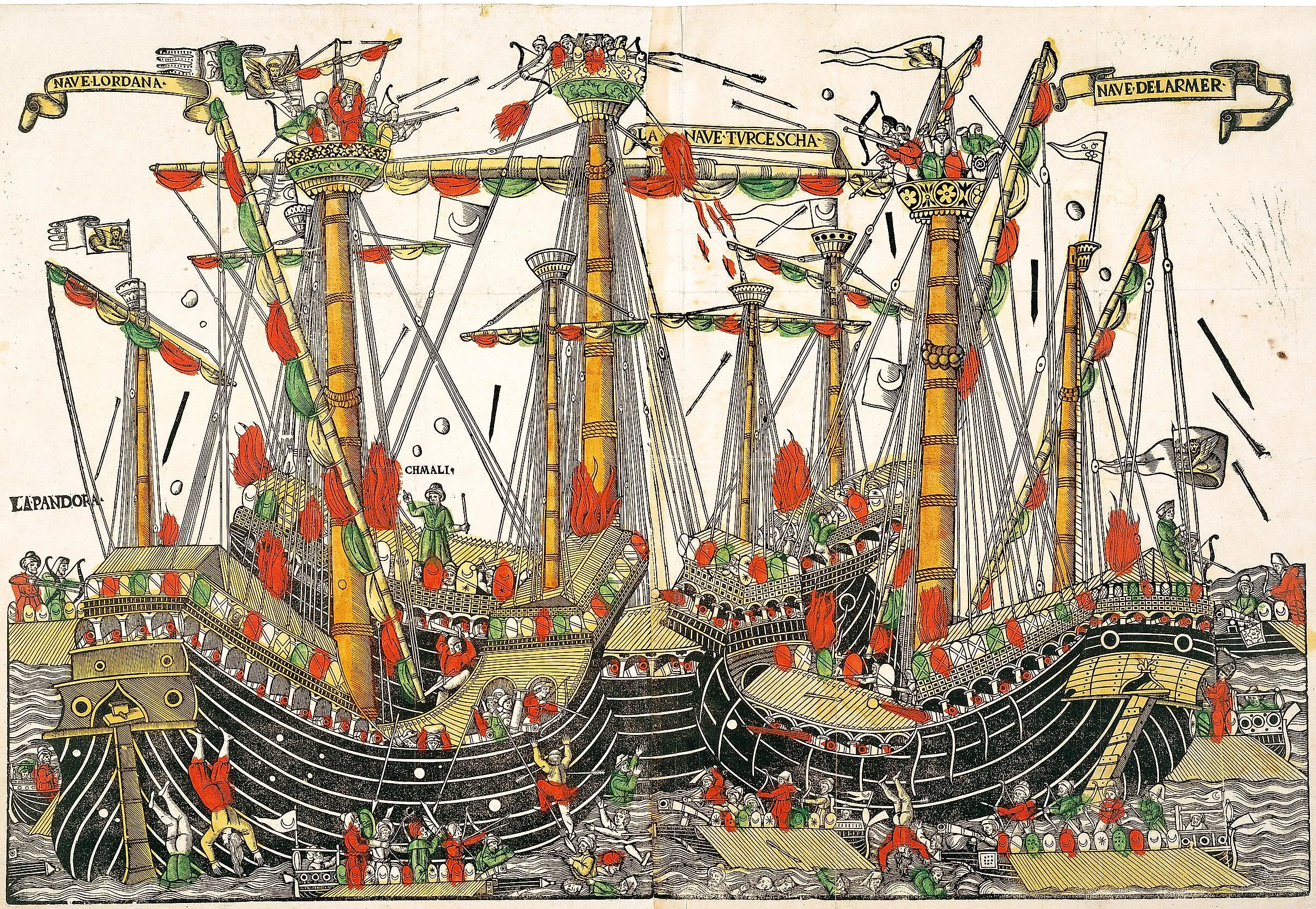
If the Ottoman Empire was one of many naval powers in the Mediterranean at the beginning of the 1500s, it was the dominant power in the region by the middle of the century. This is where Hayreddin Barbarossa comes in. Originally a Barbary pirate, or corsair, he joined the Ottomans because he needed help fighting the Spanish in North Africa. Barbarossa eventually became the empire's supreme naval commander and consistently defeated the Europeans. This culminated in the Battle of Preveza in 1538, in which Barbarossa decimated a major European coalition led by Andrea Doria, one of the most famous admirals in history. With this, the Ottomans established themselves as the dominant power in the Mediterranean for decades to come.
Impact And Legacy
The Ottoman Empire was responsible for several key military innovations. For instance, the Janissaries were a professional, standing army that outmatched most other contemporary forces. Early adoption of firearms gave the Ottomans an advantage in sieges and open combat. The timar system ensured that the empire didn't spend beyond its means while rapidly expanding. Finally, by building up their navy, the Ottomans made themselves both a land and sea power.