The Truth About Gladiators In The Roman Empire
Gladiatorial games are one of the most well-known parts of the Roman Empire. From their portrayal in popular media, to their location in iconic places like the Colosseum, they continue to capture the imagination of many people. However, the truth about gladiators is complicated. Their lives represented the intersection of class politics and imperial power. Their popularity was also indicative of morbid Roman interest in brutality and death. In short, to truly understand the Roman Empire, you must first comprehend the gladiators.
Origins

Gladiatorial combat likely originated somewhere in Italy. Historians generally agree that it was first practiced by the Etruscans, a pre-Roman civilization, during funerals as a way to honor the dead. Nevertheless, the first recorded instance of gladiatorial combat occurred in 264 BCE. Held by the sons of the deceased aristocrat Decimus Junius Brutus Pera, the fight took place in Rome’s cattle market called the Forum Boarium.

As the Roman Republic grew in power, so did the popularity of the gladiatorial games. Influential families and ambitious politicians sponsored them to flaunt their wealth and earn prestige. The games also became increasingly disconnected from funerals. This culiminated in 105 BCE with the first official state sponsorship of a gladiatorial match as an explicit show of strength. Gladiatorial combat reached its peak when the Republic fell and the Empire rose. Uninhibited by checks and balances, emperors spent on extravagant arenas, like the Colosseum. These were the sites of major spectacles that displayed both the power and garrishness of Roman civilization.
Who Became Gladiators?

A wide variety of people became gladiators, the most common of whom were slaves or condemned criminals. Slaves were generally acquired through military conquest or by purchasing them at markets. Some were also enslaved due to hereditary inheritance. Despite this lack of freedom, many slaves received rigorous and disciplined combat training in gladiatorial schools called ludi. This was not the case for condemned criminals, who often lacked any sort of training. Being forced to participate in the gladiatorial games was therefore akin to being sentenced to death.

Some free citizens voluntarily became gladiators. Known as auctorati, they did so in exchange for money, fame, and glory. Even though voluntarily putting one’s life in danger might make little sense to us, this practice was indicative of Roman belief in the values of conquest and strength. Impoverished and debt-ridden citizens, disgraced nobles, and soldiers looking for income generally chose to become gladiators. However, elites occasionally did so as well. Perhaps the most memorable example was Emperor Commodus. Ruling from 182 to 192 CE, he viewed himself as the reincarnation of the Greek god Hercules and spent more time fighting in the games than governing. Eventually, the upper echelons of Roman society grew tired of his behavior, and Commodus was assassinated by his wrestling trainer in 192 CE.
The Colosseum

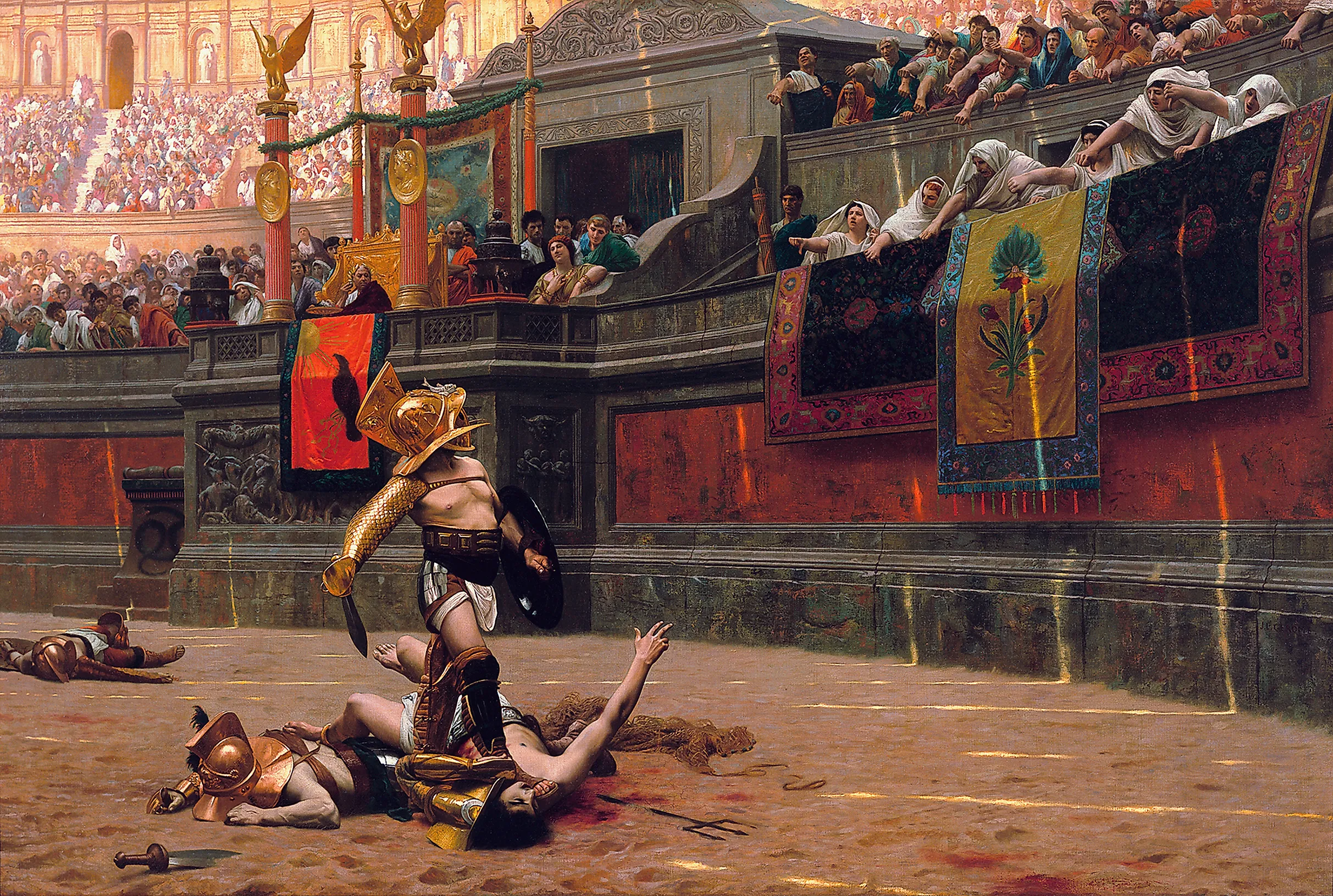
You can’t understand gladiators without a clear picture of their most iconic arena: the Colosseum. Construction began under Emperor Vespasian and was completed by his son, Titus, in 80 CE. The largest ancient amphitheatre ever built, it could house between 50,000 and 80,000 people.
As one of the primary sites of entertainment in Rome, the Colosseum saw countless gladiatorial games. Rather than being chaotic brawls, as was sometimes the case, these showdowns were highly ritualized. Theatrics were used to keep crowds entertained; for instance, gladiators often dressed up as Celts to reenact famous Roman conquests of places like Gaul. The Colosseum was also sometimes filled with water so combatants could recreate famous naval battles from events like the First Punic War.
The Dark Side Of Gladiatorial Life

As has hopefully been made clear so far, gladiatorial life was hardly one of glitz and glamor. It was deeply embedded with the institution of slavery, and often served as a death sentence for condemned criminals. Even if every gladiator was a volunteer, the fact that fights to the death were such a common form of entertainment reflects a morbid obsession with violence that infected nearly every aspect of Roman civilization. Gladiatorial games went beyond a human cost as well. Fighting animals was common, and thousands of lions, bears, elephants, and other animals were slaughtered to satiate the public appetite for violence.
Opposition To Gladiatorial Life

Not everyone accepted the reality of gladiatorial life. This resistance began among gladiators themselves, and there were several revolts throughout Rome’s history. The most famous revolt was led by Spartacus. In 73 BCE, he escaped a gladiatorial school in Capua and led a massive slave uprising known as the Third Servile War. He was eventually defeated in 71 BCE, but not before beating several Roman armies.
Opposition to gladiatorial games eventually became mainstream in Roman society. This was due to the rise of Christianity. Christian leaders condemned the violence, a condemnation which gradually changed social values. The turning point came in 404 CE when Saint Telemachus was stoned to death after jumping into an amphitheatre to stop a gladiatorial fight. The public was horrified by this event, and Emperor Honorius subsequently banned gladiatorial fights to prevent similar occurrences in the future. With this, gladiators as we know them ceased to exist.