How Aqueducts Made The Roman Empire Possible
An aqueduct is a man-made system of channels, tunnels, pipes, bridges, and reservoirs that carries fresh water from its source to towns, cities, and farms, usually relying on gravity rather than pumps to move the water to its destination. Aqueducts are a highly effective way of transporting water over long distances to supply cities and towns with clean drinking water, and they were already in use more than 2,000 years ago. Without a reliable supply of fresh water, diseases could spread quickly, making city life unpleasant and dangerous. By supplying growing cities across the empire with reliable fresh water, the Romans used aqueducts to support public health, economic growth, and urban expansion.
At its height, Rome may have had a population of more than one million people, and the abundance of water flowing into the city through its aqueducts made this growth possible. Per capita, ancient Rome consumed water at a rate comparable to some modern cities, and eleven aqueducts eventually poured hundreds of thousands of cubic meters into the capital every day. Without the aqueducts and the water they supplied, a population of this size would not have been sustainable. In short, the Rome that we know of today would not have existed without aqueducts.
How Did Aqueducts Work?

Roman aqueducts relied on gravity to carry water from springs near distant mountains, sometimes transporting it for 50 miles or more. The longest, the Aqua Anio Novus, ran close to 60 miles. What made this possible was an obsessively gentle downhill gradient, often only a few feet of drop per mile, surveyed with instruments such as the chorobates, a long leveling table, and the groma. The water flowed through channels lined with stone, brick, or a waterproof cement the Romans made with volcanic ash, which could set even underwater.
Once it reached the city, the water passed into distribution tanks called castella, where it was divided and sent through lead and terracotta pipes to public baths, fountains, gardens, and sometimes private homes. Wealthy families could pay special taxes to have water piped directly to their houses, with the flow calibrated by a bronze nozzle of a fixed diameter. With a plentiful supply of fresh water, bathhouses spread across Roman cities, farmers grew larger crops, streets ran cleaner, and Rome's toilets and sewers depended on the constant flow the aqueducts provided.
How Roman Aqueducts Brought Fresh Water to Growing Cities

Rome's eleven aqueducts were built over roughly five centuries, beginning with the Aqua Appia in 312 BCE and ending with the Aqua Alexandrina in 226 CE. The Appia was commissioned by the censor Appius Claudius Caecus, the same official behind the Via Appia, and ran almost entirely underground for about ten miles. They transported water from springs, rivers, lakes, and reservoirs into towns and cities, drawing on sources near Lake Bracciano to the northwest and the Anio River valley to the east. A collecting basin at the source and settling tanks along the route let dirt and debris drop out before the water entered the main channel.
Using precise measurements, Roman engineers constructed a network of tunnels, covered channels, and bridge-borne arcades that stretched for miles. Most of each aqueduct actually ran underground, which protected the water from contamination and evaporation and kept the line safe from tampering. The channels followed a steady, gentle slope so gravity alone could move the water without pumps. After reaching the city, the water collected in reservoirs before being distributed to toilets, fountains, public baths, gardens, and, in some cases, the private homes of wealthy citizens.
How Aqueducts Improved Daily Life Across the Empire

We know that cities cannot thrive without clean, reliable water. People needed it for drinking, cooking, bathing, farming, and cleaning. As Rome grew, the wells and streams that once supplied the city could no longer meet demand. Frontinus, the water commissioner who wrote a two-volume treatise on the system in the first century CE, recorded exactly how much each aqueduct delivered and where it went, giving us a rare administrative picture of the network. Eventually, eleven aqueducts supplied the city of Rome, and many more were built throughout the empire.
Aqueducts filled the famous Roman baths, where people could wash but also socialize, exercise, conduct business, and discuss politics. Public fountains provided free water for everyone, while a private water supply became a symbol of wealth and status. Building the lines also created work for thousands, including surveyors, engineers, stonemasons, plumbers (the Latin plumbarii, named for the lead they worked), and curatores who managed maintenance. The constant flow helped flush waste through Rome's sewer system, chief among them the Cloaca Maxima, making cities cleaner and more pleasant places to live.
Aqueducts often took years to build, sometimes well over a decade, and were expensive engineering projects funded by the state or by ambitious politicians seeking public favor. While some wealthy households had private connections, much of the water was intended for public use, and unauthorized tapping of the pipes was a persistent problem that the curatores were tasked with policing. Under Emperor Augustus, the trusted general Marcus Agrippa overhauled Rome's water system, restoring older aqueducts, building new ones such as the Aqua Virgo, and constructing public baths that made clean water far more widely available.
How Aqueducts Strengthened the Roman Economy

Aqueducts helped the Roman Empire grow by raising living standards and supporting economic activity. Cleaner water encouraged better hygiene and sanitation, promoting healthier, more productive communities. Public baths became central to Roman society, places where people gathered to socialize, network, relax, exercise, and do business, all made possible by the steady supply of water. The largest complexes were enormous. The Baths of Caracalla could hold well over a thousand bathers at once, with warm pools, cold plunges, a heated caldarium, gymnasiums, sweat rooms, libraries, shops, and shrines under one roof. Smaller neighborhood baths served everyday washing. Roman baths were far more than places to get clean. They were places to sell, trade, see and be seen, meet people, display wealth, and build relationships with influential members of society.
Aqueducts also supported industries such as milling, textile fulling, and tanning by providing a dependable water supply. At Barbegal in southern Gaul, an aqueduct fed a hillside of sixteen water-powered mills that could grind flour for thousands of people, one of the earliest known industrial complexes. This reliable power and water helped craftspeople produce goods more efficiently and sell them in markets across the empire. Agriculture benefited too, as irrigation improved crop yields and helped keep food supplies stable for a growing population. Aqueducts further encouraged urban development by making it possible to maintain public fountains, baths, and gardens. In newly conquered territories, these structures demonstrated Rome's engineering skill and helped transform ordinary settlements into fully Roman cities.
How Aqueducts Became Symbols of Roman Power

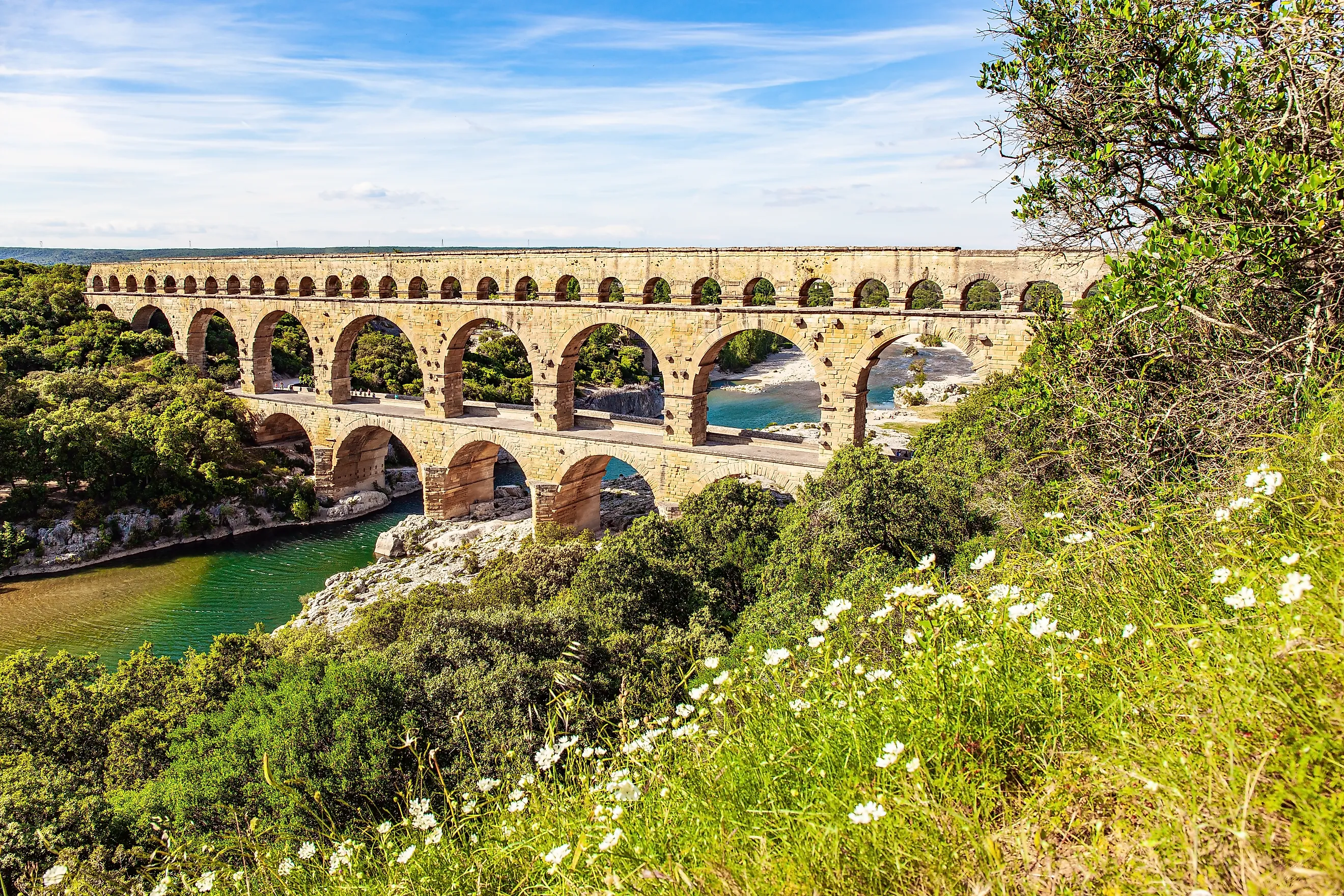
The Romans were not the first people to move water through built channels. Earlier civilizations in Egypt and the Near East had done so as well. However, the Romans developed a larger and more sophisticated network that reached across their empire. Reliable access to clean water became one of the tangible benefits of Roman citizenship, while monumental aqueducts advertised the wealth, engineering expertise, and organizational power of the state. Outside Rome itself, the Romans built as many as 200 aqueducts across Europe and the Middle East, including the Pont du Gard in France, which lifts its water channel nearly 160 feet above the Gardon River, the Skopje Aqueduct in North Macedonia, and the Caesarea Aqueduct in Israel. The three-tiered bridge at Segovia in Spain still stands without mortar, held together by the weight of its own stone. These structures became symbols of how Rome improved the lives of people across its territory.
The Lasting Legacy of Roman Aqueducts
Many Roman aqueducts lasted for centuries, and some, such as the Pont du Gard, are still standing today. A few even remain in use, including the Aqua Virgo, completed by Agrippa in 19 BCE, which still feeds Rome's Trevi Fountain through its restored descendant, the Acqua Vergine. Rome did not invent the aqueduct, but it refined and expanded the design to create an abundance of nearly free drinking water for its growing population. That water made the Roman baths possible, creating the arenas where people traded, socialized, exercised, and even settled matters of politics.
The same supply let industries such as milling, tanning, and textile production flourish, while irrigation raised farmers' yields. Without aqueducts, Rome could never have grown into the vast, densely settled city at the heart of one of history's greatest empires, nor would it resemble the Rome we know today.