Why The Persian Immortals Were The Ancient World's Elite Force
The Persian Immortals were one of the ancient world’s most famous military units, known for their size, discipline, and close connection to the Persian king. Greek historian Herodotus described 10,000 carefully chosen infantrymen whose ranks never diminished because every loss was replaced. That system gave them their enduring name. Their elite reputation rested not on invincibility but on selection, constant strength, varied weapons, and the king’s trust in difficult assignments.
Most of what historians know about the Immortals comes from Herodotus’s account of Persia’s invasion of Greece in 480 BCE. His detailed narrative reflects an outsider’s perspective influenced by Greek assumptions and storytelling traditions. Persian royal inscriptions and administrative records do not mention a unit called the “Immortals,” so the name may be a Greek interpretation rather than an official title. Achaemenid records provide evidence for standing royal troops, but they cannot securely identify them with Herodotus’s 10,000 or establish the corps’s precise duties. However, the story of the Persian Immortals reveals how careful selection, varied weaponry, and the king’s toughest assignments turned 10,000 soldiers into an ancient military legend.
The 10,000-Man Force

Herodotus names Hydarnes as their commander during Xerxes I's invasion. He belonged to one of the empire's leading military families. His father helped Darius I overthrow Gaumata in 522 BCE and later crushed a revolt in Media. The younger Hydarnes had already helped drive the Athenian leader Miltiades from the Thracian Chersonese. Xerxes therefore placed the Immortals under an experienced commander from one of the empire's most powerful noble families.
The force consisted of 10,000 Persian infantrymen. According to Herodotus, a replacement was selected whenever death or illness created a vacancy, keeping the reported strength at 10,000. The wider Persian army relied partly on levies gathered for major campaigns, which could take a long time to assemble. The Immortals gave the king a large body of soldiers that was already organized.

The broader Persian army used decimal units of tens, hundreds, thousands, and myriads, but the Immortals' internal organization is not securely known. Herodotus elsewhere describes 10,000 chosen Persian infantry, generally identified with the Immortals, in which 1,000 men with gold pomegranate spear fittings surrounded 9,000 with silver ones. They were distinct from the separate 1,000 royal spearmen whose spear butts bore golden apples. What matters more than the name is how the unit functioned. Herodotus presents the corps as 10,000 chosen infantrymen kept at full numerical strength during Xerxes's campaign, but its peacetime status and complete range of duties cannot be securely reconstructed.
Guardians of the Persian King

Their place near Xerxes carried enormous responsibility. The Great King directed the army and represented the empire itself. A breakdown around him could throw thousands of soldiers into confusion. His guards had to keep him safe during marches and military campaigns while maintaining order inside the royal procession.
After Salamis, Herodotus explicitly says Mardonius selected all the Immortals to remain in Greece except Hydarnes, but the unit is not named in accounts of the fighting in 479 BCE. This gap in the record has led historians to question how consistently the unit can be followed after this point. Herodotus says Hydarnes refused to remain with Mardonius because he would not leave Xerxes, but this does not establish that protecting the king was the Immortals' primary duty.
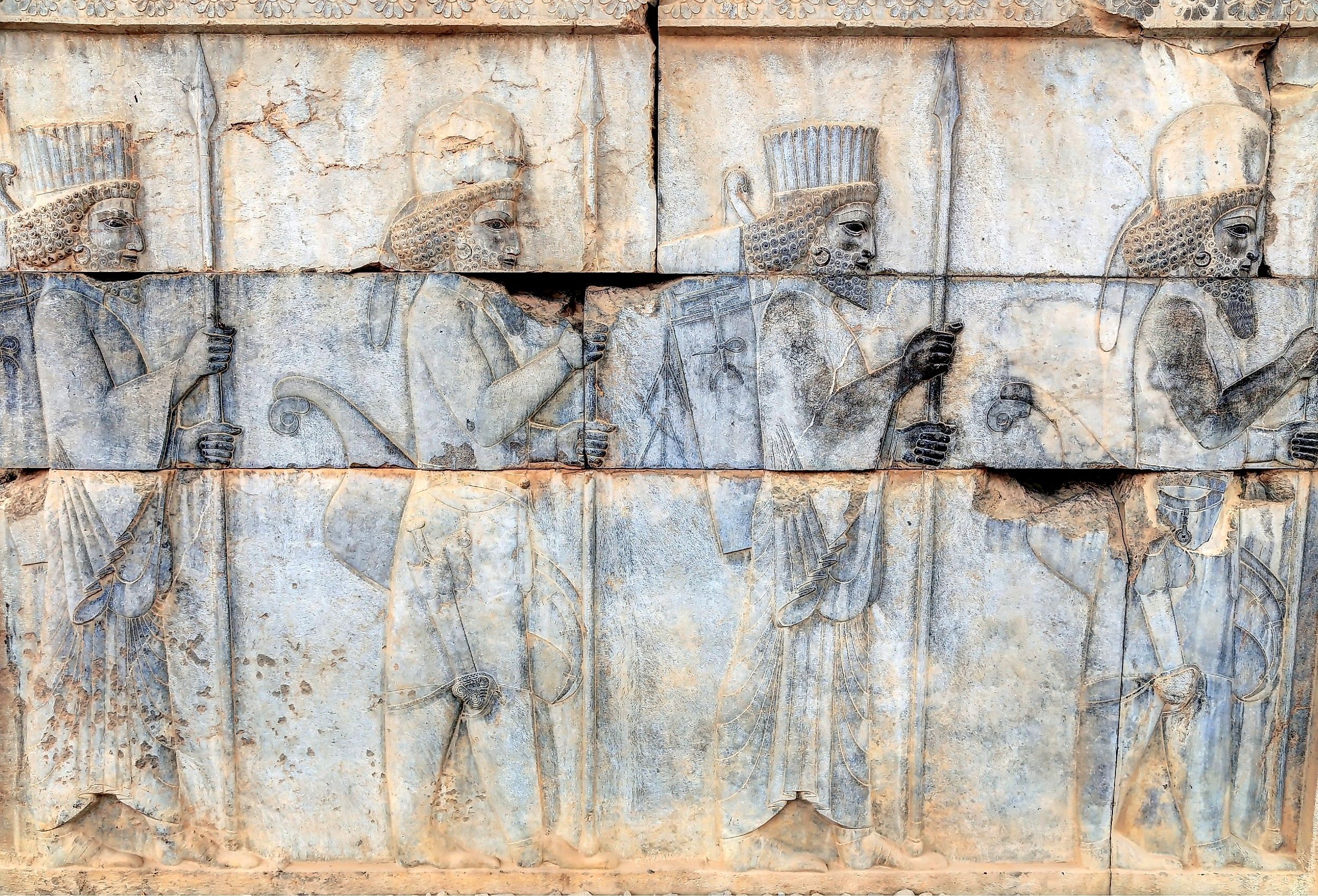
A glazed-brick frieze depicting a royal guard soldier from Darius I's palace at Susa offers a possible image of these soldiers. The figure in the work wears a decorated robe, bracelets, and earrings while carrying a long spear with a bow and quiver. No inscription calls the figures Immortals, yet the rows of matching guards show the royal court presenting its protectors as disciplined and richly equipped.
Weapons, Training, and Tactics

No surviving source gives a training program used only by the Immortals. Persian military education provides a useful starting point. Noble youths trained in companies of 50. They practiced archery and spear throwing, while riding, and difficult marches built endurance. Herodotus says Persian boys learned to ride and shoot from childhood. Since the Immortals were specifically chosen, selection likely concentrated on men with strong conditioning and weapon skills. That background cannot prove every member followed the same path, but it shows what Persian elites were expected to bring into military service.
Their equipment supported different stages of combat. Bows allowed them to damage an enemy before direct contact. Spears and sidearms gave them options once the lines closed. Some Persians wore scale armor, while large wicker shields could be planted in the ground to protect archers. The possible royal guards shown at Susa carry bows and long spears, matching this mixed role.
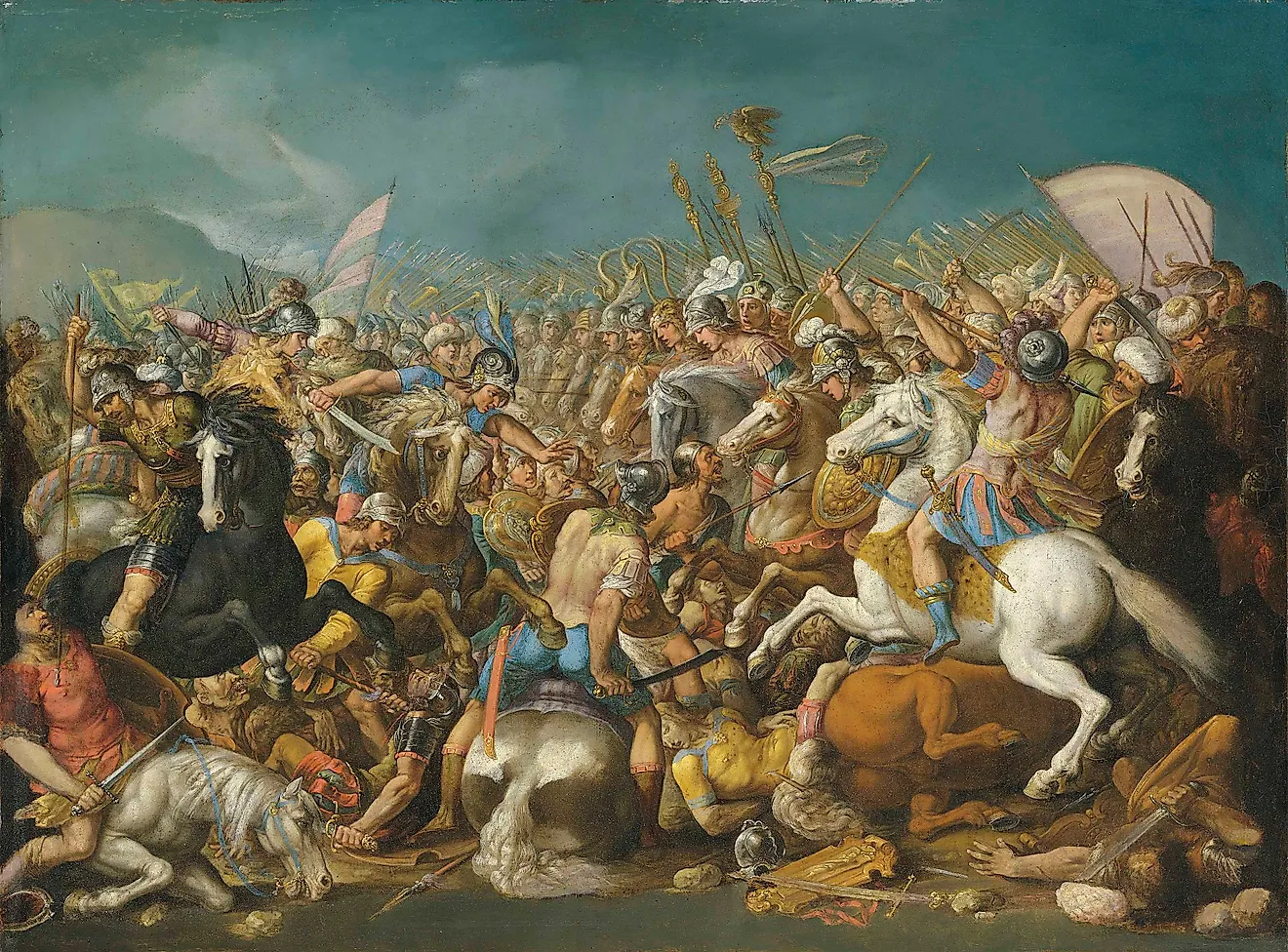
Persian infantry fought inside a larger system. Archers tried to disrupt the opposing line before spearmen advanced, while cavalry threatened exposed flanks. The aim was to break an enemy's order before the decisive clash, reducing the advantage of soldiers who depended on a tight formation. The exact arrangement used by the Immortals is unknown, but their weapons fit that approach. Chosen soldiers could deliver organized arrow fire and continue fighting after the enemy reached them.
This method was dangerous in open country, where arrows and cavalry could wear down a formation before close combat. It became less effective when terrain restricted movement or heavy armor stopped the arrows. Thermopylae created both problems. The pass denied the Persians room to surround the Greeks, while the hoplites met them with large shields and longer spears.
The Immortals at Thermopylae

Thermopylae, as described in surviving Greek accounts, was a poor place for Xerxes to use the size and range of his army. Mountain slopes restricted one side of the route, while marshes and the sea closed the other. Parts of the passage were only wide enough for a cart. The Greek defenders repaired an old wall and held a short front where heavily armed hoplites could block a much larger force.
After earlier Persian troops suffered heavy losses, Xerxes sent in the Immortals. Herodotus says they were attacked by companies and tried different ways to gain ground. The confined space kept most of the corps out of the fight, and their shorter spears left them at a disadvantage. The Spartans also pretended to retreat, drew the Persians forward, and suddenly turned on them. After failing to gain ground, the Persian attackers withdrew.

The battle changed when Ephialtes, a local Greek from Trachis who betrayed the defenders, revealed the Anopaea path over the mountains. Hydarnes left camp around the time lamps were lit and led his men through oak-covered ground all night. They reached the summit at dawn.
One thousand Phocians guarded the route. Hearing the Persians approaching through the dry leaves, they quickly took up their arms. Hydarnes thought they were Spartans at first. Once he realized who they were, he formed his men and drove them back with a concentrated volley of arrows. The Phocians withdrew uphill. Hydarnes continued toward the rear of the Greek line instead of chasing them. Once the path was open, speed mattered more than winning a separate battle on the summit.
Their arrival behind Leonidas forced the remaining Greeks to face attacks from both directions. Thermopylae exposed their limits in a frontal battle, yet it also showed why Xerxes trusted them with a difficult maneuver that decided the fight.
Elite Soldiers, Not Invincible Warriors
The Immortals’ elite reputation did not rest on an unbroken record of victory. It came from their careful selection, reported strength of 10,000, varied weapons, and Xerxes’s willingness to entrust Hydarnes with demanding assignments. Thermopylae exposed their disadvantages against hoplites in a narrow frontal battle. Their overnight march along the Anopaea path still demonstrated endurance, discipline, and clear command under pressure. They were not unbeatable, and their name referred to the replacement system that kept their reported strength constant rather than to literal invincibility.