The Longest Reigning Ancient Pharaohs
Historians and Egyptologists divide ancient Egyptian history into three major kingdom periods: the Old Kingdom, from about 2686-2181 BCE; the Middle Kingdom, circa 2055-1650 BCE; and the New Kingdom, from around 1550-1070 BCE. These three kingdoms refer to periods when Egypt was highly centralized under a single ruling faction, with brief intermediate periods of chaos or non-centralized rule. While all three fall under the broad umbrella we call Ancient Egypt, the spread is considerable. In fact, Cleopatra lived closer to our time than to the earliest dynasties of the Old Kingdom. The seven pharaohs below held the throne longer than almost anyone else who ruled Egypt, with their reigns spanning all three kingdoms and into the Late Period that followed.
The Pharaohs
Egyptian Pharaohs held several offices at once. They were kings, chief military commanders, primary religious leaders, and absolute enforcers of justice and civil order. They were also guardians of "ma'at", the ideal of justice, order, and cosmic balance. The Pharaoh's responsibilities included protecting Egypt from internal and external threats, ensuring political stability, administering justice, supporting religious rituals, and overseeing overall prosperity. Even when priests performed daily religious ceremonies, they did it in the name of the Pharaoh. Egyptian Pharaohs were semi-divine, although Egyptians knew the king was mortal (hence mummification). The living king was associated with the god Horus, but the office of Pharaoh was considered to straddle the line between mortals and the gods. Some of the Pharaohs were recipients of cult worship at different periods.
Pepi II

The exact length of reign for individual Pharaohs can vary greatly across chronologies and is complicated; some kings had co-rulers or regencies in the early days of their rule, and others are disputed by modern scholars, such as Pepi II, who reigned for 94 years according to ancient tradition. Pepi II became Pharaoh as a child and is recorded in ancient sources as governing from roughly 2278 to 2184 BCE. Many modern scholars find this hard to believe, as the average lifespan of an ancient Egyptian was between 19 and 30. This average was highly affected by the extraordinary incidence of childhood death, and many Egyptians who survived childhood lived into their 40s and 50s.
Pepi II ruled during the Old Kingdom's sixth dynasty, shortly before the collapse of the Old Kingdom. However, most historians do not blame the long-lived Pharaoh for the collapse, although he seems to have outlived several potential heirs, which may have complicated succession. The end of the Old Kingdom is usually attributed to lower Nile floods and the rise of nomarchs, provincial governors who increasingly held local power and passed it down to their heirs.
Ramesses II

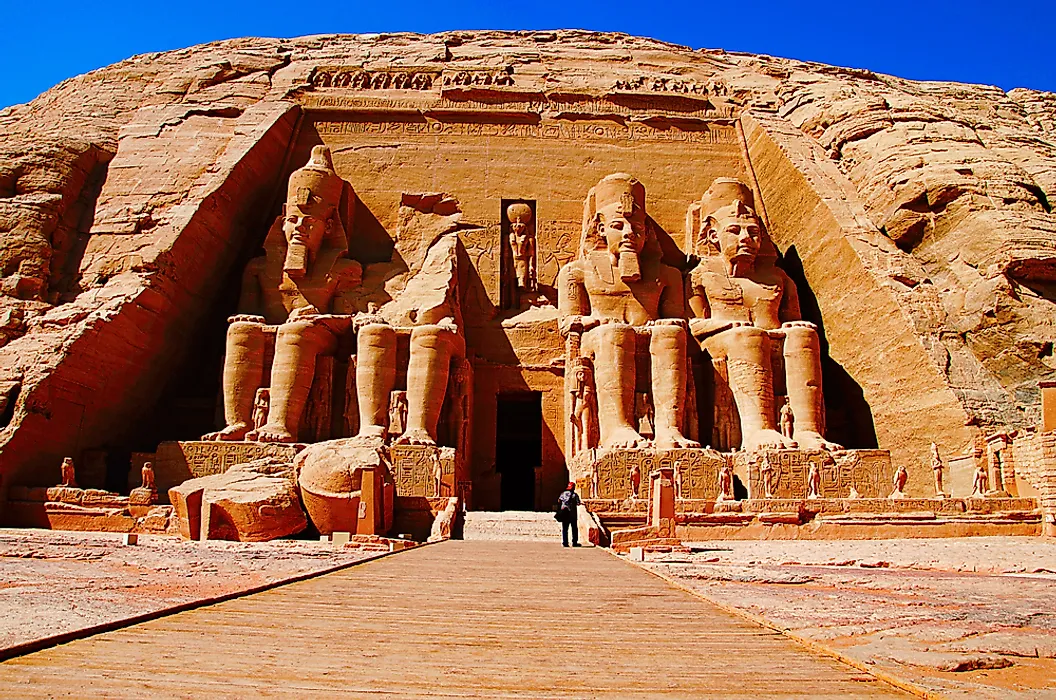
Ramesses II, also known as Ramesses the Great, ruled for 66 years in the New Kingdom's 19th dynasty. Spending much of his early reign maintaining Egyptian influence throughout Syria and the Levant, Ramesses' legacy as a military leader was greatly enhanced by his much-publicized claim of victory at the Battle of Kadesh against the Hittite Empire. The Egyptians and Hittites created one of the earliest surviving international peace treaties, with Ramesses marrying Hittite princesses to solidify their diplomatic relationship. Expanding temples throughout Egypt, Ramesses built the Ramesseum, the enormous rock-cut temples at Abu Simbel, and a new capital named Pi-Ramesses. Ramesses was featured on monuments as far north as modern Lebanon and as far south as Sudan. Ramesses' 66-year rule was so long that, when his successor, Merneptah, took power, he was already an old man.
Thutmose III

Although Thutmose III became Pharaoh as a child in about 1479 BCE, his aunt and stepmother, Hatshepsut, served as his regent, declaring herself Pharaoh and senior co-ruler for 20 years. Following Hatshepsut's death, Thutmose III went on to rule Egypt for 33 years, solidifying his reputation as a military leader through his victory at the Battle of Megiddo and numerous campaigns in Syria, Palestine, and Nubia. Ruling during the 18th Dynasty of the New Kingdom, Thutmose III funded enormous building projects, particularly at Karnak. Despite sharing the first third of his reign with Hatshepsut, Thutmose III went on to build his own powerful reputation.
Psamtik I

After the New Kingdom in Egyptian history came the Late Period. At the beginning of this, in 664 BCE, Psamtik I presided over a tumultuous time in Ancient Egypt. The 25th Dynasty of the Kushite Empire ruled both Egypt and Nubia for many years until the Assyrian Empire invaded and defeated them. Promoting local Egyptian rule, the Assyrians assisted Psamtik's rise to power, although the Pharaoh did not reassert control over Southern Egypt until about 656 BCE. After many years of foreign dominance, the Egyptian government and military had been decimated; Psamtik relied on a mix of Greek, Carian, and Phoenician mercenaries to reassert control over the kingdom. Psamtik allowed Greek merchants to access the cities of the Nile Delta, expanding cultural and commercial exchange between the two ancient powerhouses.
Amenhotep III

Amenhotep III was a New Kingdom Pharaoh of the 18th Dynasty. Unlike other, earlier New Kingdom sovereigns, Amenhotep's rule was more focused on diplomacy than military conquest. Amenhotep III inherited an empire that reached north into Syria and south into Nubia. His reign was largely peaceful and marked a pinnacle in wealth, architecture, and art. Egypt enjoyed international relations, trading gifts, correspondence, and royal marriages with Babylon, Mitanni, and the Hittites.
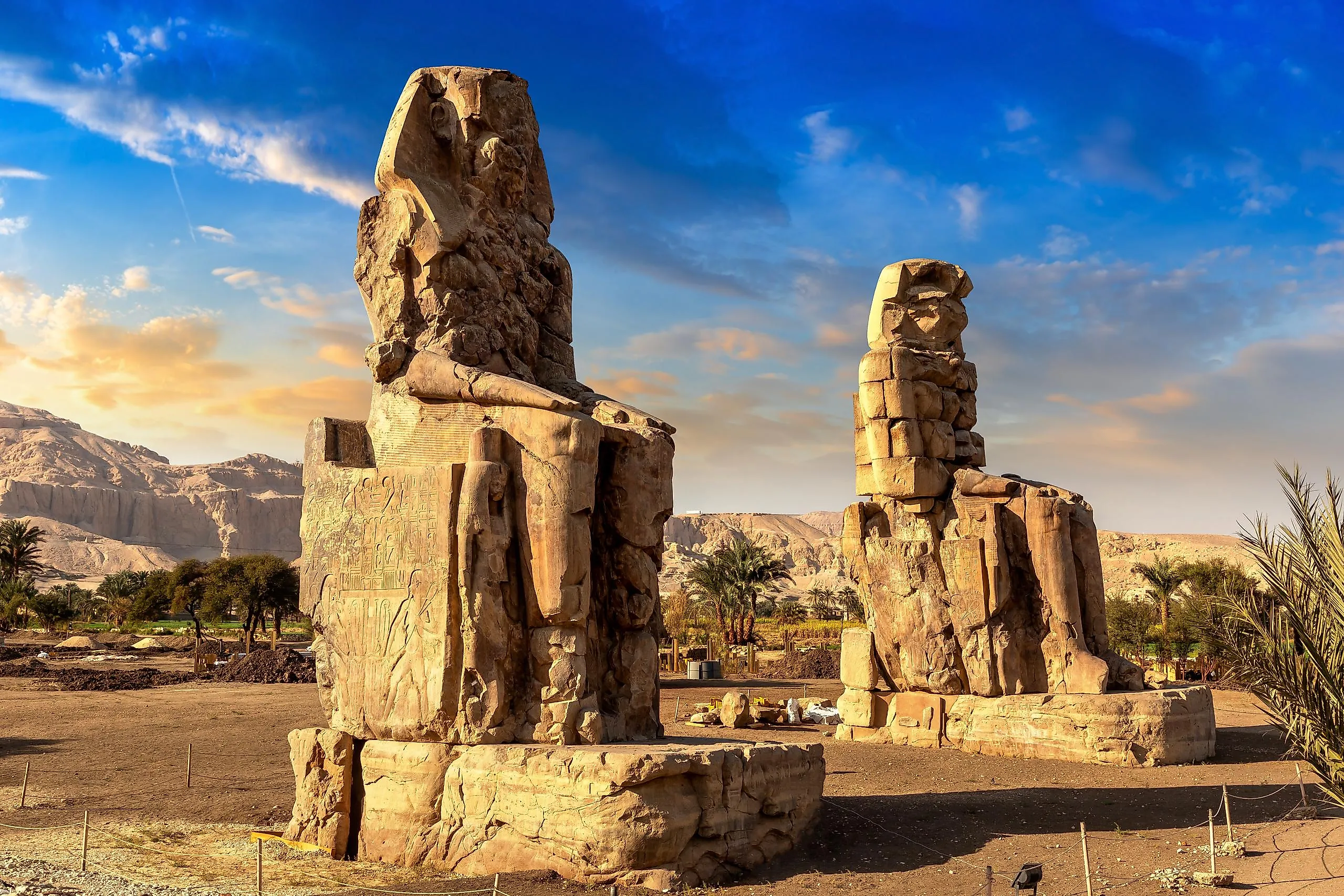
Amenhotep III funded large-scale building projects in the Luxor Temple, a gigantic mortuary temple at Thebes, and a series of colossal statues now known as the Colossi of Memnon. Amenhotep III was the father of Akhenaten and probably the grandfather of Tutankhamun. His successor, Akhenaten, drastically changed the traditional Egyptian religion, elevating the Aten, represented as a sun disc, above the Egyptian pantheon of gods, marginalizing their worship and relocating the capital to Akhetaten. After his death, these reforms were overturned and his new capital abandoned.
Senusret I

Senusret I was Pharaoh during Egypt's 12th Dynasty, from about 1961-1917 BCE. His father, Amenemhat I, founded the 12th Dynasty during the early Middle Kingdom, after Egypt had just recovered from the First Intermediate Period, so Senusret I inherited a kingdom rebuilding a strong central royal government. Senusret assisted in the rebuilding of royal authority by backing the construction of new temples and religious centers throughout the kingdom. Senusret I also conducted military operations in Nubia, securing Egyptian access to gold, trade routes, and other resources. Senusret built his pyramid complex at Lisht, near his father Amenemhat's, with whom he may have shared a co-regency, although scholars disagree on this point.
Amenemhat III

Amenemhat III ruled near the height of the Twelfth Dynasty, from about 1859-1813 BCE, after Amenemhat I, Senusret I, and their successors had built the Middle Kingdom into a highly centralized and wealthy power. Amenemhat III and his predecessors built extensive water management projects in the Fayum, a large natural depression west of the Nile River Valley, expanding irrigation and settlements throughout the region. The Pharaoh also oversaw extensive mining and quarrying in the Eastern Desert and the Sinai, acquiring valuable stones and minerals for royal construction and luxury items. Not content with just one, Amenemhat III built two pyramids. One was located at Dahshur, but the one that became his actual burial place was at Hawara; the complex was so extensive that later Greek writers called it the labyrinth.
The Long View Of Pharaonic Egypt

Although the Pharaohs on this list ruled for exceptionally long periods of time, their reigns were just a drop in the bucket compared to the long history of pharaonic Egypt. The pharaohs ruled Egypt for three millennia, from about 3100 BCE, when the kingdoms of Upper and Lower Egypt were unified by a pharaoh traditionally identified as Menes, until the death of Cleopatra VII and the Roman annexation of Egypt in 30 BCE. There the pharaohs lay, beneath the shifting desert sands, awaiting rediscovery in the 19th and 20th centuries, their incredible monuments towering over the Nile River Valley and Giza Plateau.