9 Strange Discoveries About Ancient Egypt You Never Learned in School
Ancient Egypt keeps handing archaeologists new surprises after 5,000 years. Muon detectors now peer through solid granite. Ground-penetrating radar maps buried cities. DNA analysis rewrites royal family trees. Yet the desert still holds sealed chambers no one has entered and kings whose names were deliberately scrubbed from the record. These finds range from the Predynastic era to headlines from 2025, and several of them turn up in monuments that millions of tourists already think they know, yet may never have learned about in school.
A Hidden Entrance in the Smallest Giza Pyramid

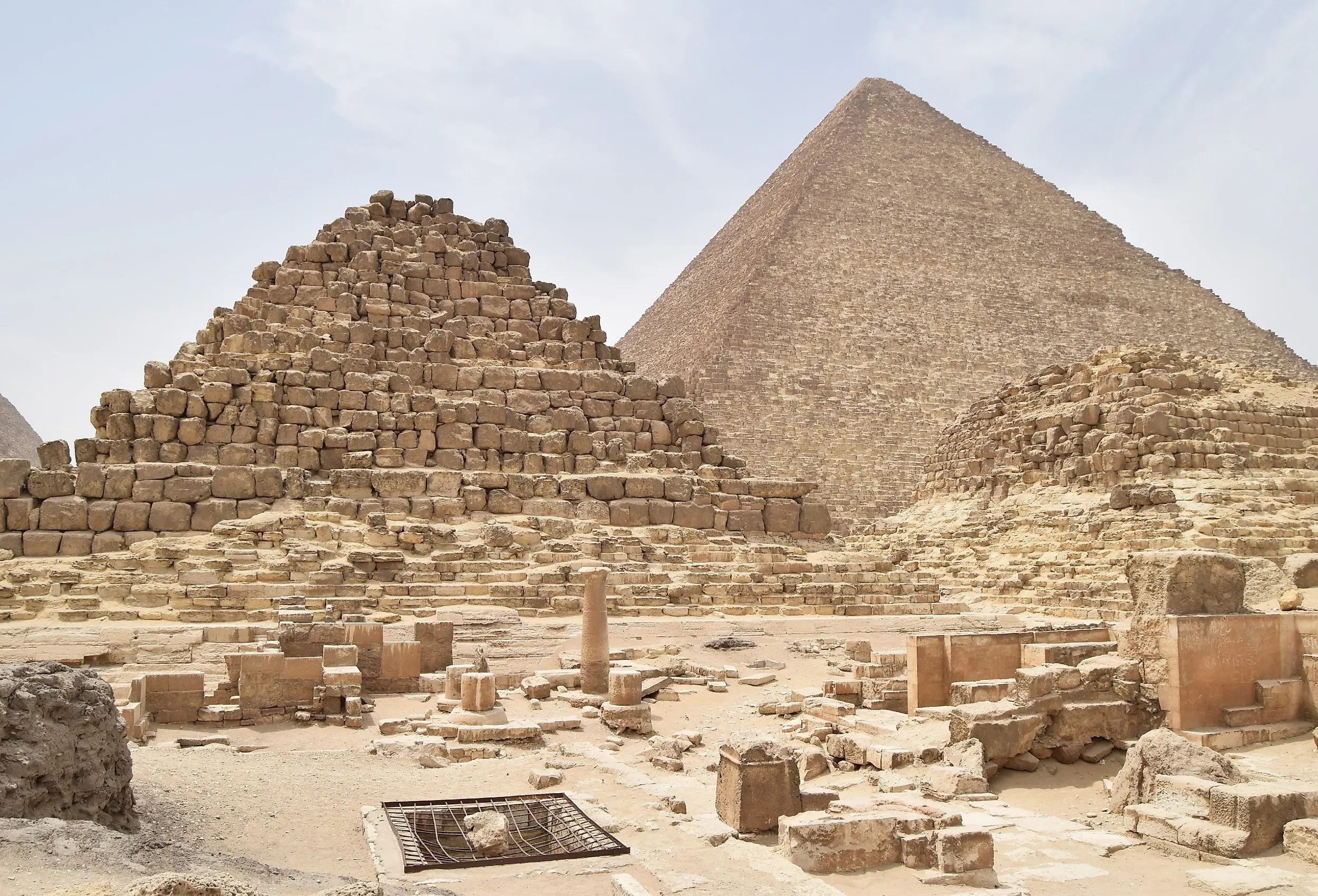
The Pyramid of Menkaure is the runt of the Giza trio, rising about 213 feet against the far larger monuments of Khufu and Khafre. Built during the Fourth Dynasty around 2510 BCE, it is made mostly of limestone but keeps a skirt of granite casing stones around its lower courses. One patch of that granite on the eastern face has bothered Egyptologists for decades. The stones there are ground as smooth as the masonry that frames the pyramid's only confirmed entrance, on the north side.
A study published in the journal NDT and E International in 2025, carried out by Cairo University and the Technical University of Munich under the ScanPyramids project, put that eastern patch to the test. Using ground-penetrating radar, ultrasound, and electrical resistivity tomography, the team detected two air-filled voids sitting just over a meter behind the polished blocks. The researchers stopped short of calling it a doorway. They argue instead that the voids offer the first physical evidence for a hypothesis floated back in 2019: that Menkaure was built with a second, sealed entrance no one has opened.
The Pharaoh Who Erased His Predecessors

Egyptian kings treated the historical record as editable. They chiseled rivals' names out of inscriptions, carved their own cartouches over older ones, and hauled off statues and temple blocks to prop up their own legitimacy. Horemheb, who took the throne around 1319 BCE as the last pharaoh of the Eighteenth Dynasty, ran one of the most thorough campaigns of the kind. He rose from the army to command it, then to the kingship, and he had no interest in the disgraced "Amarna" rulers who came just before him.
Horemheb dismantled the temples that Akhenaten had raised to the sun-disc Aten and recycled the blocks into his own building projects at Karnak. He usurped monuments belonging to Ay and Tutankhamun and dated his own reign back to the death of Amenhotep III, writing the Amarna years out of existence. He presented himself as the rightful heir to Amenhotep III and the man who restored traditional kingship. The erasure outlasted him. Later king lists, including the one Seti I of the Nineteenth Dynasty carved at Abydos, skip straight from Amenhotep III to Horemheb and leave Akhenaten, Tutankhamun, and Ay out entirely.
The First Royal Tomb Found in the Theban Necropolis Since 1922

In February 2025, Egypt's antiquities authority announced that a tomb in Wadi Gabbanat el-Qurud, roughly a mile and a half west of the Valley of the Kings, belonged to Thutmose II. That made it the first tomb of a New Kingdom pharaoh identified in the Theban necropolis since Howard Carter opened Tutankhamun's in 1922. Thutmose II ruled early in the Eighteenth Dynasty, around 1493 to 1479 BCE. He was the half-brother and husband of Hatshepsut, who would go on to rule as one of Egypt's most formidable pharaohs.
The joint Egyptian-British mission first found the entrance in 2022 and assumed it led to a royal wife, given how close it sits to the tombs of Hatshepsut and the consorts of Thutmose III. Fragments of alabaster jars inscribed with the king's name settled the question. The tomb itself was a wreck. Floodwater had poured in soon after the burial, and officials appear to have emptied it not long afterward. The king's mummy had already turned up in the 19th century, recovered from the Deir el-Bahari royal cache. Excavators suspect that the bulk of the original burial goods was moved elsewhere and may still be waiting to be found.
A King Nobody Knew Existed

In January 2025, a team from the University of Pennsylvania Museum digging at South Abydos hit a limestone burial chamber nearly 23 feet down, roofed by mudbrick vaults that once stood about 16 feet high. The scale and layout mark it as a king's tomb from the Second Intermediate Period, a fractured stretch of Egyptian history running roughly from 1640 to 1540 BCE, when the country splintered into rival kingdoms. The likely owner belonged to the Abydos Dynasty, a short-lived line of local rulers who governed part of Upper Egypt about 3,600 years ago.
Whose tomb it is remains an open question. The hieroglyphic inscriptions that once spelled out the king's name at the entrance were battered beyond reading, probably by ancient robbers. Without a legible cartouche, the excavators cannot yet name him, though they have floated candidates such as Senaiib and Paentjeni, whose monuments stand at Abydos but whose own resting places have never been located. Or it could be an unknown king. The dig is led by Josef Wegner, the same Egyptologist whose team confirmed the Abydos Dynasty in 2014 by uncovering the tomb of King Senebkay nearby.
Painted Coffins Under a Single Burial Shaft

In April 2017, excavators at Dra' Abu el-Naga on the west bank of Luxor opened the tomb of a New Kingdom official named Userhat. He was a city judge who lived some 3,500 years ago. Behind roughly 450 cubic meters of cleared debris waited ten wooden coffins, at least eight mummies, and more than 1,000 ushabti figurines, the small servant statues meant to do the deceased's labor in the afterlife. The tomb was first cut in the Eighteenth Dynasty and reopened for fresh burials centuries later, during the Twenty-first Dynasty, when tomb robbery was rampant, and priests moved bodies into safer ground.
The coffins are the prize. After nearly 3,000 years underground, many of the anthropoid cases still carry vivid red, blue, yellow, green, and black pigment. Their surfaces are covered in finely cut hieroglyphs and painted scenes of protective deities meant to guard the dead and steer them through the underworld. That preservation lets archaeologists study both the painting techniques of the period and the funerary beliefs the decoration was built to express.
The Big Void Inside the Great Pyramid of Khufu

Since 2015, the ScanPyramids project has probed Egypt's pyramids with cosmic-ray muon tomography, infrared thermography, and laser scanning, all without shifting a single stone. Muons pass through the atmosphere and penetrate solid rock, allowing researchers to locate hidden spaces by measuring how many particles pass through different parts of a structure. In 2017, three independent detection teams using different technologies reported the same anomaly inside the Great Pyramid of Khufu, a large cavity that became known as the Big Void.
A separate feature sits behind the chevron blocks above the pyramid's original northern entrance. A 2023 study characterized it as a corridor at least five meters long, and follow-up imaging suggested it runs closer to nine. What any of these spaces were for is still unsettled. Researchers have proposed structural roles that helped distribute the pyramid's colossal weight, leftover features from the construction process, or deliberately sealed elements whose purpose has simply been lost.
The Lost Golden City Preserved Beneath the Sand

In 2021, a mission led by Zahi Hawass announced the discovery of a large settlement dubbed the Rise of Aten (The Lost Golden City), built during the reign of Amenhotep III in the 14th century BCE. The team had actually gone looking for Tutankhamun's mortuary temple and stumbled onto a city instead. Its mudbrick neighborhoods survive in unusual detail, with some walls still standing close to ten feet high.
The site reads like a snapshot of working life in the New Kingdom. Excavators found large food-production zones capable of feeding a substantial population, workshops, metalworking areas, and administrative buildings, alongside jewelry molds, pottery kilns, weaving tools, scarabs, rings, and ordinary household objects. Because so much of the city is still buried, researchers expect it to become one of the most important sources anyone has for understanding how ordinary Egyptians actually lived.
Gold Tongues for Speaking in the Afterlife

Over the past several years, excavations at Taposiris Magna, Oxyrhynchus, and Marina el-Alamein have turned up burials with thin, tongue-shaped amulets of gold foil placed inside the mouths of the dead. The Oxyrhynchus finds, announced in December 2024, came from Ptolemaic-era tombs and joined a growing list of similar discoveries across cemeteries of the Ptolemaic and Roman periods. Egyptians regarded gold as the flesh of the gods, a material that never decayed, which made it a fitting substance to leave on the tongue.
Most Egyptologists read the amulets as symbolic aids for speech in the next world, meant to let the dead address Osiris, the god of resurrection and judgment of the dead. A gold tongue could allow its owner to recite the right prayers, answer during judgment, and communicate beyond the grave. The custom appears to be uncommon, but its appearance at multiple sites shows how Egyptian funerary tradition continued to evolve well into the Greco-Roman age.
The World's Oldest Figurative Tattoos

In 2018, researchers reported that infrared photography had resolved faint smudges on two Predynastic mummies into the oldest known figurative tattoos. The markings had gone unnoticed for more than a century of museum display. The find showed that symbolic tattooing was already being practiced in Predynastic Egypt and pushed the earliest direct evidence for tattooing anywhere in Africa back by roughly 1,000 years.
The remains, known as Gebelein Man A and Gebelein Woman, were found near the site of Gebelein in Upper Egypt and now belong to the British Museum. On Gebelein Man A's upper arm, the images read as a wild bull overlapping a Barbary sheep, both motifs familiar from Predynastic art. The linear and S-shaped marks on the Gebelein Woman are harder to interpret. Both bodies date to roughly 3350 to 3000 BCE, centuries before the pyramids rose or a unified Egyptian state existed.
A Civilization Still Emerging From the Sand
Ancient Egypt is one of the world’s most extensively studied ancient civilizations, and it is also one of the least finished. Nearly every excavation season forces some revision, whether it arrives as a forgotten pharaoh, a sealed corridor inside a familiar pyramid, or fresh proof that a king rewrote the record to serve his own ambitions. As the scanning gets sharper and the digging reaches deeper, the next major find may well surface inside a monument that millions of people walk past every year.