The Rise And Fall Of Cleopatra And Ptolemaic Egypt
Cleopatra VII's rise and fall has been told and retold for two thousand years, but its meaning shifts when you set it inside the larger story of the Ptolemaic dynasty. Cleopatra wasn't just the last pharaoh of Egypt; she was the last ruler of a Greek-Macedonian dynasty founded after the breakup of Alexander the Great's empire, a line that had ruled Egypt for nearly three centuries. Her romantic and political alliances with two Roman leaders, Julius Caesar and Mark Antony, also tied her country's fate directly to Rome's civil wars. Understanding what happened to Cleopatra means understanding what happened to that wider Hellenistic world.
Background

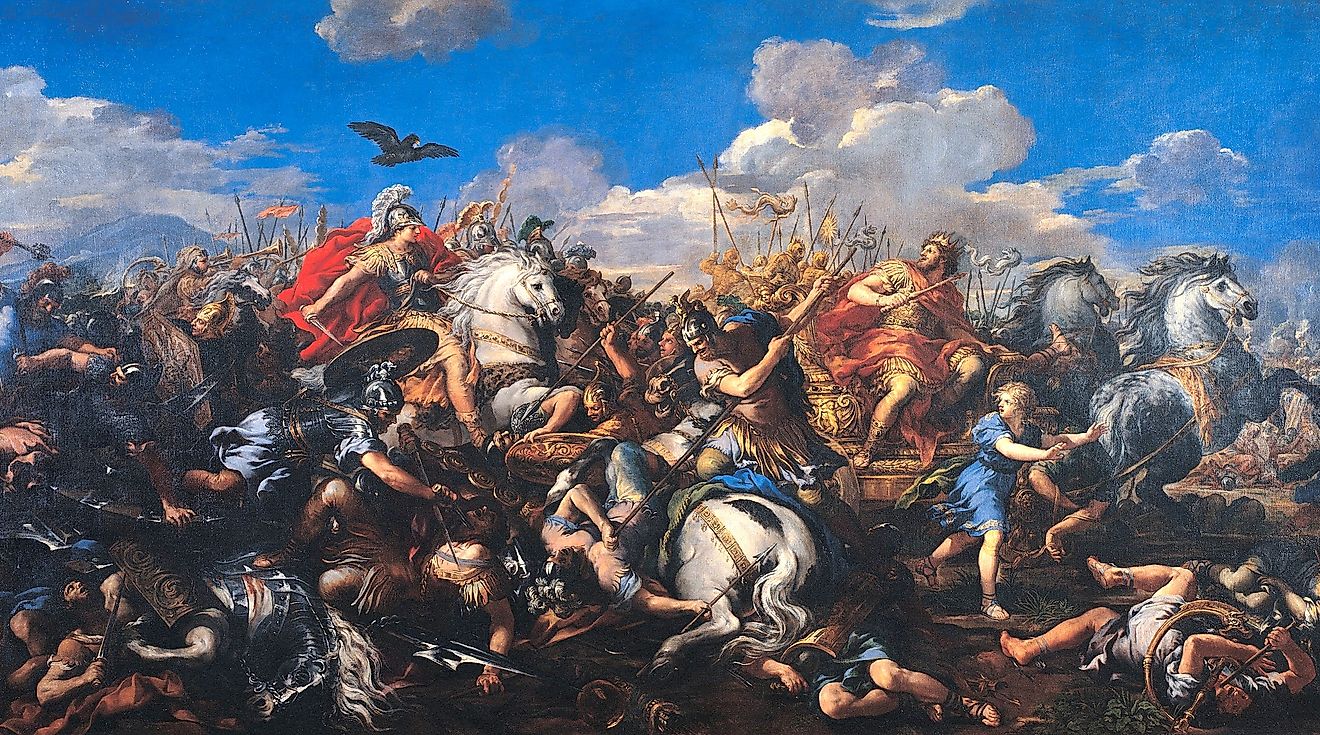
When Alexander the Great died in Babylon in 323 BCE, his empire fractured almost immediately. An initial power-sharing arrangement collapsed under the rivalries of his generals, the Diadochi, who fought a series of wars (the Wars of the Diadochi) for control of his territories. One of those generals, Ptolemy, son of Lagus, was named satrap of Egypt in 323 BCE and consolidated his hold over the country across the next two decades. In 305 BCE, with Alexander's empire effectively partitioned, Ptolemy declared himself king and pharaoh, taking the title that would later earn him the epithet Soter, "Savior."

Over the next three centuries, Ptolemaic Egypt became the dominant Hellenistic power in the eastern Mediterranean. Its capital, Alexandria (founded by Alexander himself in 332 BCE), grew into the cultural and intellectual center of the Greek world. The Library of Alexandria collected hundreds of thousands of scrolls and supported scholars including Euclid, Archimedes, and Eratosthenes. The dynasty's blend of Egyptian pharaonic traditions and Greek administrative practice produced a stable and effective state, while Egypt's natural defenses (vast deserts to the east and west, the cataracts of the Nile to the south, the sea to the north) made it difficult to invade.
The Rise Of Cleopatra

By the time Cleopatra VII was born in 69 BCE, Ptolemaic Egypt was a much-diminished kingdom. Generations of dynastic infighting between siblings (assassinations, exiles, and civil wars were almost routine) had drained the royal house. Heavy taxation and an over-reliance on grain agriculture had left the economy stagnant. The Greek ruling class had grown unpopular among native Egyptians, who were largely shut out of high political office. By the early first century BCE, Egypt was financially dependent on Rome, and many in the Mediterranean world treated the country as a Roman client state in all but name.
When Cleopatra's father, Ptolemy XII Auletes, died in 51 BCE, his will named Cleopatra (then 18) and her brother Ptolemy XIII (about 10) as joint rulers and required them to marry, following Ptolemaic custom. The arrangement was unstable from the start. Cleopatra, older and more politically capable, issued royal decrees in her name alone and sidelined her brother's regency council, which included the eunuch Pothinus, the general Achillas, and the tutor Theodotus. In 48 BCE, that council pushed back: Cleopatra was driven from Alexandria and forced to flee to Syria, where she began raising an army to retake the throne. Ptolemy XIII's faction had effectively triggered a civil war.
Cleopatra And Julius Caesar

That same year, the Roman general Julius Caesar arrived in Alexandria pursuing his rival Pompey, who had fled there after his defeat at the Battle of Pharsalus. Pompey had been a longtime ally of Ptolemy XII, but Ptolemy XIII's advisors had Pompey killed before Caesar's arrival, hoping to win Caesar's favor. The gambit backfired. According to ancient accounts, Cleopatra had herself smuggled into Caesar's quarters at the royal palace, possibly inside a rolled carpet or sack of bedding, to make her appeal in person. Caesar, by then her lover, sided with her. The Alexandrian War followed, ending with Ptolemy XIII's death by drowning in the Nile in early 47 BCE during a chaotic retreat.
Caesar then formally restored Cleopatra to the throne, paired with another younger brother, Ptolemy XIV, in a nominal co-rulership that Cleopatra fully dominated. Cleopatra and Caesar produced a son, Ptolemy XV (popularly called Caesarion, "Little Caesar"), born in 47 or 46 BCE. After Caesar was assassinated in Rome on the Ides of March, 44 BCE, Cleopatra returned to Egypt; Ptolemy XIV died shortly afterward, almost certainly poisoned at her command, clearing the way for Caesarion to be elevated as her co-ruler in September 44 BCE.
Cleopatra And Mark Antony

Caesar's assassination plunged Rome back into civil war. With her most powerful Roman ally gone, Cleopatra waited to see who would emerge on top. The new Second Triumvirate (Octavian, Mark Antony, and Lepidus) defeated Caesar's assassins at Philippi in 42 BCE and divided the Roman world among themselves. Mark Antony took control of the eastern provinces, which placed Egypt squarely within his sphere.
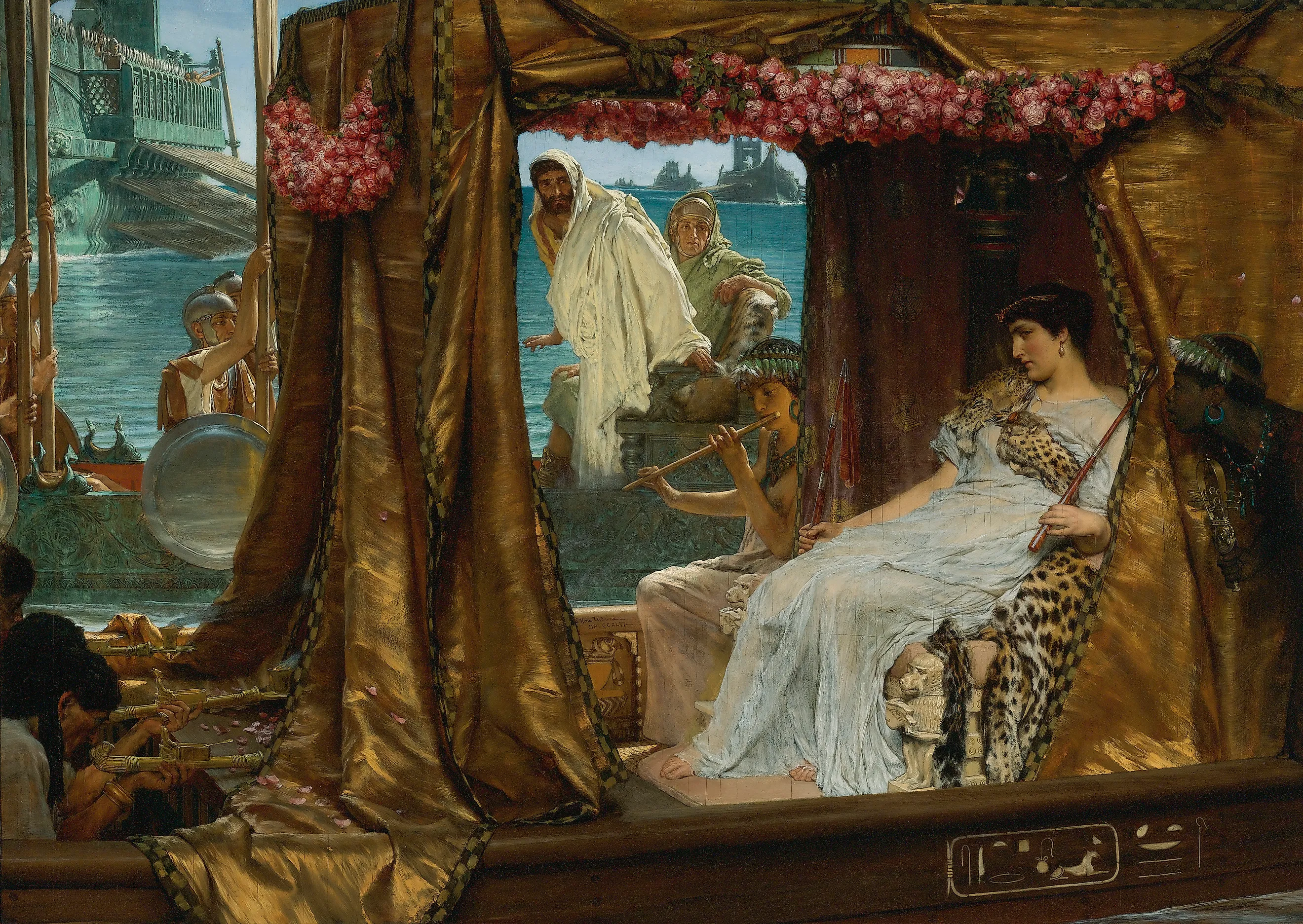
In 41 BCE, Antony summoned Cleopatra to meet him at Tarsus, in modern-day Turkey, to answer for the resources Egypt had supplied to the assassins. According to Plutarch's account, Cleopatra arrived on a gilded barge dressed as the goddess Aphrodite, a piece of political theater calculated to dazzle. The strategy worked. Antony needed Egyptian wealth to fund his planned invasion of Parthia; Cleopatra needed Roman protection to keep her throne. The alliance, both political and personal, lasted more than a decade and produced three children.
The Fall Of Cleopatra And Ptolemaic Egypt

Antony's relationship with Cleopatra became a political liability in Rome. His rival Octavian, Caesar's adopted heir, used the alliance as the foundation of an effective propaganda campaign: Antony was a Roman general who had abandoned Roman duty for an eastern queen, who had given Roman territory away to her foreign children, and who had ceased to act in Roman interests. The Donations of Alexandria in 34 BCE, in which Antony parceled out eastern provinces and titles to Cleopatra and their children, gave Octavian everything he needed to argue the case. The Roman Senate stripped Antony of his offices, declared war on Cleopatra in 32 BCE, and the showdown came the following year.
The Battle of Actium, fought off the western coast of Greece on September 2, 31 BCE, was a naval engagement that pitted Octavian's fleet, commanded by Marcus Vipsanius Agrippa, against the combined navies of Antony and Cleopatra. The battle ended with Antony and Cleopatra breaking through the line and fleeing south to Egypt, leaving most of their fleet behind. Octavian invaded Egypt the following year. Cornered in Alexandria in August 30 BCE, Antony took his own life, and Cleopatra followed him days later, traditionally said to have died from the bite of an asp smuggled into her chambers, though most modern historians think she more likely used a self-administered poison. Octavian had Caesarion executed shortly after capturing Alexandria, ending the Ptolemaic dynasty after 275 years. Egypt became a Roman province, and its grain wealth went directly to the personal control of the emperor.
Impact And Legacy
Cleopatra was the last sovereign of an order that stretched back to Alexander the Great. Her death didn't just end her own line but a centuries-long chapter of Greek political and cultural dominance over Egypt. The country that emerged after Actium was a Roman possession in a way it had never been before, and the Hellenistic world that the Ptolemies had helped build effectively ended with her. The personal alliances she made with Caesar and Antony, often portrayed in retrospect as romance, were also calculated political acts to keep Egyptian sovereignty alive against an expanding Rome. They almost worked. The fact that they didn't has shaped how every generation since has imagined her.