8 Of The Largest Zoos in the US
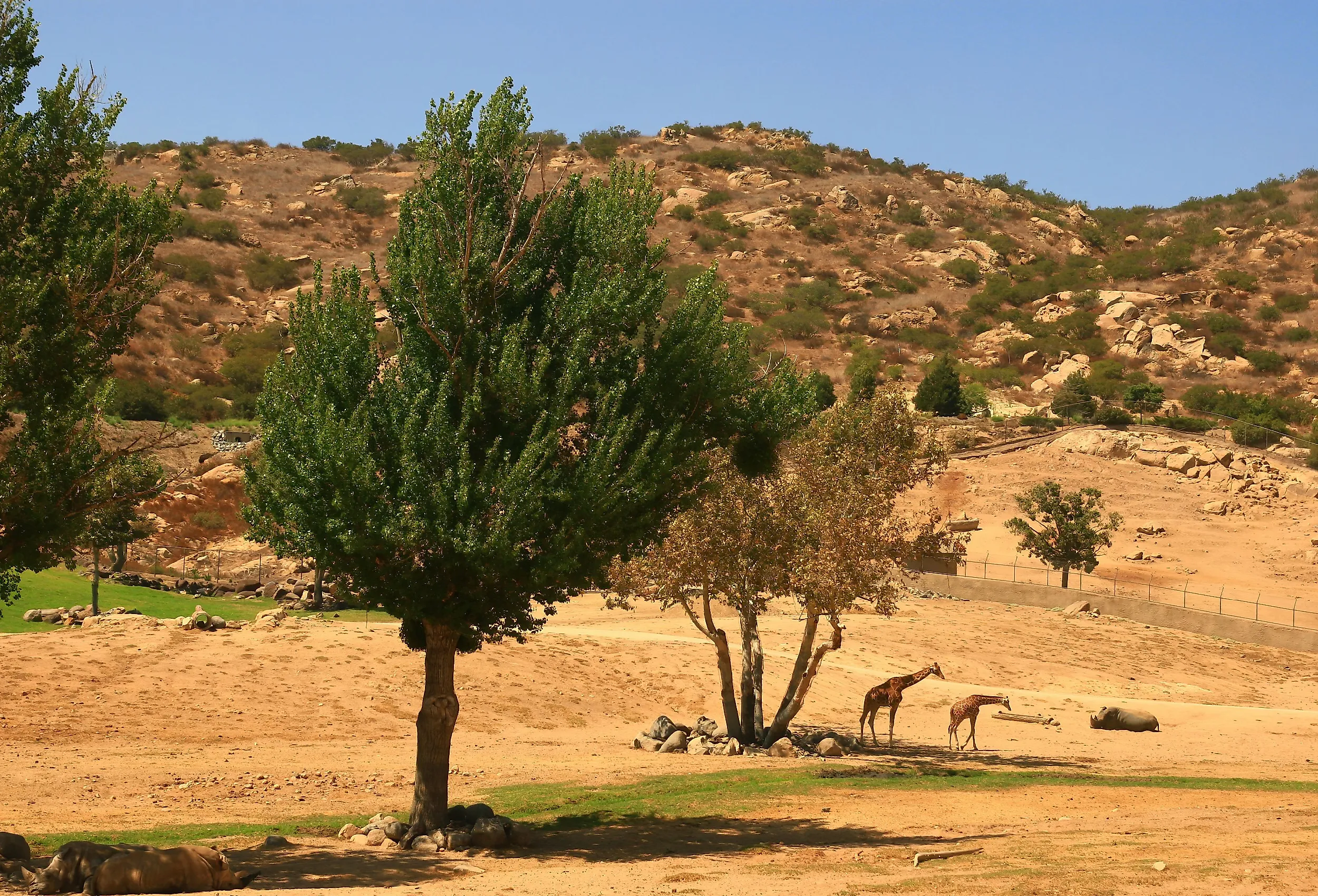
The Living Desert Zoo and Gardens in Palm Desert, California, owns about 1,200 acres and lets visitors walk on roughly 80 of them. The rest is desert hillside the zoo holds rather than builds on, which turns out to be the quiet truth behind almost every entry here. Ranking American zoos by size means choosing between the land a zoo develops and the land it simply owns, and those two numbers can differ by a factor of fifteen. The eight below are the largest walk-through zoos in the country by total acreage, with the developed figure given alongside wherever the gap matters. Safari parks toured by vehicle and theme parks with roller coasters are a different category and are not counted, which is also why the order looks nothing like the usual rankings of top zoos.
North Carolina Zoo, North Carolina

At roughly 2,600 acres just south of Asheboro, the North Carolina Zoo is the largest in the country by a margin nothing else approaches. It develops about 500 of those acres, and on the strength of that figure the zoo bills itself as the world's largest natural habitat zoo. The design logic is simple enough: rather than compress animals into a compact downtown footprint, it spreads more than 1,700 animals across 250-plus species over landscaped habitats built to imitate African and North American ecosystems. Opened in 1974, it is one of only two state-owned zoos in the United States.

The newest addition is a 12.5-acre Asia continent that cost about 75 million dollars, houses tigers, king cobras, white-cheeked gibbons and Komodo dragons, and has not opened. Construction finished. The animals moved in and settled. North Carolina then went without a comprehensive state budget for over a year, leaving the zoo unable to hire the roughly seventy staff the expansion needs to run, so a completed 75-million-dollar exhibit currently operates as very expensive private housing for a group of tigers. Target dates in September 2025 and June 2026 both passed without an opening.
What visitors can do is ride the Zoofari, an hour-long open-air vehicle tour across the 40-acre Watani Grasslands, where ostriches and rhinoceroses have the run of the place. Tickets are sold the day of at Junction Plaza. Seeing the developed half of the zoo on foot is a genuine hike, and the shoes matter more than the map.
San Diego Zoo Safari Park, California

The 1,800-acre Safari Park near Escondido is the country cousin of the San Diego Zoo proper, about thirty miles away in Balboa Park, and the two are run by the same organization. Roughly 900 of those acres are undeveloped coastal sage scrub, meaning half the park is deliberately left as nothing at all. It went by San Diego Wild Animal Park until a 2010 rename. The collection runs past 3,000 animals across close to 300 species by the park's own count, though some tallies put the species figure well above 400.

Open-range habitats here were built so herd animals could behave like herd animals, and the Africa Tram crosses them at no extra charge. Paid options escalate from there: cart safaris, behind-the-scenes tours, and the Roar and Snore overnight in one of 46 tents. The zip line carries riders about two-thirds of a mile at heights reaching 130 feet, which is one way to see rhinos and not the restful one.
A new elephant habitat opened in March 2026, giving the park's African elephants considerably more ground. The park also runs a cryogenic cell bank for endangered species, and maintains live animal cameras for anyone who cannot get to California.
The Living Desert Zoo and Gardens, California

Third-largest in the country, and the entry that makes the total-acreage measure look ridiculous: The Living Desert holds about 1,200 acres and has developed roughly 80. Everything else is preserved desert on the edge of Palm Desert. Opened in 1970 and accredited since 1983, it keeps more than 500 animals across 150-plus species, all of them chosen because they belong in a desert rather than in spite of it.
Visitors can hand-feed the giraffes romaine lettuce, selected for the job specifically because romaine is mostly water and almost no calories. The giraffes are fed all day by a rotating public and the arrangement only works if what they are being fed barely counts as food.
The conservation record is more substantial than the acreage split suggests. The zoo has contributed to returning Arabian oryx to Oman and to local recovery work for peninsular bighorn sheep. One clarification worth making: an unrelated Living Desert Zoo and Gardens State Park operates in Carlsbad, New Mexico, and lost its accreditation in 2023. Different institution, similar name.
Zoo Miami, Florida

Zoo Miami covers 750 acres with 324 of them developed, making it both the largest and the oldest zoo in Florida. Its origin is a matter of public record and remains hard to improve on: in 1948 the operation began when three monkeys, a goat and two black bears were bought for 270 dollars from a small road show stranded near Miami. That collection became the 48-acre Crandon Park Zoo on Key Biscayne, which relocated to the current mainland site in 1980.
The climate is the real asset. Zoo Miami is the only subtropical zoo in the continental United States, so animals from Asia, Africa and Australia live outdoors year-round without heated indoor houses, an arrangement no northern zoo can match at any acreage. About 3,000 animals across roughly 500 species are grouped by region along several miles of pathway.
It is a long, hot walk, and the tram and rental bikes exist for good reason. Longtime communications director Ron Magill has been the public face of the place for decades, which in South Florida counts as institutional continuity.
Columbus Zoo and Aquarium, Ohio

The Columbus Zoo and Aquarium sits in Powell, north of Columbus, on about 580 acres it owns, of which roughly 406 are zoo. The remainder is a water park and an 18-hole golf course occupying something like 140 acres, which is to say the golf alone takes up more land than most American zoos have in total. Habitat regions cover Africa, Asia, Australia, the polar world, the Congo, North America and the shoreline, holding over 10,000 animals.

Much of its national profile traces to Jack Hanna, director between 1978 and 1992 and director emeritus afterward. Attendance rose more than 400 percent during his tenure, helped considerably by a 1983 Good Morning America appearance with twin baby gorillas and years as a reliable guest on David Letterman's shows. Hanna retired as the zoo's spokesperson in 2020, and his family announced a dementia diagnosis in 2021.
The institution has had a harder recent decade than the acreage suggests. It lost its accreditation in 2021, the first such loss in 41 years, amid a financial misconduct case in which former executives were later indicted over the theft of nearly 2.3 million dollars. Accreditation was regained in 2023. The zoo also owns a 9,154-acre conservation site in Cumberland, Ohio, which is toured by bus rather than on foot and is not counted in the figures above.
Minnesota Zoo, Minnesota

The 485-acre Minnesota Zoo in Apple Valley answered a question most zoos would rather avoid, which is what the animals are supposed to do for five months of winter. It leaned in and built the collection around cold-climate species, so the Northern Trail carries Amur tigers, takin and wild horses that are entirely comfortable below freezing. Opened in 1978, it is a state agency and the other state-owned zoo alongside North Carolina's, holding more than 4,500 animals across roughly 500 species.
Its best feature came from a failure. A monorail opened here in 1979 and was retired in 2013, and rather than demolish the track the zoo converted it into the Treetop Trail, a 1.25-mile elevated walkway running as high as 32 feet above the habitats. The zoo calls it the world's longest elevated pedestrian loop, and the governor declared a Minnesota Zoo Treetop Trail Day when it opened in 2023.
The campus also contains a public high school. The School of Environmental Studies operates on zoo grounds, which means several hundred teenagers spend their school day at a zoo and, by all accounts, stop noticing.
Binder Park Zoo, Michigan

Binder Park Zoo in Battle Creek, Michigan, covers 433 acres, which puts a mid-sized zoo most people outside the state have never heard of ahead of the Bronx Zoo on land. It opened in 1977 and keeps around 500 animals across 140 species, with a good deal of the acreage left wooded between exhibits.
The centerpiece is Wild Africa, a 50-acre section reached by a tram because walking to it would be its own outing, containing an 18-acre savanna. At the Twiga Overlook, visitors feed the giraffes, whose tongues run about 18 inches and remove lettuce from a hand with more precision than expected.
The zoo also operates a dinosaur attraction called Zoorasic Park, featuring the only category of animal it can guarantee will not escape.
Bronx Zoo, New York

At 265 acres the Bronx Zoo is the smallest entry here and the most improbable, since all of it sits inside New York City. It is widely cited as the largest metropolitan zoo in the United States, and it fits more than 4,000 animals across roughly 650 species into a footprint that still finds room for wooded river gorge. It opened in November 1899 with 843 animals in 22 exhibits, which makes it one of the older zoos in the country as well as the flagship of the Wildlife Conservation Society.

Its conservation record starts early and seriously. First director William Temple Hornaday co-founded the American Bison Society with Theodore Roosevelt in 1905, and in 1907 the society shipped fifteen bison from the Bronx to the Wichita Mountains Wildlife Refuge in Oklahoma, the first animal reintroduction carried out in North America. More herds went to Montana and South Dakota in 1913. In 1916 the zoo opened the world's first animal hospital located at a zoo.
It has also had a sense of humor about itself for a long time. In 1963 the zoo mounted an exhibit billed as the most dangerous animal in the world, and what visitors found behind the glass was a mirror. Elsewhere on the grounds sits the Rocking Stone, a balanced glacial boulder of roughly thirty tons that is perfectly poised and completely immovable.
What The Acreage Actually Buys
Sorted by developed land instead of total land, this list reorders itself completely. The Living Desert falls all the way to last place, the North Carolina Zoo shrinks to 500 usable acres, and the Bronx Zoo, which develops nearly everything it owns, climbs. Neither measure is wrong, but the gap between them is the interesting part, because undeveloped acreage is not wasted acreage. It is buffer, breeding space, and native habitat a zoo has taken off the market, which is the same work these institutions do for threatened and endangered species inside the fence. The ethics of keeping animals in zoos remain genuinely contested, and the standards separating a well-run institution from a poorly run one are worth knowing before choosing which zoos to support. Land is not the whole answer. It is just the part that can be measured from above.