The First Ski Resort In America
It's no surprise that America's first ski resort is in Colorado, the most-skied state in the country. Skiers and snowboarders made 10.5 million visits to its slopes in the 2025-26 season, according to The Colorado Sun, which is double California's total. And the hill where it all started is a 440-foot slope in a Steamboat Springs city park.
Howelsen Hill has operated every winter since a Norwegian circus performer made the first jump there in 1915, and the National Ski Areas Association (NSAA), the industry's trade group, places it first among 354 American ski areas by founding year. That's the yardstick we've used here: the oldest ski area still selling lift tickets to the public. Here's how the ranching town of Steamboat Springs ended up becoming home to America's oldest ski resort.
A Ski Resort Is Born
In February 1914, a crowd of 2,000 people gathered on Woodchuck Hill, the rise where Colorado Mountain College now stands, to watch a ski jumping contest at the first Steamboat Springs Winter Carnival. The man who organized it was Carl Howelsen. Born in Oslo in 1877, he was a cross-country racer and jumper who had won medals at Holmenkollen, Norway's national ski festival, in 1902 and 1903.
Howelsen emigrated to the United States in 1905 and signed on with the Barnum and Bailey circus. Billed as the Flying Norseman, he was paid $200 a week to ski down a greased ramp and jump over a pair of elephants. He left the circus for Denver in 1911, and two years later, after a visit to Steamboat Springs, became the owner of a ranch in Strawberry Park, north of town.
At the time, ranchers in the Yampa Valley around Steamboat Springs used skis to get around in winter, not for fun. Howelsen changed that within a year of arriving. Along with the carnival, he helped found the Steamboat Springs Winter Sports Club to plan the event and coached its young skiers. It was the first winter sports club in the West, and it still runs the carnival today.
The First Big Jump

For the second carnival, Howelsen wanted a steeper hill to help participants set new records. Elk Park, a fenced wild-game enclosure owned by the Steamboat Springs Company, the town's development firm, was to prove ideal. In December 1914, he and volunteers from the Winter Carnival Committee began clearing the slope. A wooden jump followed, and on February 6, 1915, Howelsen himself was the first to use it. The hill opened in time for the carnival later that month.
Known locally simply as "Big Hill" or "Big H," the ski hill was renamed for Howelsen in time for the 1917 carnival. And as the hill's popularity grew, the records came quickly. Norwegian jumper Ragnar Omtvedt flew 193 feet there in 1916 for a world record, and American Henry Hall beat it with 203 feet the following year.
Howelsen eventually moved back to Norway in 1922, and a bronze statue of him, unveiled in 2009, stands on Lincoln Avenue, Steamboat Springs' main street.
Almost The Big Time
The first lift at Howelsen Hill was a boat tow, and very much a feat of improvisation and ingenuity. Consisting of a sled hauled up the slope on a cable, it was powered by the engine and transmission of a Ford Model T. Originally rigged up in 1934 to haul lumber for jump repairs, it was soon adapted to carry eight skiers at a time up the slope. An electric motor replaced the car engine in 1937.
That same year, a spotlight was mounted on a building in town to light up the runs, making Howelsen Hill one of the first ski areas to offer night skiing. It was also in 1937 that the City of Steamboat Springs took ownership of the hill. A beginner rope tow followed in 1945, a base lodge in 1946, and in 1948 a T-bar ran to the top of Emerald Mountain, 1,000 feet above the hill.
The hill's defining moment came in May 1972. Denver had been awarded the 1976 Winter Olympics, and Howelsen Hill was to host the Nordic events, until its 90-meter jump burned to the ground (arson by opponents of the Games was suspected). But that November, Colorado voters rejected Olympic funding, Denver withdrew, and Howelsen was left with one less jump and no money to replace it.
The Million-Dollar Rebuild
That's when John Fetcher, a Steamboat Springs resident and member of the Denver Olympic Committee, stepped in. The interational-regulation jumping complex costed $1.1 million to build and it was funded through from residents and four charitable foundations. It was dedicated in January 1978, when the hill hosted the North American Ski Jumping and Nordic Combined Championships (Nordic combined pairs a jump with a cross-country race).
That complex is why the city calls Howelsen Hill the largest and most complete natural ski jumping complex in North America. The three big hills were reprofiled in 2001 to the current HS127, HS100, and HS75 specifications (HS, or hill size, is the distance in meters to the farthest safe landing point), with the HS75 given a plastic surface for summer jumping in 2005. In 2010, new lights and a year-round training jump were also added.
Plenty of America's best skiers and jumpers learned their craft on Howelsen Hill. The city counts 100 Olympians and more than 150 Winter Olympic appearances from athletes who trained here and says the hill has sent more skiers to international competition than any other area in North America.
Howelsen Hill Today
The city's Ski Free Sundays program is on the entire season, covering alpine and Nordic sports alike. The 2026-2027 season is scheduled to run from November 28 through to March 28, conditions permitting. The hill closes on Christmas Day.
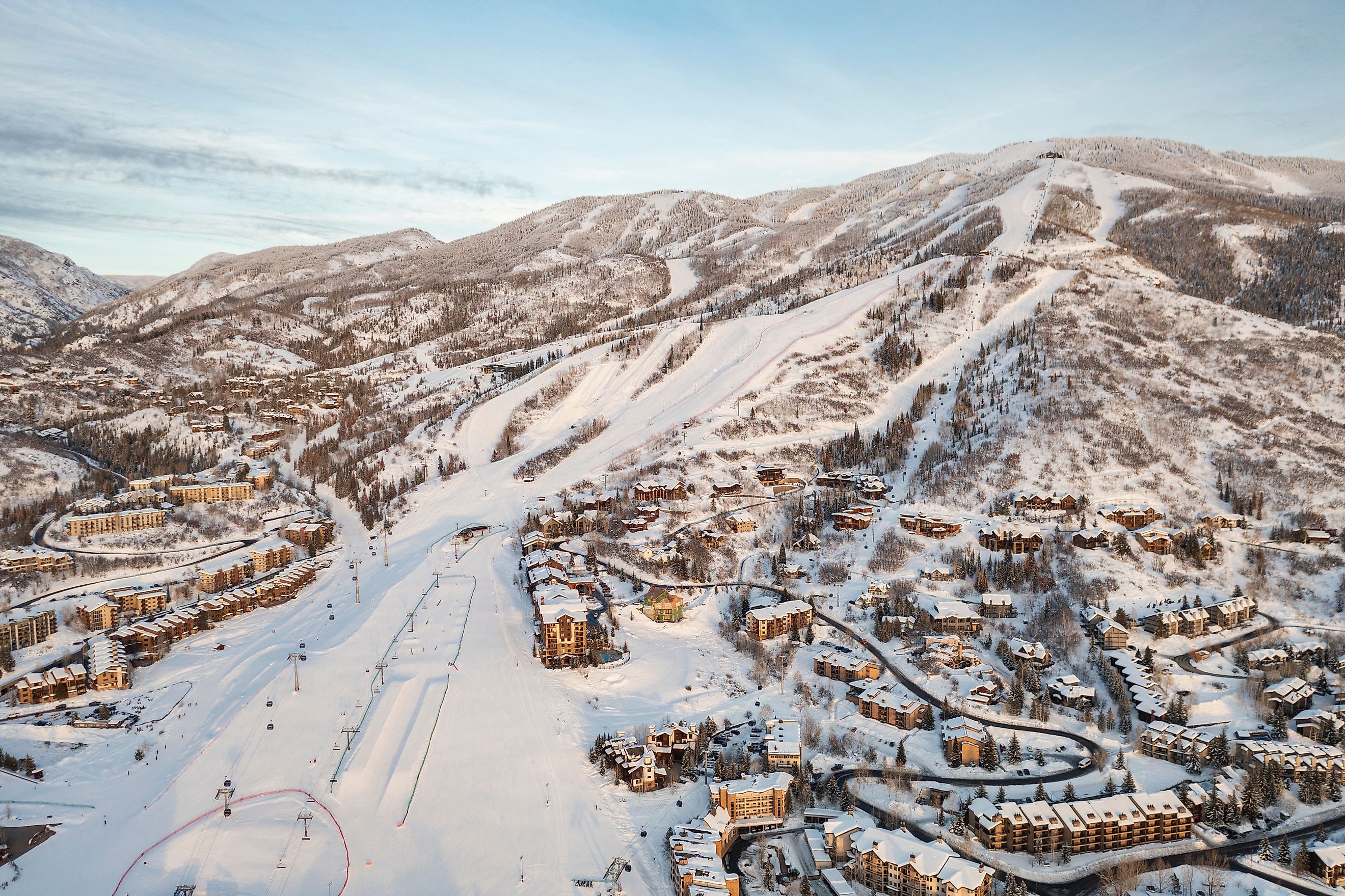
The terrain is modest by Colorado standards, with a base at 6,696 feet and a summit at 7,136 feet, along with 17 alpine trails and snowmaking on half the acreage, it's an ideal locale for beginners and casual skiers.
Four lifts serve the hill: the Barrows triple chair, a three-seat chairlift; the Boardwalk carpet, a conveyor-belt lift for beginners; the Poma, a surface lift that tows skiers uphill on a platter between their legs and runs until 8 p.m. on weeknights for night skiing; and a carpet lift at Tube Howelsen, the snow tubing hill, which isn't covered by the free Sunday ticket. The nine Nordic trails cover 13 miles and are shared with snowshoers and fat bikers, cyclists on wide-tired snow bikes.
Winter Carnival Still Closes Main Street
Now in its 114th year, the Steamboat Springs Winter Carnival runs from February 2 to 7, 2027. Lincoln Avenue is closed and packed with plowed snow on Saturday and Sunday mornings so kids on skis and snowboards can be towed down it behind galloping horses, an event called skijoring. The same mornings bring a street slalom, three-legged races, shovel races, and the carnival parade.
Adding to the fun, the Steamboat Springs High School marching band performs on skis, one of the only such bands in the United States to do so. The event's Night Extravaganza, held Saturday night on Howelsen Hill, features ski jumpers passing through a ring of fire, skiers descending with flares, a fireworks display, and the Lighted Man, a skier who descends the face in a suit wired with lights and launching pyrotechnics.
The Tread of Pioneers Museum is the place to go for the rest of the town's story. Its permanent Ski Town USA exhibit traces skiing in the valley from transportation to sport and displays an original Barnum and Bailey poster of Carl Howelsen, along with an earlier Lighted Man suit on a mannequin.
America's First Ski Resort Keeps On Going
Not only is Howelsen Hill America's oldest ski resort, but it's also a city park, owned and operated by the City of Steamboat Springs. It runs at a loss and still gives lift tickets away on Sundays. And the same Steamboat Springs Winter Sports Club that Carl Howelsen helped found in 1914 still trains its ski jumpers on the original slope he and his volunteers cleared. Visit in February for the Winter Carnival or for some ski jumping, and it's easy to see why people keep on coming.