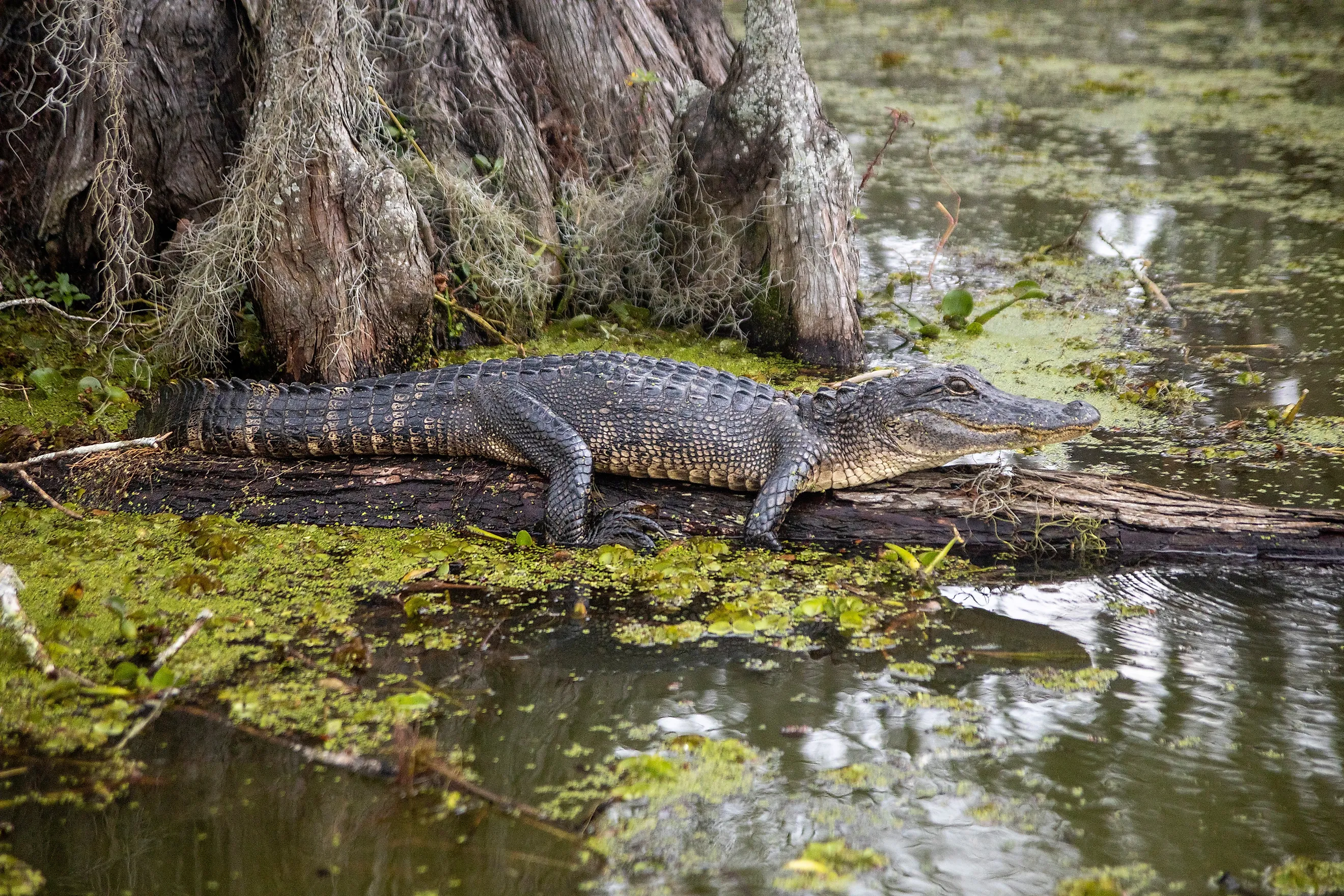
The US Lakes Where Alligators Live
American alligators live across the southeastern United States, from coastal North Carolina to South Texas. Florida holds some of the biggest lake populations, especially in Lake Okeechobee and Lake Jesup. But major populations also occur far beyond the peninsula. Warm, shallow water and dense shoreline vegetation matter more than whether a lake is natural or man-made. Some lakes on this list hold thousands of alligators. Others mark the northern or western edge of the species' regular US range.
Lake Jesup, Florida

Lake Jesup has long been regarded as one of the premier alligator lakes in the United States. Located northeast of Orlando, the roughly 8,058-acre lake is widely described by wildlife officials as having the highest concentration of alligators per acre in Florida, with local reports estimating more than 13,000 alligators living in and around the lake. Because of this, Lake Jesup has served as one of Florida's most important alligator research sites for decades. Scientists with the Florida Fish and Wildlife Conservation Commission and the U.S. Geological Survey have repeatedly surveyed the lake using nighttime spotlight counts, documenting some of the highest alligator densities recorded anywhere in the state. One long-term study found an average of 27.4 alligators per survey mile, highlighting just how exceptionally dense the population is compared with many other monitored lakes.
The lake's shallow water, extensive marshes, floating vegetation, and connection to the St. Johns River create ideal alligator habitat. Airboat tours regularly encounter dozens of alligators in a single outing, particularly during warmer months when many bask along the shoreline. Because alligators are so abundant, the FWC advises visitors to assume they may be present anywhere along the lake's edge.
Lake Okeechobee, Florida

Since the statewide alligator harvest program began in 1988, biologists have conducted annual night-light surveys across Florida's Lake Okeechobee to monitor population trends and determine sustainable harvest quotas. Lake Jesup is known for having the highest concentration of alligators in a lake in Florida, while Lake Okeechobee is known for having the highest population. In part, this is because rather than managing Okeechobee as a single body of water, the Florida Fish and Wildlife Conservation Commission divides it into four Alligator Management Units (west, north, east, and south). In total, it is estimated that there are around 30,000 alligators in Lake Okeechobee.
Covering roughly 730 square miles, Florida's largest freshwater lake averages only about 9 feet deep, allowing enormous marshes to develop around its edges. Those wetlands provide nesting sites, basking areas, and abundant prey, including fish, turtles, snakes, birds, and small mammals. The result is one of Florida's most intensively monitored alligator populations and one of the state's premier places to observe the species in its natural habitat.
Lake Marion, South Carolina

South Carolina's largest lake has become one of the state's best places to see wild alligators. Covering more than 110,000 acres, Lake Marion is fringed by flooded cypress and tupelo forests and shallow backwaters that provide excellent habitat for alligators. The lake falls within one of the state's designated Alligator Management Units, where regulated public hunting has been used since 2008 as part of long-term conservation. The South Carolina Department of Natural Resources states that Lake Marion, which is located near Congaree National Park, contains the most alligators in the state. It is followed by Lake Moultrie, which sits just to the south and is connected by the 6.5-mile Diversion Canal.
Lake Moultrie, South Carolina

Lake Moultrie is not simply an extension of Lake Marion's alligator habitat. South Carolina manages the 60,400-acre reservoir separately for alligator hunting, placing the entire lake within its Middle Coast management unit. Moultrie and Marion together form the Santee Cooper lake system, but the two bodies of water have different shorelines and habitat. Moultrie is surrounded by extensive low-lying Coastal Plain country, while protected coves, canals, marshy edges, and aquatic vegetation provide the cover alligators use for feeding and resting.
The lake's inclusion as a specific part of South Carolina's alligator management system provides unusually clear confirmation of an established population. Alligators can also move between Moultrie and Marion through the Diversion Canal connecting the two reservoirs. That makes the Santee Cooper system one of the most significant expanses of connected alligator habitat in South Carolina rather than a population limited to a single lake.
Lake Waccamaw, North Carolina

Lake Waccamaw brings the list close to the northern limit of the American alligator's regular range. Located about 40 miles west of Wilmington, the lake is the largest water-filled Carolina bay and has a shoreline extending roughly 14 miles. Unlike many acidic Carolina bay lakes, limestone beneath Waccamaw changes its water chemistry and supports an unusually diverse freshwater ecosystem. Alligators are an established part of that system rather than occasional visitors.
The North Carolina Wildlife Resources Commission conducts field research at Lake Waccamaw to study alligator health, diet, growth, and movement. The agency describes the area as holding hundreds of wild alligators, and researchers reported seeing 65 in a single day during fieldwork in 2024. Adults, juveniles, and previously tagged animals have all been captured and monitored there. Few lakes demonstrate the species' northern reach more clearly than Waccamaw, where alligators persist despite cooler winters than populations farther south in Florida and Louisiana.
Lake Kissimmee, Florida

Lake Kissimmee drew national attention in May 2025, when a woman was fatally attacked after her canoe passed over a submerged alligator near the mouth of Tiger Creek. Wildlife investigators described it as a rare defensive encounter that nevertheless underscored how frequently people and alligators share these waters.
Lake Kissimmee is part of the 65,000-acre Kissimmee Chain of Lakes, an interconnected system of Lakes Tohopekaliga, Cypress, Hatchineha, and Kissimmee that ultimately feeds Lake Okeechobee, the Everglades, and Florida Bay. That connectivity allows alligators to move throughout one of Florida's largest freshwater ecosystems rather than remaining confined to a single lake. While numbers vary, it is estimated that the greater chain is home to roughly 16,000 alligators.
Lake Eufaula, Alabama And Georgia

Lake Eufaula, officially Walter F. George Reservoir, covers 45,181 acres of the Chattahoochee River along the Alabama-Georgia border. Alligators are sufficiently established here that Alabama maintains a separate Lake Eufaula Alligator Management Area rather than grouping the reservoir entirely with surrounding counties. The management area covers Alabama's public waters in the reservoir and many of its navigable tributaries, although portions of the Eufaula National Wildlife Refuge are excluded.
Shallow creeks, sloughs, vegetated shorelines, and backwaters provide habitat along a reservoir better known nationally for bass fishing. Alabama's management rules also distinguish Eufaula from the state's other alligator zones by requiring harvested animals to meet an eight-foot minimum length. The regulations are designed around an existing breeding population rather than stray individuals moving through the Chattahoochee system. Lake Eufaula therefore provides one of the clearest examples of a major inland reservoir supporting alligators in both Alabama and Georgia.
Ross Barnett Reservoir, Mississippi

Ross Barnett Reservoir covers about 33,000 acres along the Pearl River northeast of Jackson. It is also the center of one of Mississippi's most intensively managed alligator populations. State wildlife biologists have reported particularly high alligator densities in Rankin County, with most of that population concentrated in and around Ross Barnett Reservoir and the adjoining Pearl River.
Pelahatchie Bay provides the strongest evidence of just how productive the reservoir can be for alligators. Mississippi established a special hunting season there specifically because suitable habitat had supported a dense breeding population. Unlike a general statewide hunt, the program is designed partly to remove adult breeding females and reduce the local population, human-alligator conflicts, and nuisance complaints. The reservoir combines open water with riverine habitat, shallow vegetation, tributaries, and protected bays, giving alligators access to several different types of freshwater habitat within the same system.
Millwood Lake, Arkansas

Millwood Lake in southwestern Arkansas demonstrates how far inland substantial alligator populations extend. The roughly 29,500-acre reservoir contains flooded timber, marshes, oxbow lakes, shallow coves, and river channels connected to the Little River system. Those features provide the secluded, slow-moving water and shoreline cover favored by American alligators. The lake is also warm enough to support a reproducing population despite lying well north of the Gulf Coast.
Arkansas manages Millwood as one of its principal public alligator hunting areas. For the 2026 season, the Arkansas Game and Fish Commission allocated 12 public permits to the lake with a nine-alligator harvest quota. Millwood receives more permits than any other single named lake in the state's public-land program. The quota system itself reflects active population management: once the designated number of animals has been taken, hunting on the lake closes for the season.
Caddo Lake, Texas

While there have been no reported alligator attacks on humans in Caddo Lake, the nearly 27,000-acre network of slow bayous, backwaters, and bald-cypress swamp supports a well-established alligator population in Texas. The exact number inhabiting the lake is unknown, but alligators are native to this part of the state and occur throughout suitable wetlands surrounding the Texas-Louisiana border.
Caddo's more than 70 fish species, along with turtles, snakes, birds, nutria, beavers, and other mammals, provide an unusually broad prey base. In addition, much of the water averages only eight to ten feet deep. This means alligators can stalk and capture prey by both blending into the floating vegetation and propelling out of shallow water.
Cypress Lake, Louisiana

Cypress Lake occupies just two acres in the middle of the University of Louisiana at Lafayette campus. Despite its modest size, the university-managed wetland has become one of Louisiana's best-known places to see wild alligators up close. The reptiles are such regular residents that the university issues annual public safety reminders during mating season, warning students to avoid nesting females, keep pets away from the shoreline, and never feed or provoke the animals. In 2013, officials fenced off part of the lake after a female alligator built a nest beside a campus sidewalk, with wildlife experts estimating it could contain as many as 100 eggs. The hatchlings emerged roughly two months later, and university staff documented eggshells around the nest after the young dispersed into the wetland. The university describes it as the only managed wetland located on the campus of a U.S. university, making encounters with wild alligators an unusually routine part of student life.
Lake George, Florida

Lake George connects directly with the St. Johns River and borders a wildlife management area exceeding 39,000 acres, much of it hardwood swamp, a suitable environment for alligators. After Hurricane Irma in 2017, Lake George lost most of the submerged vegetation that had historically covered thousands of acres. The FWC began restoration in 2020 and planted approximately one million eelgrass plants across more than 90 acres in 2025, creating additional cover and breeding habitat for the fish as well as for alligators. Florida Fish and Wildlife estimates around 2,600 alligators live in Lake George. This included a 13-foot gator that a couple caught in 2013.
Toledo Bend Reservoir, Texas And Louisiana

At 181,600 acres, Toledo Bend Reservoir is one of the largest man-made lakes in the United States, stretching for more than 65 miles along the Texas-Louisiana border. While it is internationally known as a trophy bass fishery, its flooded timber, quiet coves, marshes, and vegetated shoreline also support a well-established population of American alligators. Neither Texas Parks and Wildlife nor the Louisiana Department of Wildlife and Fisheries publishes a reservoir-specific alligator population estimate. Instead, both agencies manage alligators across broader regions through regulated hunting seasons and ongoing monitoring. Visitors are most likely to encounter alligators in shallow creeks, backwater sloughs, and heavily vegetated coves, such as where two people legally hunted a pair of 14-foot-long alligators in 2015.
Choke Canyon Reservoir, Texas

Choke Canyon Reservoir marks a particularly important edge of alligator country. Texas Parks and Wildlife describes Choke Canyon as the westernmost place where American alligators commonly occur. The reservoir lies on the Frio River about 80 miles south of San Antonio and has a conservation-pool surface area of roughly 26,000 acres, although severe water-level fluctuations can shrink the actual flooded area substantially from year to year.
The surrounding South Texas brush country is much drier than the swamps normally associated with alligators, but the reservoir creates a large permanent freshwater refuge. Its shoreline contains periodically flooded vegetation, standing timber, cattails, rushes, hydrilla, water hyacinth, and other aquatic cover. Choke Canyon therefore helps define the western ecological boundary of the species in the United States. Beyond this part of Texas, conditions become progressively drier and established alligator populations become much less common.
Sharing The Water
The lakes on this list stretch from Lake Waccamaw near the northern edge of the alligator's regular range to Choke Canyon near its western limit in South Texas. Florida still holds some of the most extraordinary concentrations, including an estimated 13,000 alligators around Lake Jesup and roughly 30,000 at Lake Okeechobee, but major populations are not confined to the peninsula. South Carolina manages alligators across Lakes Marion and Moultrie, Arkansas issues dedicated permits for Millwood Lake, and Mississippi actively manages a dense breeding population at Ross Barnett Reservoir. Other lakes show how adaptable the species can be, occupying everything from enormous reservoirs and cypress swamps to a two-acre university wetland. Across the Southeast, suitable warm freshwater, abundant prey, and vegetated shorelines can turn lakes of almost any size into alligator habitat.