The Most Snake Infested Rivers In Florida
A five-foot-long brown watersnake can climb 20 feet into a tree, and occasionally even fall into a passing boat while trying to escape. Encounters like these are possible along Florida's rivers, which provide extensive habitat for aquatic snakes. The state has eight species of nonvenomous watersnakes, many of which share the same wetlands as the venomous cottonmouth, commonly called a water moccasin. Their preferred habitats include slow-moving channels, flooded forests, marshes, and riverbanks where fish and amphibians are plentiful. These five Florida rivers offer particularly extensive examples of the habitats where snakes thrive.
Apalachicola River

The Apalachicola River flows approximately 107 miles (172 kilometers) from the Jim Woodruff Dam near the Georgia border to Apalachicola Bay. Although shorter than the St. Johns or Suwannee, it has the largest discharge of any river in Florida. Its expansive floodplain, reaching several miles across in places, contains bottomland hardwood forests, cypress swamps, and seasonally flooded wetlands.
These habitats support the brown watersnake (Nerodia taxispilota), one of Florida's largest nonvenomous aquatic snakes. Adults typically measure 30 to 60 inches (76 to 152 centimeters) and feed almost exclusively on freshwater fish, particularly catfish. Brown watersnakes are also excellent climbers, frequently resting on tree branches above the water.
Their unusual behavior has contributed to a persistent misconception about cottonmouths. When startled by an approaching boat, a brown watersnake may drop from its branch into the water. Occasionally, it lands in the boat instead, an accidental encounter sometimes mistaken for an intentional attack. Banded watersnakes and cottonmouths also inhabit the Apalachicola's freshwater wetlands. Both can be encountered around vegetated shallows, sloughs, and flooded forest floors, although cottonmouths are venomous and should always be given plenty of space.
Suwannee River

The Suwannee River originates in Georgia's Okefenokee Swamp and flows approximately 246 miles (396 kilometers) to the Gulf of Mexico. Its blackwater channels, limestone banks, and extensive floodplain forests provide suitable conditions for numerous snake species. The Suwannee also serves as an important geographical boundary between two closely related varieties of watersnake.
The banded watersnake (Nerodia fasciata fasciata) occurs primarily north and west of the Suwannee River, including throughout the Florida Panhandle. The Florida watersnake (Nerodia fasciata pictiventris) occupies the peninsula south and east of the river. Both are nonvenomous members of the southern watersnake species, recognizable by their broad crossbands, although older individuals can become almost uniformly dark.
Another notable inhabitant is the plain-bellied watersnake (Nerodia erythrogaster). Most Florida populations occur in the Panhandle, but isolated populations inhabit portions of the Suwannee and Santa Fe Rivers. Brown watersnakes and cottonmouths also occur within the river system. The resemblance between harmless watersnakes and cottonmouths frequently leads to misidentification. According to the Florida Museum of Natural History, Florida's nonvenomous watersnakes are considerably more abundant than cottonmouths, meaning a snake spotted swimming near the riverbank is more likely to be harmless.
St. Johns River

The St. Johns River is Florida's longest river, flowing 310 miles (499 kilometers) northward through the state before reaching the Atlantic Ocean near Jacksonville. Despite its length, the river drops less than 30 feet (9 meters) between its headwaters and mouth, producing an exceptionally slow current. Its upper basin contains extensive marshes, sawgrass prairies, and cypress swamps that provide habitat for several aquatic snake species.
Among them is the Florida watersnake, which inhabits shallow freshwater habitats and feeds primarily on fish and frogs. The Florida green watersnake (Nerodia floridana) favors calmer, vegetation-filled portions of the river's wetlands, where its greenish or brownish coloration helps it blend into the surroundings.
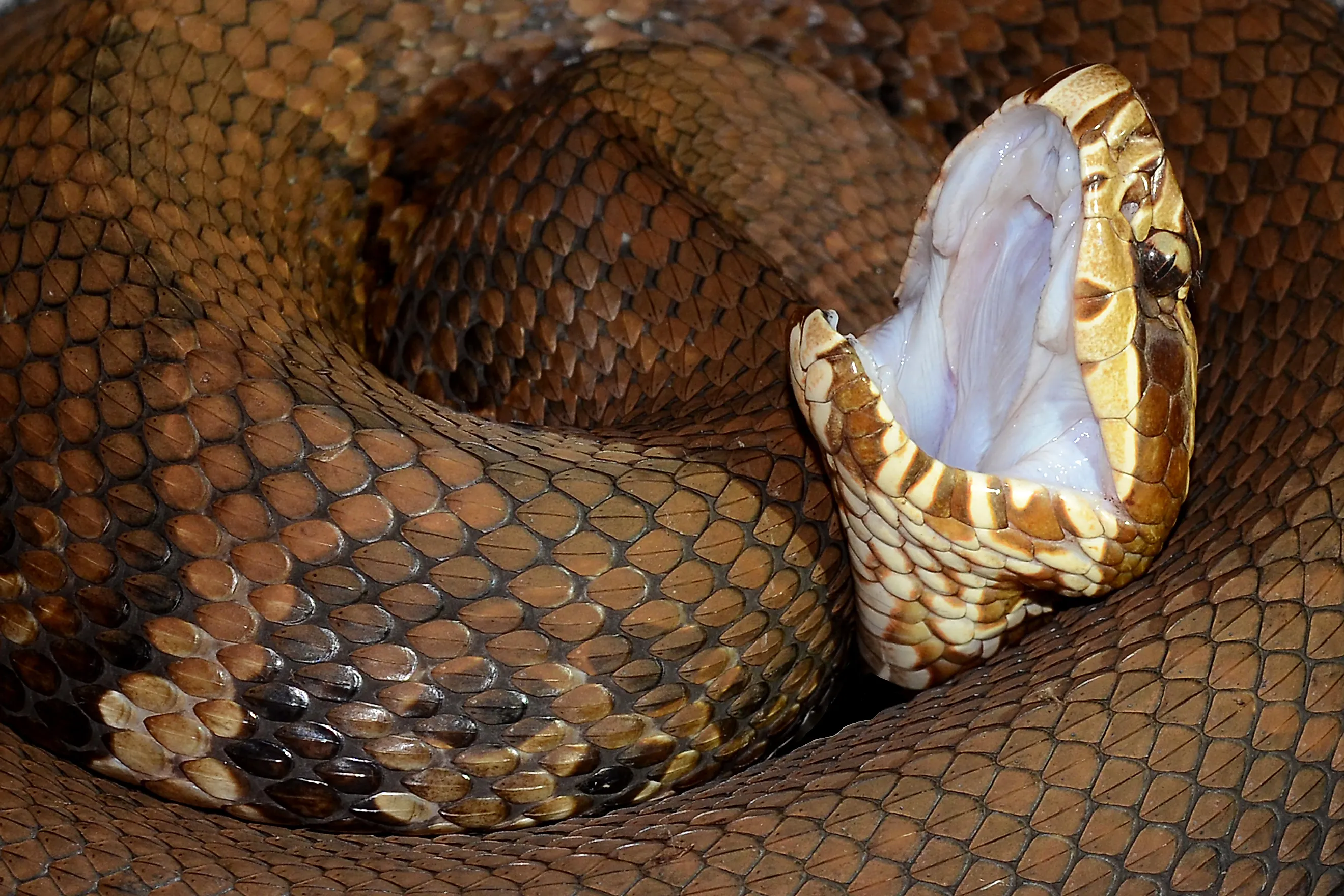
The venomous Florida cottonmouth (Agkistrodon conanti) also inhabits the St. Johns River system. Cottonmouths are heavy-bodied snakes that commonly grow between 30 and 48 inches (76 and 122 centimeters) long. They occupy swamps, riverbanks, and other wetland habitats, and their dark coloration can make them difficult to distinguish from harmless watersnakes.
Withlacoochee River

Florida has two rivers named Withlacoochee, but the west-central river is particularly notable for its extensive wetlands and unusual northward course. Originating in the Green Swamp, it winds approximately 160 miles (257 kilometers) through central Florida before entering the Gulf of Mexico near Yankeetown. The river passes through cypress forests, lakes, marshes, and hardwood floodplains. It is classified as a blackwater river because tannins and decomposing plant material stain much of its water a dark brown. These conditions provide habitat for several aquatic snakes, including Florida watersnakes, brown watersnakes, and cottonmouths.
Florida watersnakes inhabit the river's shallow margins and surrounding swamps, where they search for fish and frogs. Florida green watersnakes prefer calmer, heavily vegetated wetlands, including marshes and lakes connected to the river system. Brown watersnakes can also be found basking along branches above the water. Cottonmouths occupy similar wetland habitats, although they are not restricted to the water's edge. They can wander into nearby forests and occasionally climb into bushes and trees. The Withlacoochee's extensive floodplain provides numerous opportunities for both aquatic and terrestrial snakes to find shelter and food.
Peace River

The Peace River begins near Bartow in Polk County and flows approximately 105 miles (169 kilometers) southward before reaching Charlotte Harbor. Its watershed encompasses more than 2,300 square miles (5,957 square kilometers), including pine flatwoods, cypress swamps, hardwood forests, and seasonally flooded marshes.
Among the snakes associated with these habitats is the Florida green watersnake. Adults commonly reach 30 to 55 inches (76 to 140 centimeters) long, with females growing considerably larger than males. Despite their name, these snakes can be greenish, brownish, or even orangish, making their coloration highly variable. They are particularly associated with calm, shallow water and dense aquatic vegetation.
Florida’s Snake-Filled Rivers
Florida's rivers provide a remarkable variety of snake habitats, with their floodplains, swamps, and slow-moving waters supporting species that spend much of their lives hunting fish and amphibians. The Suwannee River marks an important division between two watersnake populations, while the Apalachicola's flooded forests provide habitat for large brown watersnakes that sometimes rest high above passing boats. Although cottonmouths occur along all five rivers, the majority of aquatic snakes encountered in Florida are nonvenomous. For people exploring these waterways, the safest approach is to observe snakes from a distance and leave them undisturbed, whether they are resting on a riverbank or swimming nearby.