How Deep Crater Lake Is Compared To The Empire State Building
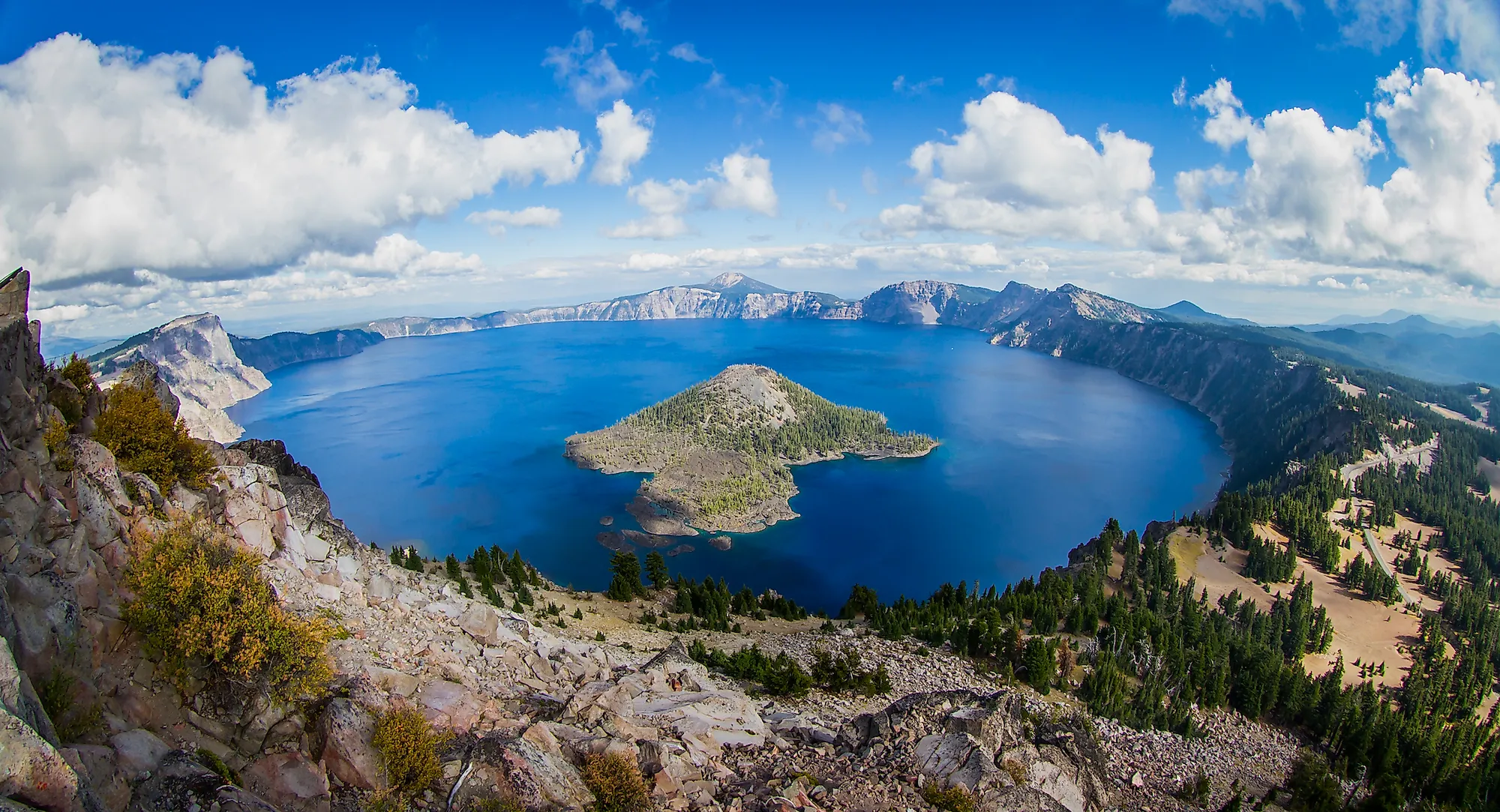
If the Empire State Building were dunked into the bottom of Crater Lake in Oregon, it would be covered by several hundred feet of water and would require a significant dive to find it.
At 1,949 feet deep, it is the deepest lake in the US, followed by Lake Tahoe at 1,644 feet. This lake's vast depth comes as a result of a volcanic eruption that left behind a large caldera that was gradually filled with precipitation, making this one of the deepest blue waters in the U.S. Both Crater Lake and the Empire State Building have a history of cataclysmic events followed by stunning success.
How deep would the Empire State Building sink?

The height of the Empire State Building depends on how one measures it. If measured from its bottom to the highest occupied floor, it stands at 1,250 feet tall. If the antenna and roof extensions are included, it is 1,454 feet tall.
The Empire State Building is 102 stories, plus a small 103rd floor terrace that's closed to the public. But only 102 floors are occupied. Guests to the Empire State Building can go to the 86th level or the 102nd level to reach an observation deck, as the 103rd floor and roof are off limits to guests.
If one takes the lower measurement, the Empire State Building would be 699 feet below the water of Crater Lake if it sank all the way to the bottom. If the taller measurement is used, it would be 495 feet below the water.
The geology of Crater Lake

Prior to the formation of Crater Lake, the land was occupied by Mount Mazama, a composite volcano that was formed through smaller lava flow eruptions. The volcano stood 12,000 feet in elevation at its height. However, 7,700 years ago, Mount Mazama had a massive eruption that pumped out 12 cubic miles of magma as pumice, ash, and rhyodacite.
This ash traveled so far that some of it reached Greenland. After this initial eruption, ring vents opened around the peak, allowing more magma to escape. As it removed this magma, the chamber collapsed in on itself, creating a deep caldera that is 4,000 feet deep. This wasn't the end of volcanic activity in this caldera, as another eruption formed Wizard Island, which today stands as an island in Crater Lake.
Into this caldera, rain and snow gradually collected, bringing it to its total depth at around 6,000 to 5,000 years ago.

Crater Lake is completely isolated, with no streams coming in or going out. Water flows out through evaporation and seepage into the rocks. This isolation keeps the water clean and clear. In fact, it set records in 1994, when a water clarity of 134 feet was measured. Average clarity is between 90 and 100 feet. The only major impact on water clarity is plankton and pollen.
Today, Crater Lake is part of Crater Lake National Park, with the lake itself situated at 6,178 feet above sea level. The volcano that sits under the lake is listed as dormant, as it has not erupted in 5,000 years. However, geologists believe that an eruption could occur here in the future, with a lava vent opening up in the lake itself or just outside of it. If an eruption were to occur in the water, the magma would send up large rock fragments exploding up from the lake.
The Empire State Building's history

The Empire State Building's origins date back to the years prior to the Great Depression. Originally, the area was occupied by the Waldorf-Astoria Hotel, which was built in 1893. However, during the 20th century, several new hotels opened in New York City, creating significant competition. No longer able to keep the doors open, the Astor family sold the land to the Empire State Inc. in 1928, who in turn demolished the hotel to make way for a vast new skyscraper.
Their initial plans were to design this space as an office tower that would be more than 100 stories. In 1929, plans began on the building, with former governor of New York Alfred E. Smith selected to head up the operation. That same year, on October 29, the stock market crashed in an event known as Black Tuesday. This event would spiral into the Great Depression, with the Dow Jones Industrial Average losing 90% of its value by 1932.
However, this event did not slow down construction, as it began on March 17, 1930. It took one year and 45 days to complete construction of the building. The builders used an assembly line of limestone, wood, marble, and other materials to constantly keep up progress. There were at least 3,000 men who worked on the project. They marked steel with codes to know which of the derricks would be moving columns. On May 1st, 1931, President Hoover inaugurated the skyscraper by pressing the telegraph button that switched on the lights.

However, with the Great Depression in full swing, the building became known as the Empty State Building, as it was 75% empty at the time of its opening. Even into the 1940s, almost every office above the 41st floor of the Empire State Building remained vacant. However, cinema would help give the building a more star-studded reputation, especially with the 1933 "King Kong" movie, which displayed the giant ape climbing to the top of the Empire State Building.
It wasn't until after World War II that the Empire State Building was able to turn a profit as the economic boom enabled more businesses to purchase prime offices in the tower. In 1950, a broadcast antenna was added, and the building now stands at 1,454 feet tall to its tip. In 1961, the successful tower was sold for $65 million to Lawrence A. Wien, Peter L. Malkin, and Harry B. Helmsley.
Out of the ashes, a lake (and building) rises

Both of these landmarks are success stories, although of different kinds. In Crater Lake's case, what began as a devastating volcanic eruption settled down into the most beautiful, clear lake in America. For the Empire State Building, it took over from a failed hotel and was able to survive the tumultuous decades of the Great Depression and World War II to become one of America's premier skyscraper office spaces and tourist attractions.
All that being said, if one were to compare the height of the Empire State Building with the depth of Crater Lake, the lake wins out by a wide margin. It would swallow this skyscraper whole and still have plenty of room left in its deep blue waters.