The Most Common Trees In American Forests
In its 2017 forest-resource assessment, the USDA Forest Service estimated that the most abundant tree species in the conterminous United States numbered about 25 billion trees, with the runner-up close behind at roughly 22 billion. Neither of them is the tallest or the longest-lived tree on this list. One species here can survive for more than 1,000 years, while another spreads through shared root systems that may persist for thousands. A third drops its cones while they are still on the branch, and a fourth has seeds that germinate at temperatures only slightly above freezing. Read on to find out which tree leads American forests and what helps all nine thrive.
Red Maple

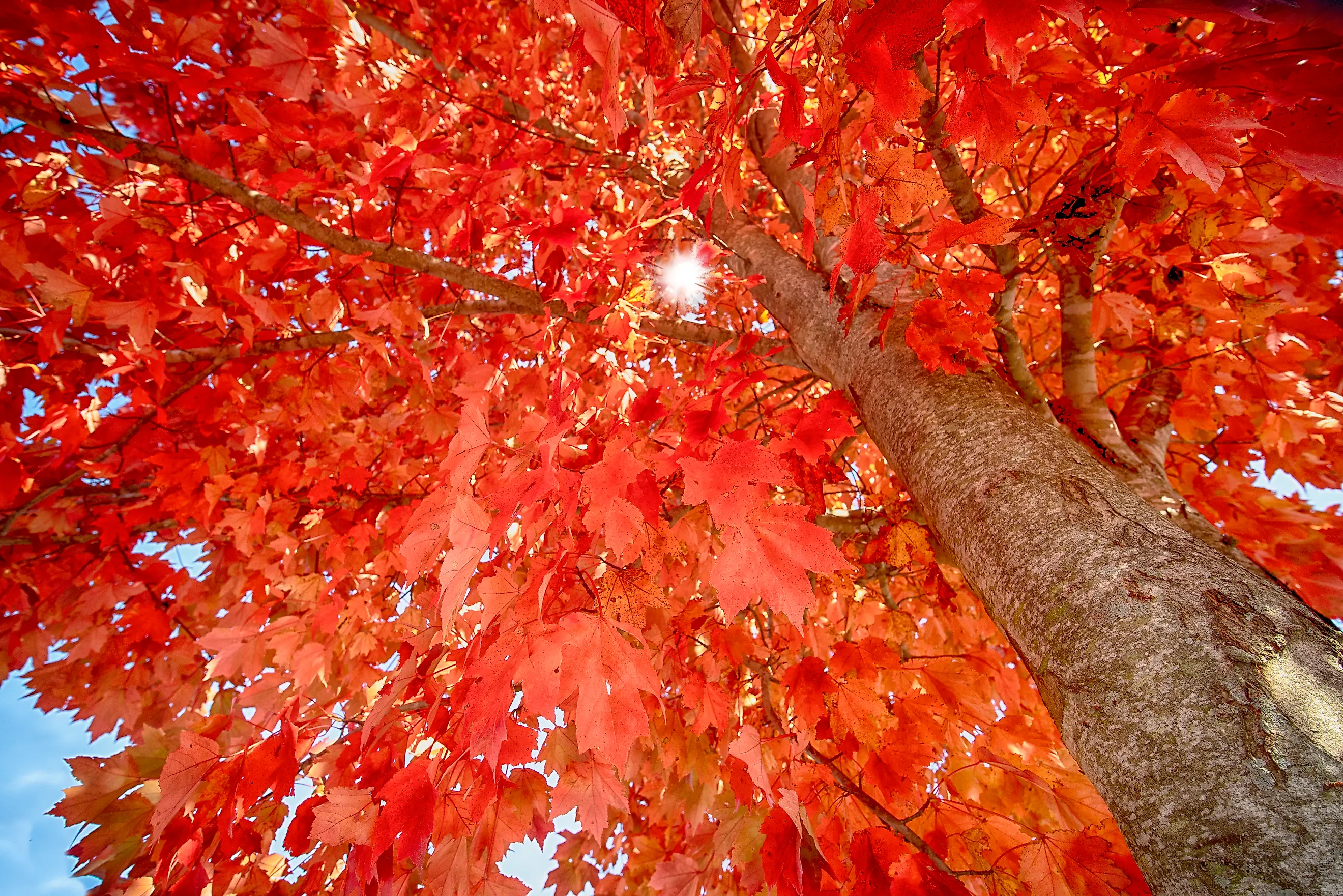
With an estimated 25 billion trees, red maple ranked as the most abundant species in the 2017 assessment. It is most recognizable in fall, when its leaves can turn brilliant shades of red and orange. Mature trees typically reach 60 to 90 feet tall and develop gray bark that becomes darker and more ridged with age. Small, paired winged fruits called samaras develop in spring, allowing the seeds to travel on the wind. Established trees can also regenerate by producing shoots from surviving stumps after cutting or damage.
Red maple grows across much of eastern North America and tolerates an unusually wide variety of environments. It can establish itself on dry, rocky hillsides, in wet swamps, and along streams. The species grows across a broad range of soil moisture and acidity conditions, while young trees can survive beneath an established forest canopy. Although red maple is susceptible to fire injury, surviving roots and stumps can produce new sprouts following some disturbances. This combination of shade tolerance, adaptability, and vigorous regeneration helps explain its abundance in eastern forests.
Loblolly Pine

Loblolly pine ranked second, with approximately 22 billion trees. It is a defining species of southern forests, growing naturally from New Jersey south to Florida and west to Texas. These fast-growing evergreens thrive on many soil types, particularly deep, acidic soils with adequate moisture. They are less successful on severely eroded or persistently waterlogged sites. On good sites, mature trees can exceed 100 feet, with exceptional specimens reaching more than 150 feet. Their long needles grow in bundles of three, while the woody cones are typically three to six inches long and have scales ending in small, sharp prickles.
Loblolly pine is one of the most commercially important timber trees in the southern United States. It grows in natural forests and managed plantations, frequently alongside oaks, sweetgum, and other pines. Its rapid growth makes it valuable for lumber and pulp production. Although loblolly pines can produce some seeds annually, large seed crops generally occur every three to six years. The reproductive cycle takes approximately 26 months from the initiation of reproductive structures to cone maturity, with cones typically ripening during the second autumn after pollination.
Balsam Fir

Balsam fir is familiar for its fragrant needles and popularity as a Christmas tree. In the wild, it grows in the cool, moist forests of the Northeast and Great Lakes region, often alongside spruce, birch, and maple. Mature trees commonly reach 40 to 60 feet tall and have narrow, conical crowns with dense branches. Their short, flat needles are aromatic, while their upright cones are generally two to four inches long. Unlike the cones of many other conifers, balsam fir cones disintegrate while still attached to the branches, releasing their seeds and leaving behind a central stalk.
Balsam fir is highly tolerant of shade, allowing seedlings and young trees to survive for years beneath a forest canopy. When older trees fall, or openings develop, these younger trees can grow more rapidly with increased sunlight. The species occurs from low elevations to mountainous terrain, including the higher slopes of New Hampshire's White Mountains. Near the upper limits of tree growth, exposure to wind and cold can produce stunted or low-growing forms. Its ability to survive in shaded forests and cold environments makes balsam fir an important component of northern woodland ecosystems.
Sweetgum

Sweetgum is among the more recognizable hardwoods of eastern and southern forests. Its star-shaped leaves usually have five pointed lobes, while the gray-brown bark develops deep ridges as the tree matures. Mature sweetgums grow 60 to 100 feet tall, although some grow considerably larger. Their most distinctive feature is the round, spiny fruit that hangs from branches and sometimes remains through winter. Young trees often have narrow crowns, while older specimens can develop broader canopies.
Sweetgum thrives throughout much of the South, particularly in river bottoms, along streams, and on moist upland soils. Its ability to regenerate after disturbance contributes to its success. In addition to reproducing by seed, sweetgum can produce new shoots from roots and stumps, sometimes forming dense stands after logging or other disturbances. The species is also a commercially valuable hardwood, with its timber used in furniture, plywood, cabinets, and interior woodwork. Its adaptability and regenerative capacity have helped establish it as an abundant tree across the southeastern United States.
Douglas Fir

The Douglas fir is among the tallest trees of western North America, with large coastal old-growth specimens often reaching 200 to 250 feet. Its natural range extends from British Columbia south into California and inland through the Rocky Mountains. Despite its name, Douglas-fir is not a true fir. Its soft, flat needles grow individually along the branches, while its cones are distinguished by three-pointed bracts protruding between the scales. The thick, deeply furrowed bark of mature trees provides some protection against low-intensity surface fires.
Douglas-fir grows under a broad range of climatic conditions. Coastal populations benefit from the relatively mild, moist environment of the Pacific Northwest, while inland populations tolerate colder winters and drier growing conditions. Trees generally reach their greatest heights in productive coastal forests, where the growing environment supports sustained growth over many decades. Douglas-firs are also long-lived, with some surviving for more than 1,000 years. The species is a major source of commercial timber and a key part of western forest ecosystems.
Sugar Maple

Sugar maple is a signature hardwood of the cool, moist forests of the Northeast and Great Lakes region. Mature trees usually top out at 70 to 100 feet, with some growing taller on ideal sites. Their broad crowns create substantial shade, while the five-lobed leaves turn yellow, orange, or red during autumn. Sugar maples generally grow best in fertile, well-drained soils and are less suited to persistently waterlogged environments.
Like balsam fir, young sugar maples can endure many years in the shade of mature trees. Their seeds are adapted to cold conditions, with germination occurring at temperatures only slightly above freezing. The species is also best known as the principal source of maple syrup. Producers typically collect sap during late winter and early spring, when freezing nights and warmer days keep the sap flowing. The sap is then concentrated, usually by evaporation, to produce syrup. Sugar concentration varies among trees and throughout the tapping season.
White Oak

White oak is a large, long-lived hardwood found across much of the eastern United States. Mature trees commonly reach 80 to 100 feet tall, developing broad, rounded crowns when growing in open spaces and taller, narrower forms within forests. Their leaves have rounded lobes, distinguishing them from many oak species with sharply pointed leaf tips. The bark becomes pale gray and scaly or ridged with age. According to the US Forest Service, exceptionally large white oaks can reach 150 feet tall, while some individuals survive for several centuries.
White oak acorns provide valuable food for wildlife, including deer, squirrels, turkeys, blue jays, and raccoons. Across oak species, the Forest Service identifies over 180 bird and mammal species that consume acorns. White oaks do not produce abundant acorn crops every year, with especially productive seasons generally occurring at intervals of four to 10 years. The species can also regenerate through stump sprouts, particularly when younger trees are cut or damaged. Its ecological importance extends beyond serving as food for wildlife, as mature white oaks provide habitat, and their wood is widely used for furniture, flooring, and barrels.
Ponderosa Pine

Ponderosa pine is widespread across the western United States, growing in forests and woodlands from the Pacific Coast to the Rocky Mountains and south into Mexico. Mature trees often grow 90 to 130 feet tall and can survive for several centuries. Their long needles grow in bundles of two or three, depending on the variety, while their woody cones generally measure three to six inches long. Mature trees develop thick bark that often forms large, orange-brown plates separated by dark fissures.
One of the ponderosa pine's most notable adaptations is its ability to survive many low-intensity surface fires. Thick bark helps protect living tissues from heat, while the elevated crowns of mature trees can keep foliage beyond the reach of smaller flames. Historically, frequent fires maintained relatively open conditions in many ponderosa pine forests by reducing competing vegetation and small trees. However, forest density varies by region, and decades of fire exclusion have contributed to denser stands in some areas. Young ponderosa pines are more vulnerable to fire than mature trees, and even established specimens can be killed by severe wildfires.
Quaking Aspen

Quaking aspen is easily recognized by its smooth, pale bark and rounded leaves that flutter in a light breeze. Its leaves have flattened stalks that allow them to twist in the wind, producing the rustling sound that gives the species its name. During autumn, the foliage turns bright yellow, making aspen groves stand out among darker conifers. The species has an extensive geographic range, growing across much of Canada and Alaska, as well as large portions of the continental United States. Mature aspens typically grow 40 to 80 feet tall, although larger specimens occur.
Quaking aspen also stands apart for its ability to reproduce through underground root systems. Roots produce new shoots that grow into additional trunks, allowing colonies to expand across large areas. Many aspens within a grove may share the same genetic identity, forming a single clone, although some groves contain multiple distinct clones. This reproductive strategy helps the species recover rapidly following disturbances such as logging and wildfire, provided the underground root system survives. Individual trunks generally live for decades, while the shared root systems of some clones may persist for thousands of years. Aspen stands also provide food and habitat for wildlife, including deer, elk, and ruffed grouse.
The Trees That Define American Forests
From the red maple forests of the East to the towering Douglas-firs of the Pacific Northwest, these nine species illustrate the diversity of American woodlands. Ponderosa pines can survive low-intensity fires, while quaking aspens regenerate through extensive root systems. Sugar maples and balsam firs can establish themselves beneath shaded forest canopies, while loblolly pines grow rapidly in productive southern forests. These adaptations help explain why these trees are so widespread and why they remain important to wildlife, forest ecosystems, and the timber industry throughout the United States.