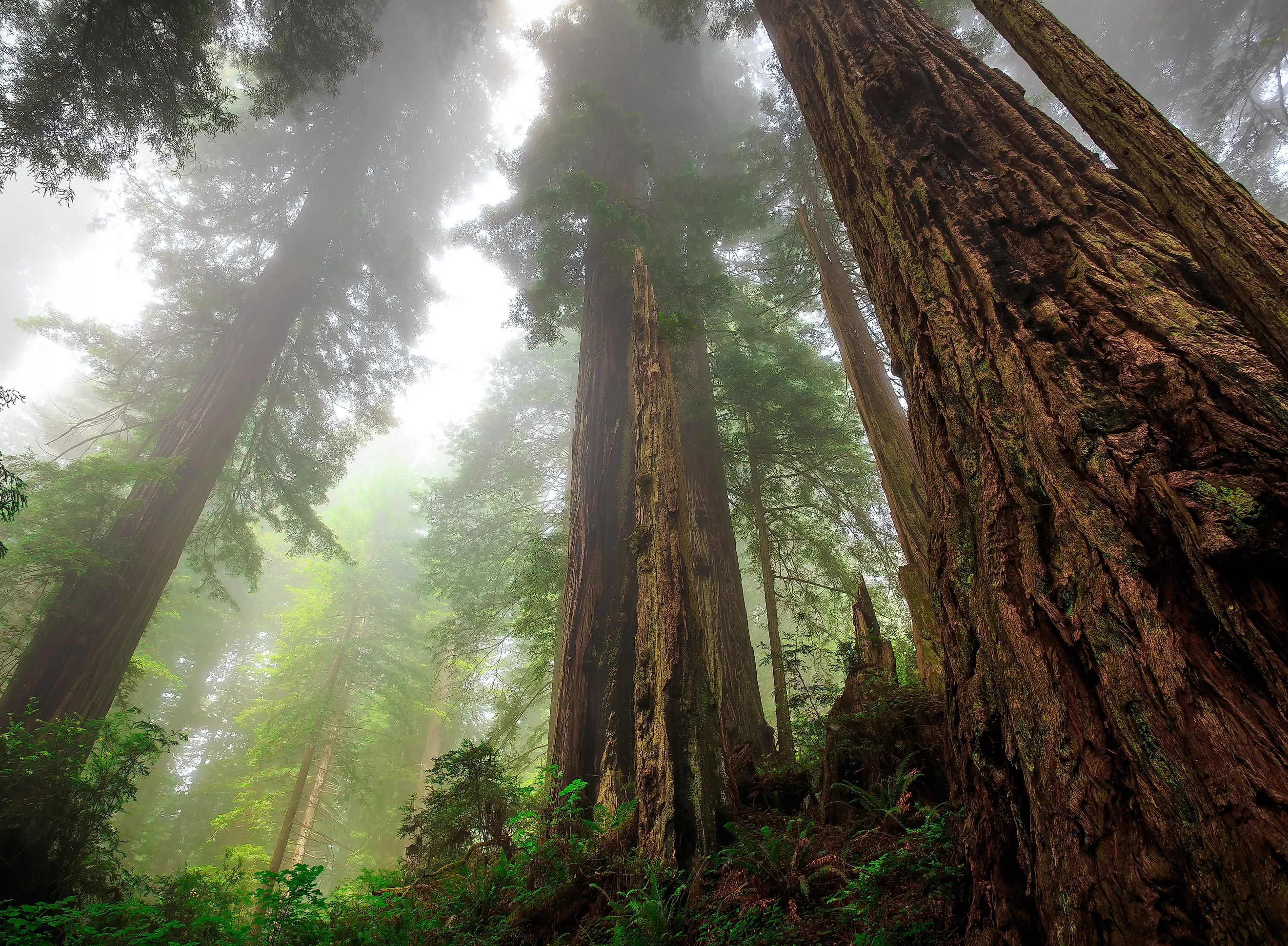
The Tallest Trees In The World
The world's list of tallest trees is constantly changing. With modern technology letting us explore spaces we couldn't before, researchers are still finding and measuring new forest giants. In 2006, the title of world's tallest tree changed when a new coast redwood was discovered. The tallest tree in Asia was also discovered in 2023, replacing the former record holder. As of 2026, these are the tallest trees in the world that we know of. However, it's possible that even taller titans are hidden in unexplored pockets of the world.
Coast Redwood (Sequoia sempervirens)

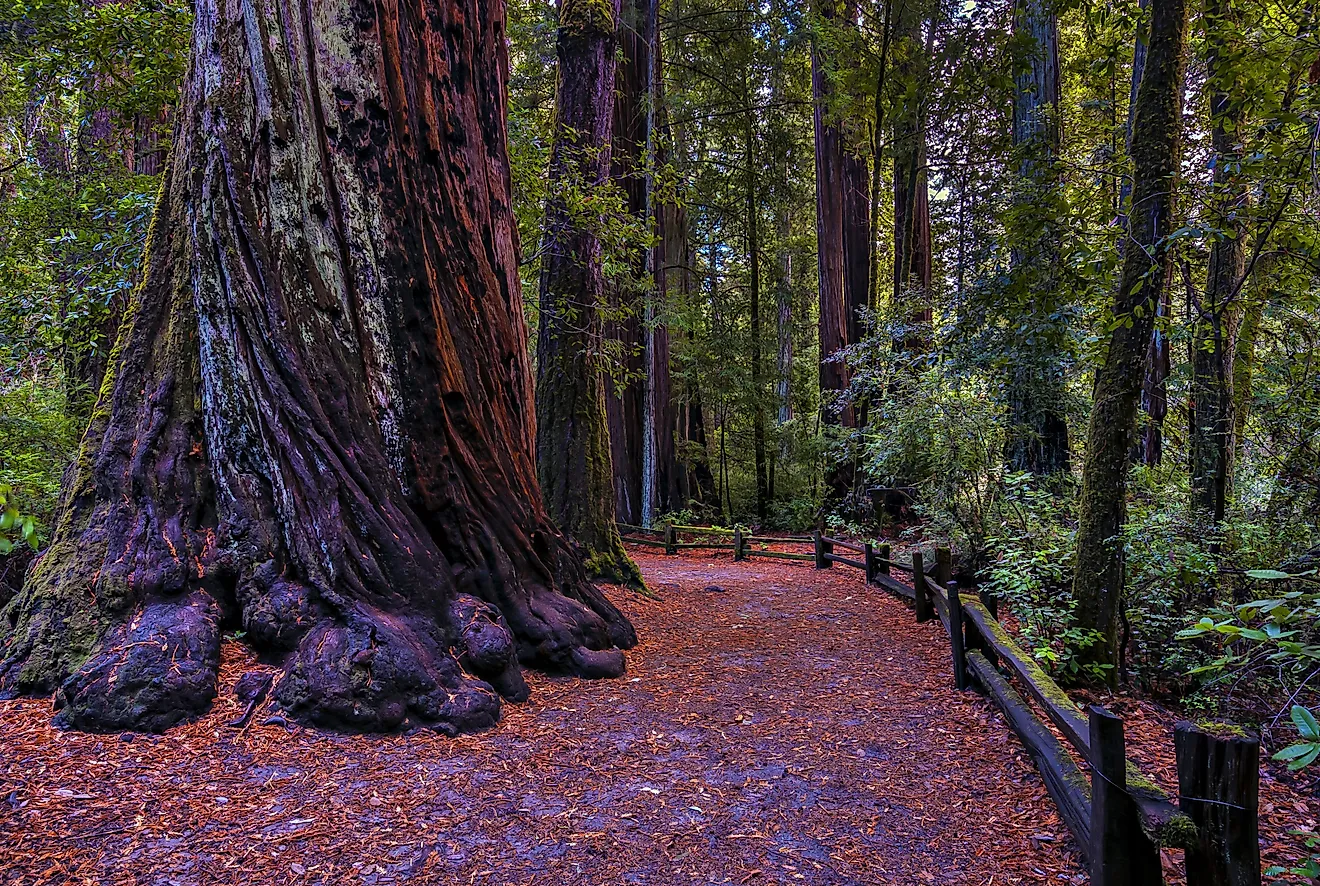
Coast redwoods are the tallest trees in the world by a fairly large margin. Naturalists found Hyperion, the tallest known redwood, in a quiet part of California's Redwood National Park in 2006. American forest ecologist Dr. Stephen Sillett measured the redwood's height at 379 feet (115 meters). Before this, the Stratosphere Giant coast redwood was thought to be the highest tree in the world, at 370 feet (112 meters) tall. As of 2026, Hyperion remains the tallest tree we know of.
The coast redwood species once spanned much of the Northern Hemisphere. Today, they are restricted to a narrow band of coast between central California and southern Oregon. The species can absorb water through its leaves and bark, making coastal fog a prominent water source. These massive conifers can also live for over 2,000 years. Despite this ancient age, estimates date Hyperion back only 700 to 800 years, meaning it could get even larger.
Many coast redwoods can be visited in America's parks and reserves. California's Redwood National and State Parks feature vast old-growth groves for parkgoers to explore. The Grove of Titans and Lady Bird Johnson Grove are two popular hiking areas laced with the enormous redwoods. As for the world's tallest, Hyperion is strictly off-limits as of 2022 to help protect the conifer's fragile ecosystem from further damage.
Himalayan Cypress (Cupressus torulosa)

The tallest tree in Asia grows in the deepest canyon in the world. Situated in southeastern Tibet, the Yarlung Zangbo Grand Canyon reaches a maximum depth of over 19,714 feet (6,009 meters). In 2023, researchers from Beijing's Peking University discovered an unrecorded Himalayan cypress growing inside it. The cypress turned out to be the second-tallest recorded tree in the world, measuring 335 feet (102 meters) tall.
The Himalayan cypress is an evergreen conifer native to the western Himalayas. Although these trees typically only grow up to 150 feet (46 meters) tall, outliers can grow much higher. The cypress found in Yarlung Zangbo was not alone in its height. Using lasers, drones, and radar tools, researchers found several other towering trees in the area, standing over 279 feet (85 meters) tall.
Wild Himalayan cypresses are rare in China, making them a first-class protected plant species. Although the tallest is located in the Yarlung Zangbo Grand Canyon National Nature Reserve, it is not accessible to tourists due to the harsh landscape. The tree is more common in Bhutan, which many consider its national tree. Bhutanese culture depicts the plant as a symbol of resilience due to its ability to thrive in harsh, rocky landscapes. As timber, it has been used for centuries in temples and monasteries, and many grow near these religious sites. Himalayan cypresses also occur naturally in Bhutan's Jigme Dorji National Park.
Yellow Meranti (Richetia faguetiana)

A yellow meranti is the tallest tropical tree in the world and the third-tallest tree overall. Menara, the tallest meranti, is located in the Malaysian State of Sabah on the island of Borneo. It stands 330 feet (100 meters) tall. In 2019, a field researcher with the South East Asia Rainforest Research Partnership verified this height by climbing the tree and releasing a tape measure. Before this, height records were tied to a Sabah grove found in 2016, where the meranti measured above 295 feet (90 meters).
The yellow meranti is a tall tropical hardwood that produces yellow flowers. The tree species is native to Malaysia, Thailand, Indonesia, and the Philippines, though its wild populations are at risk. The International Union for Conservation of Nature (IUCN) classified the yellow meranti as endangered as of 2017. Much of this pressure is connected to decades of logging, as the tree's lightweight and durable hardwood makes it highly prized for its commercial timber.
Menara is located in the Danum Valley Conservation Area, growing alongside other tall yellow meranti. Visitors can hike to see these rare giant trees, though entry to the conservation area must be prearranged through accommodations or licensed tour operators. The same applies to Sabah's Maliau Basin Conservation Area, another site protecting yellow meranti groves.
Sitka Spruce (Picea sitchensis)

Tree hunters discovered the world's tallest Sitka spruce in Redwood National Park. In 2021, Steve Sillett and Michael Taylor fulfilled their decades-long search for a non-redwood over 100 meters tall. Using laser measurements and 3-D imaging, the pair verified the unnamed Sitka was 328.7 feet (100.2 m) high, just meeting the threshold. The tree was hidden in a dense section of the national park, and remains the tallest known Sitka spruce as of 2026.
The Sitka spruce is a coniferous evergreen native to North America's west coast. It ranges between Alaska's Kenai Peninsula and northern California. Although the tallest known Sitka spruce was found in Redwood National Park, other massive trees grow in Washington and British Columbia. The tree's coastal preference means it is rarely found more than 20 miles inland. In fact, Sitka spruces can grow where many trees can't, in extremely moist, poorly-drained soil. Its bark and needles are also resistant to salt spray.
Sitka spruce populations are generally stable across their natural range. Though many mature Sitka spruces cap at 180 feet (55 meters), countless exceptional trees surpass this. A Sitka spruce is Canada's tallest known tree. The 315-foot (96-meter) Carmanah Giant can be found in Carmanah Walbran Provincial Park on Vancouver Island. In California, some of the world's tallest Sitka spruces grow amongst redwoods. In addition to the record-breaker in Redwood National Park, a 276-foot (84-meter) giant grows in Prairie Creek Redwoods State Park.
Douglas-Fir (Pseudotsuga menziesii)

The world's tallest Douglas-fir was dethroned in 2025. Previously, the Doerner Fir in Southern Oregon measured highest in its species, at 327 feet (100 meters). However, a 2025 wildfire caused the 450-year-old tree to lose about 50 feet of height, shifting the record. Previously second-tallest, the Douglas-fir that took its place measures 326 feet (99 meters) high. The unnamed tree was found and measured in Redwood National and State Parks in 2022.
Native to North America, Douglas-firs are split into two varieties. The Rocky Mountain variety lives in the interior west. It grows up to 160 feet (49 meters) tall and rarely lives longer than 400 years. The world's current tallest Douglas-fir is part of the coast variety. These trees live in the Pacific Northwest and California, commonly reaching heights of 250 feet (76 meters). They also have a longer lifespan, with some over 1,000 years old. Steve Sillett, one of the botanists who discovered the current tallest Douglas-fir, estimates it is less than 300 years old.
Douglas-firs are generally widespread, with a stable population despite timber harvesting. However, specific zones are considered at risk due to small size and urbanization, such as the Coastal Douglas-fir ecosystem in British Columbia. As seen with the Doerner Fir, other pockets of Douglas-fir are also susceptible to wildfire damage. Still, Redwood National and State Parks preserve a mix of coast redwoods and Douglas-firs for parkgoers to explore. Both can be seen on the James Irvine, Clintonia, and Miners Ridge hiking trails at Prairie Creek Redwoods State Park in California.
Australian Mountain Ash (Eucalyptus regnans)

Centurion, the world's tallest Australian mountain ash, would have once been higher on this list. Located in southern Tasmania, this record-breaking tree measures about 317 feet (97 meters) tall as of 2019. Prior to a severe bushfire, this number was even larger. In early 2019, the Riveaux Road fire destroyed thousands of hectares in Tasmania's Huon Valley. Directly in its path, Centurion faced damage despite efforts to protect it. Before fire scarred and shortened it, the tree measured about 328 feet (100 meters) tall.
Despite its reduced height, Centurion is the tallest tree in Australia as of 2026. In general, the mountain ash is a very tall species. Native to Tasmania and Victoria, the forest giants typically reach heights of 300 feet (91.4 meters). Slinky Sloan, another mountain ash, is the tallest tree in Victoria, measuring 305 feet (93 meters) tall. These hollow evergreens thrive in high-rainfall mountainous regions of Australia, living for 400 to 500 years.
According to the IUCN, Australia's mountain ash ecosystems are considered critically endangered as of 2014. Intensive clearfell logging and high-severity wildfires are listed as contributing pressures. As of 2026, countless parks can be visited to see these tall trees in person. Yarra Ranges National Park in Victoria and Mount Field National Park in Tasmania both feature old-growth specimens over 230 feet (70 meters) tall. Centurion can also be visited, though its remote wilderness setting makes it difficult to reach.
Visiting The World's Tallest Trees
Many of the tallest trees in the world can be visited in Redwood National and State Parks. In contrast, extreme geography keeps Tibet's unsurpassed cypress hidden and inaccessible. With all that said, sometimes it's better to explore a species as a whole rather than the tallest of the tall.
In Redwood National and State Parks, less popular hiking trails feature massive trees with fewer crowds. Meanwhile, many Himalayan cypresses in Bhutan don't reach record-breaking heights, yet their cultural significance is just as rewarding. In any case, sticking to designated park trails and exploring tall trees from a respectful distance helps preserve these forest giants so people can enjoy them for years to come.