8 Old-Timey General Stores In Oregon
Before supermarkets and online shopping, general stores supplied rural communities with groceries, household essentials, and a place to exchange local news. In Oregon, several of these businesses have survived for generations, while others occupy historic buildings and continue the country-store tradition. Some still stock groceries and hardware for remote communities, while others have added cafes, specialty foods, and gifts. From the historic Butteville General Store in the Willamette Valley to Frenchglen Mercantile near Steens Mountain, these eight old-timey general stores preserve a part of Oregon's rural shopping history.
Wheeler County Trading Co.

Wheeler County Trading Co. is a locally owned general store on Main Street in Mitchell, a small community in north-central Oregon. The store occupies a historic building reportedly dating to approximately 1875, reflecting the town's early settlement period. Mitchell developed during the 1870s as a commercial center for the surrounding ranching communities, with one of its earliest stores established by R. E. Edmundson in 1875. Its location along a historic travel corridor helped the settlement attract merchants, ranchers, and travelers.
Wheeler County Trading Co. continues to meet the practical needs of the community by offering groceries, hardware, feed, sporting goods, and other merchandise. The store, operated by Gabe and Megan Salvage, has received recognition from the local chamber of commerce. In a small town where larger shopping centers are a considerable drive away, the store provides access to everyday essentials. Its historic setting and wide assortment of merchandise preserve the familiar role of a rural general store, where residents can shop for supplies and connect with neighbors.
Wonder General Store

Located along Redwood Highway in Wilderville, Wonder General Store traces its history to the small community of Wonder in southwestern Oregon. Around 1902, John T. Robertson established the Wonder Store, reportedly choosing its name because neighbors wondered whether a store could attract enough business in such a sparsely populated area. A post office followed in December 1903, making the settlement a small commercial and postal stop for the surrounding countryside. The store's history reflects the importance of roadside businesses to isolated communities before larger shopping centers became commonplace.
The Wonder General Store on Redwood Highway has continued to be identified as a grocery and convenience store serving residents and travelers. A regional commercial-use study listed the property as Sam's Market and Deli Wonder General Store, while business directories continue to identify it by its traditional name. Its retail offerings have included groceries, snacks, beverages, and deli foods. Rather than operating solely as a historical attraction, the property has retained the practical retail function associated with a country general store.
Frenchglen Mercantile

Frenchglen Mercantile sits in a remote corner of southeastern Oregon, near Steens Mountain and the Malheur National Wildlife Refuge. Its history is closely connected to the area's ranching industry, particularly the enormous cattle operation associated with Peter French and the historic P Ranch. During the 1920s, the Eastern Oregon Livestock Company established commercial facilities in Frenchglen, including a store and a hotel, to serve ranch workers and travelers through the region. In an area where settlements are separated by many miles of open country, businesses providing food, fuel, and supplies have long been essential.
Frenchglen Mercantile continues that tradition by serving the small local community and travelers exploring southeastern Oregon. The seasonal business provides basic provisions, refreshments, gifts, and fuel, with gasoline generally available from mid-April through October. Its location makes it a useful stop for people visiting Steens Mountain and the surrounding high desert, where services are limited. Although its merchandise now caters partly to visitors, the mercantile still performs the practical supply role that helped establish Frenchglen as a stopping point nearly a century ago.
McKenzie General Store

The rustic McKenzie General Store was established in 1932 in McKenzie Bridge, along the McKenzie River in western Oregon. Located near the Willamette National Forest, the store has long served as a local market and stopping point for people traveling through the McKenzie River Valley. Its location along Highway 126 makes it convenient for residents and for hikers, cyclists, anglers, and campers exploring the surrounding mountains. Although the business has evolved over the decades, its original general-store role remains central to its identity.
Inside, the store stocks groceries, organic produce, snacks, beverages, books, and regional products. The adjoining Obsidian Grill adds a dining option, offering burgers, sandwiches, and other prepared meals. The business operates as both a market and restaurant, giving customers a place to purchase supplies or stop for food before heading into the forest. Its combination of everyday merchandise, local products, and casual dining reflects how traditional general stores have adapted while continuing to serve their communities.
Dayville Mercantile

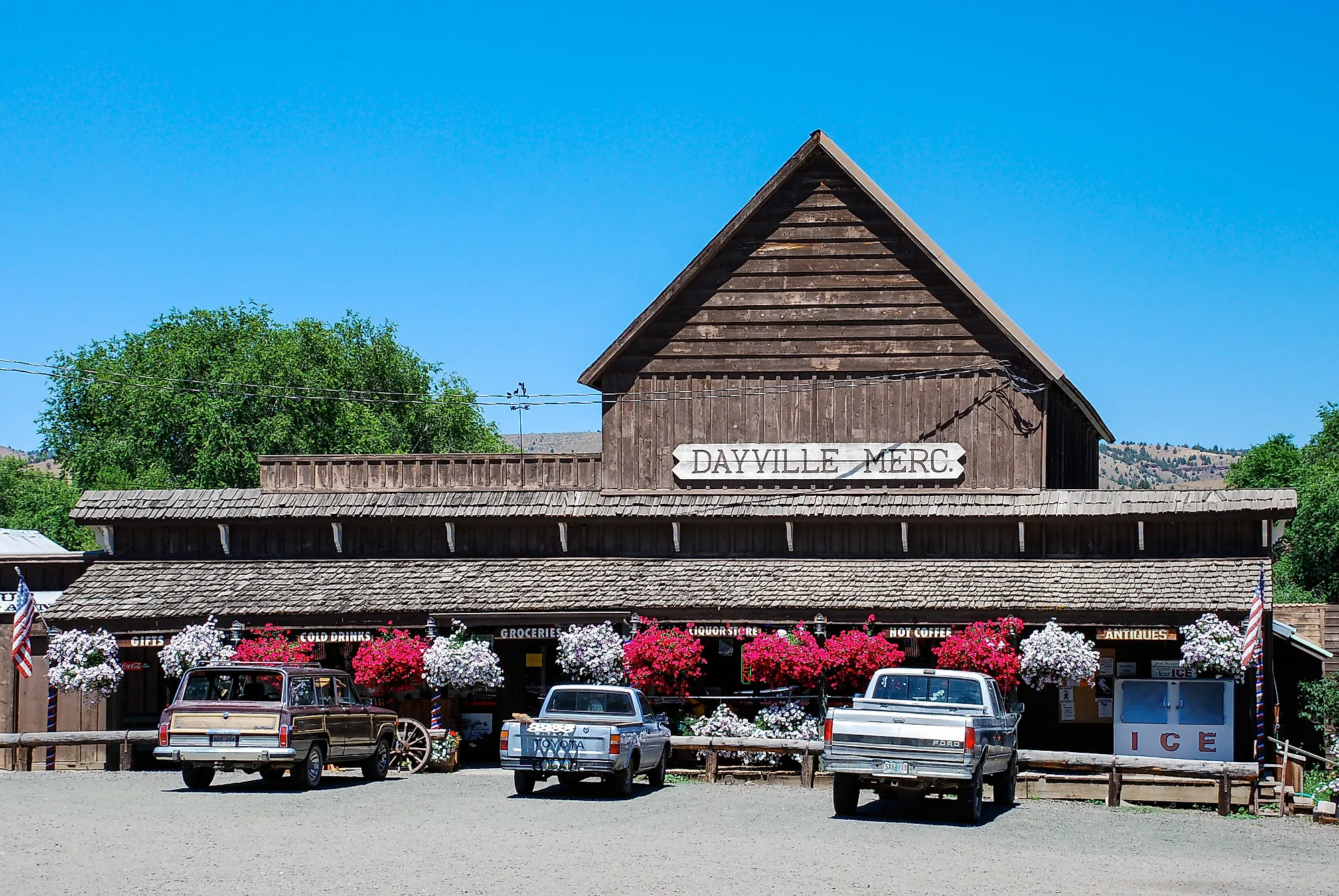
In the high desert of eastern Oregon, Dayville Mercantile has been serving the community of Dayville since 1896. The store stands along Highway 26, near the John Day River and the John Day Fossil Beds National Monument. Established during an era when small agricultural and ranching settlements depended on local merchants, the mercantile provided a place to obtain goods without making lengthy trips to larger towns. More than a century later, the business remains an established part of Dayville's small commercial district.
Dayville Mercantile continues to operate as a traditional country store, offering groceries, old-fashioned candy, souvenirs, locally made products, and gifts. Its selection combines practical necessities for residents with small purchases for travelers exploring the John Day region. The store's historic character and longstanding presence distinguish it from a typical modern convenience store. With roots stretching back to the 19th century and a continuing role in the community, Dayville Mercantile is one of Oregon's surviving examples of traditional rural retail.
Butteville General Store

In the small Willamette Valley community of Butteville, near Champoeg State Heritage Area, the historic Butteville General Store is considered Oregon's oldest continuously operating retail establishment on record. Its history dates to 1876, when George Fleckenstein purchased a house and converted it into a store. In 1881, Joseph J. Ryan acquired the property and expanded the business into a general mercantile that also operated a saloon. The saloon closed in 1916 during Oregon's Prohibition era, but the store continued serving customers. Over the following decades, it survived changes in ownership, storms, and a serious 1975 fire that damaged the front of the building.
Today, the historic property belongs to the Oregon Parks and Recreation Department and forms part of Champoeg State Heritage Area. The store continues operating as a cafe, specialty food shop, and community gathering place, with food service associated with the Friends of Historic Butteville and its concession partners. Visitors can purchase prepared meals, homemade ice cream, drinks, and other refreshments, while special events and music performances help maintain its role as a social center. Although it no longer functions as a full-service mercantile, its continued retail use preserves a tradition stretching back approximately 150 years.
Post General Store

Post General Store stands in the small central Oregon community of Post, along the Paulina Highway southeast of Prineville. The settlement takes its name from Walter H. Post, who became its first postmaster in 1889. The community developed as a supply and postal stop for the surrounding ranching country, where distant towns and long travel distances made local businesses particularly important. Today, Post is also associated with the geographic center of Oregon, which lies on private ranchland nearby. The store's rustic appearance reflects the rural character of a community that has remained small for more than a century.
The Post General Store and Eatery continues to combine retail services, food, and a local gathering place. The store sells groceries, gifts, and merchandise celebrating Post's connection to Oregon's geographic center. Its small eatery serves sandwiches, milkshakes, and other refreshments, including the meatloaf sandwich for which the business is locally known. The adjacent post office adds to the property's longstanding role as a community service point. In 2026, the store was also used as a meeting location for wildfire information and a distribution point for smoke-protection supplies, demonstrating its continuing importance to residents of the surrounding rural area.
Whiskey Hill Store
The Whiskey Hill Store near Hubbard in the Willamette Valley occupies a building with an unusual history. Constructed in 1926 as a two-room schoolhouse, it was moved across the road in 1949 after a newer school opened. The former school building eventually became a neighborhood store, providing a place for local families to purchase groceries, snacks, and other everyday necessities. In 2019, Amy and Darryl Lenhardt, who had grown up in the Whiskey Hill community, acquired the property and began restoring it. Their work preserved the historic building while returning the store to an active role in the neighborhood.
Today, Whiskey Hill Store operates as a country market and cafe, selling groceries, household supplies, snacks, candy, locally made gifts, and prepared food. The cafe serves breakfast and lunch, while a vintage-style soda cooler and ice cream offerings recall the neighborhood stores of earlier generations. The restored property also includes guest rooms upstairs, adding a new use to the former schoolhouse. By retaining its grocery selection and community gathering space, Whiskey Hill Store honors both the building's history and its later role as a local country store.
Where the Old Country Store Still Lives On
Oregon's surviving general stores show how rural businesses have adapted while preserving familiar traditions. Dayville Mercantile and Wheeler County Trading Co. continue supplying groceries and other essentials, while Butteville General Store and Whiskey Hill Store combine historic settings with food and community activities. In remote communities such as Frenchglen and Post, a local store remains especially valuable when the next shopping destination is miles away. These eight businesses demonstrate how the general store has remained part of Oregon's rural communities, even as its merchandise and services have changed over time.