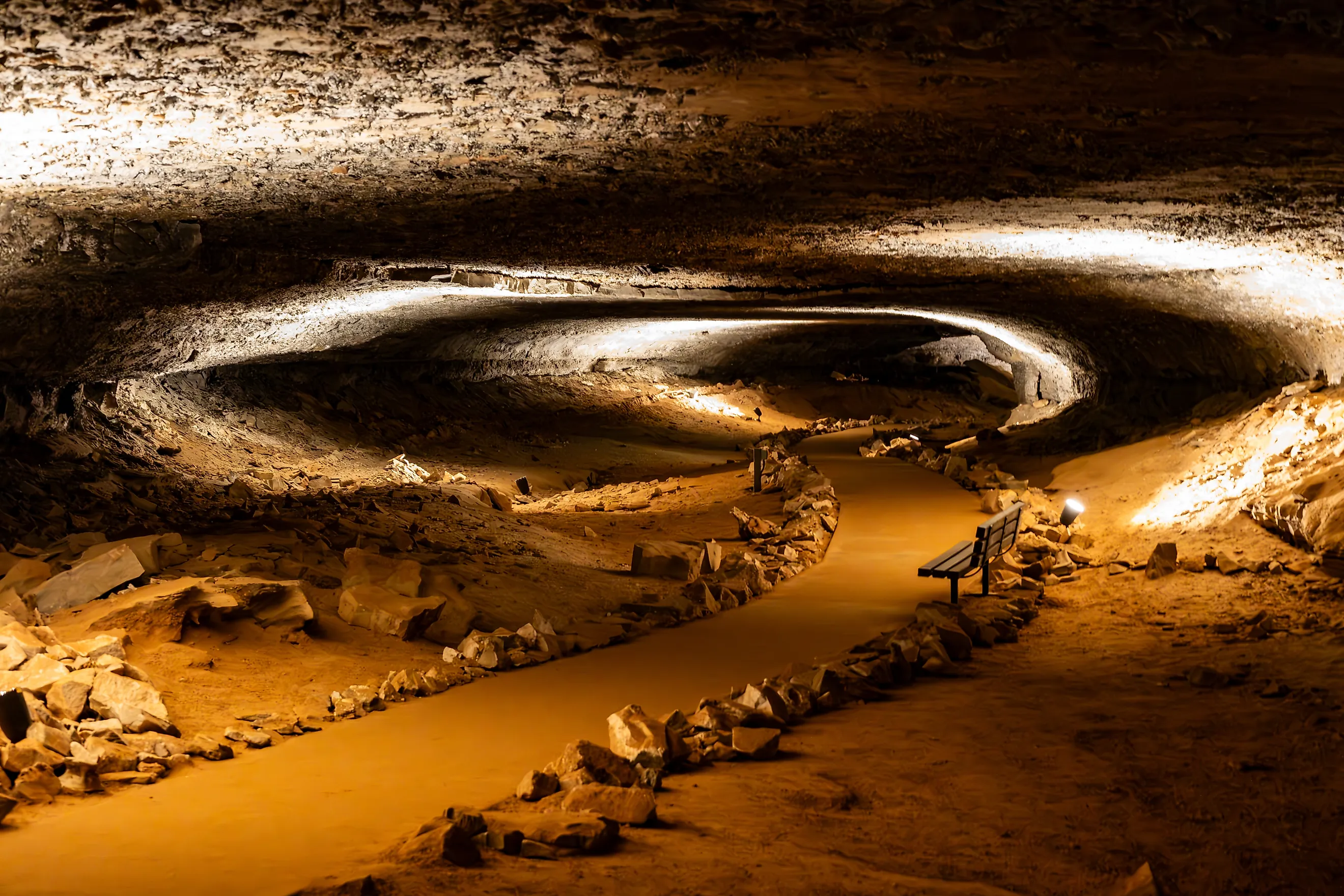
The Uncharted Miles of Mammoth Cave
Beneath the hills of south-central Kentucky, volunteer cavers are squeezing through tight crawlways and navigating underground rivers to help continute to chart the longest cave known on Earth.
Mammoth Cave contains over 426 miles of mapped passageways, but researchers estimate that at least 600 miles still remain undiscovered. Volunteer caving organizations such as the Cave Research Foundation and Central Kentucky Karst Coalition are still finding these new miles.
Only about 12 miles of Mammoth Cave is open to the general public for tours. However, each year, experienced cavers embark on trips to locate new routes through the massive cave system; squeezing, climbing, and scrambling their way through the cave in hopes of finding unexplored passageways.
From Torches to Maps

Ancestral Indigenous peoples began exploring the Mammoth Cave of south-central Kentucky at least 5,000 years ago. They used river cane torches to push deep into the cave's passageways where they explored, used rooms for ceremonial practices, and mined small quantities of minerals like gypsum, mirabilite, and epsomite. Archaeological evidence shows that these initial explorers reached the upper three levels of Mammoth Cave and discovered at least 19 miles of passageways. Today, tribes including the Shawnee tribe and Cherokee Nation maintain ties to the area.
Around the late 1790s, European settlers began exploring the cave system and using the saltpeter found in the cave to manufacture gunpowder. By 1815, the saltpeter extraction operations ceased, and the first formal, public tour of Mammoth Cave began in 1816. In 1835, surveyor Edmund Lee created the first formal survey map and profile of the initial, main cave passages. For over a hundred years after this first formal survey, cavers added more and more mileage of additional routes.

In 1959, the recently formed Cave Research Foundation officially partnered with the National Park Service to expand exploration and mapping (cartography) efforts throughout the cave system. Prior to 1972, the nearby Flint Ridge Cave system was the longest known in the world at 86.5 miles of mapped passageways. Mammoth sat in second place with 57.9 miles.
Then, on September 9th, 1972, a team of volunteer cavers with the Cave Research Foundation made a monumental discovery when they found a passageway that connected the two. This discovery proved that Flint Ridge and Mammoth were actually a part of the same massive cave system, now totaling over 144 miles of surveyed passages. Initially, the system was called the Flint Mammoth Cave, but later changed to Mammoth Cave. Since 1972, cavers have added over 276 miles to the formal survey of Mammoth Cave to reach the current total of just over 426 miles.
Mile-by-Mile: Mapping the Dark

The National Park Service estimates that the true length of Mammoth Cave could be over 1,000 miles of winding passageways. Researchers have made this estimation based on a number of factors, including the vast karst topography of the area, how and where water flows underground, the prevalence of sinkholes, and the fact that the area is surrounded by over 500 smaller caves.
Today, cave researchers use a range of tools to locate, measure, and explore new passageways. Since GPS and satellite imagery cannot be used underground, cavers must use other methods to document the subterranean world. Essential tools include a survey book, compass, measuring tape or laser, and an inclinometer to measure the slope of a passage. Teams work together to take these measurements and transform them into a map, previously and still sometimes by hand, but often nowadays through entering the data into a computer that translates the info.

Exploration of new passageways is timed according to the season, when the water table is low enough that cavers are able to push through more areas. Otherwise, water can completely flood certain routes. Cavers also avoid entering areas in the late fall and winter where bats are hibernating.
The most recent additions to Mammoth by cave expeditions occurred on September 11th, 2021, which added 8 miles to the system, bringing the total to 420 miles. Then, on September 8th, 2022, a team with the Cave Research Foundation added six miles of newly mapped passageways, bringing the known length to 426 miles.
Life without Light

Mammoth Cave is not only the longest known cave system in the world, but it also is one of the most biodiverse cave ecosystems in the world. At least 130 species live inside the cave system at least part of the time, and 49 species of those live exclusively within the cave. These include cave-adapted animals like the Kentucky cave shrimp (Palaemonias ganteri) and blind cavefish. At least 13 species of bats also use the cave system for hibernation and roosting. 14 species are also endemic to Mammoth Cave, meaning they are only found within Mammoth and exist nowhere else on earth. The Kentucky cave shrimp is an example of such an endemic species.
Continuing to map Mammoth Cave helps researchers monitor underground water systems and pollution levels, protect sensitive ecological sites and species above and within the cave, and perform hydrological tracking of the watershed around Mammoth. Tracking where water is going through a karst region, through dyeing an above ground source of water with a water-safe dye, and tracing its route as it disappears underground, helps researchers understand how large a cave system may be and how above-ground pollution can spread through a karst region.
Miles to Go: An Estimated 600 Miles Still Unmapped

Since cavers linked Flint Ridge to Mammoth Cave on September 9th, 1972, the surveyed length has climbed from about 144 miles to 426. Teams measure each new passage with a compass, a tape or laser, and an inclinometer. They push into new routes only when the water table drops low enough to open them or they are able to use inflatable rafts or cave diving equipment. Whatever additional passages future expeditions reveal will provide researchers important information to help protect both the above and underground world within and surrounding Mammoth Cave.