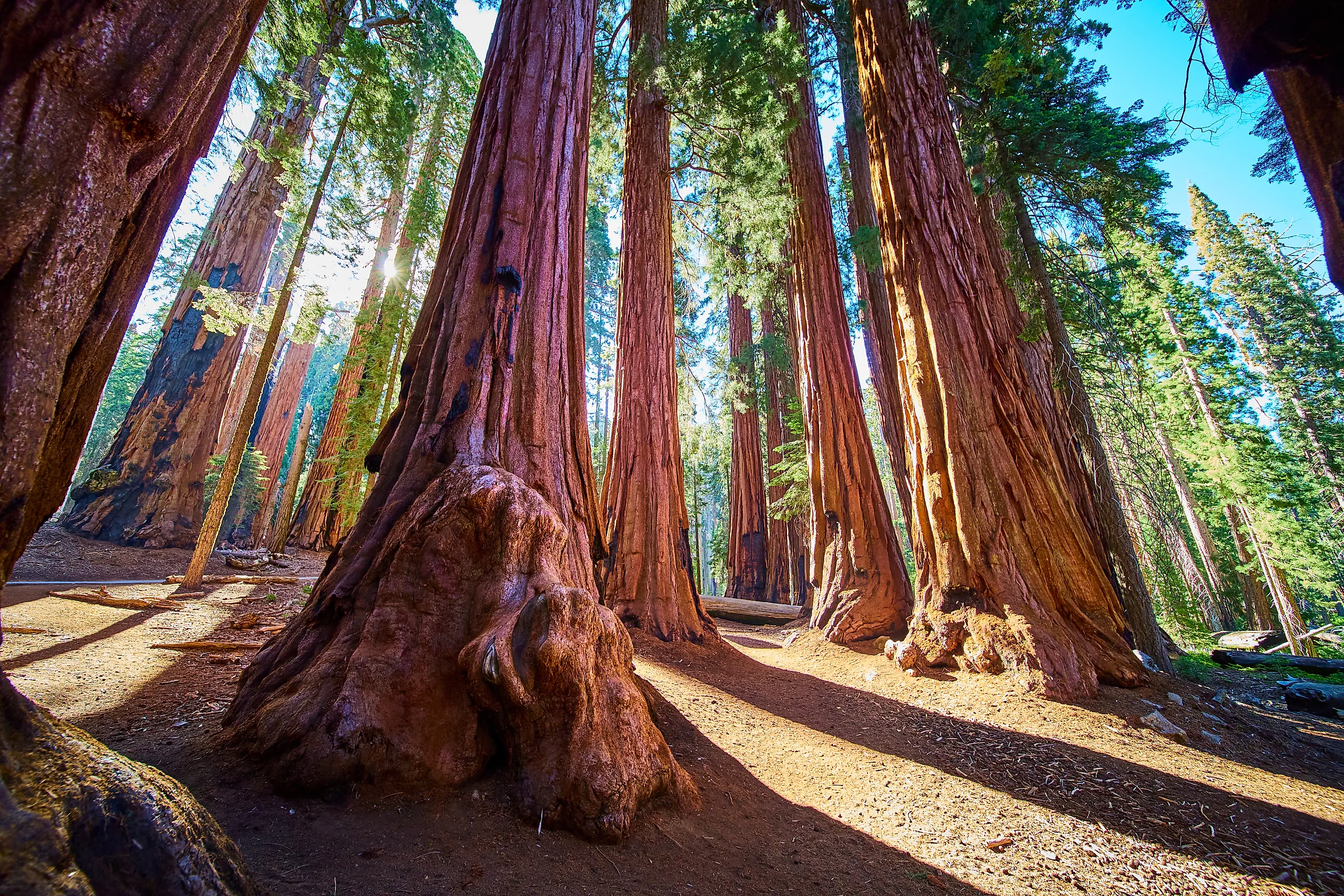
The National Parks With The Largest Trees By Volume
One tree in Sequoia National Park named General Sherman contains more than 52,000 cubic feet of trunk wood, enough to make it the largest known living single-stem tree on Earth by volume. Among America's 63 National Parks, four California parks contain exceptionally large documented trees: Sequoia, Kings Canyon, Yosemite, and Redwood. Giant sequoias dominate the volume rankings, while the coast redwoods of Redwood National Park combine enormous trunks with heights that no living sequoia can match.
Meet The General

General Sherman, a giant sequoia in Sequoia National Park's Giant Forest, has an estimated trunk volume of 52,508 cubic feet, according to the National Park Service. It stands 274.9 feet tall and measures 102.6 feet around at ground level. Even 180 feet above its base, the trunk remains about 14 feet in diameter. General Sherman is estimated to be thousands of years old.
Sequoia National Park was established on September 25, 1890, making it the second National Park created in the United States. Protection of giant sequoias was central to its creation. Giant Forest now contains General Sherman and many other trees that rank among the world's largest by volume. The park's enormous trees thrive at middle elevations of the Sierra Nevada, where winter snow supplies water during the warmer months. The National Park Service identifies roughly 5,000 to 8,000 feet as especially favorable elevation for giant sequoia growth. Mild temperatures, deep winter snow, and a long history of recurring fire helped produce the massive trees that survive there today.
Another General in Kings Canyon National Park

Just north of Sequoia National Park stands the world's second-largest known tree by trunk volume. The General Grant Tree in Kings Canyon National Park contains an estimated 46,608 cubic feet of trunk wood. It reaches 268.1 feet tall and measures 107.5 feet around at ground level. General Grant is the second-largest tree by the National Park Service's trunk-volume measurement, but it's not among the oldest. Its tremendous size reflects favorable growing conditions, including abundant sunlight and water.
The tree stands in Grant Grove, an area protected as General Grant National Park in 1890, less than a week after Sequoia National Park was established. General Grant National Park remained a separate park until 1940, when its land became part of the newly created Kings Canyon National Park. Sequoia and Kings Canyon together contain an extraordinary concentration of giants. NPS reports that seven of the world's 10 largest giant sequoias and 18 of the largest 30 are found within the two parks.
Yosemite National Park: The Giants Of Mariposa Grove

Yosemite's granite cliffs may receive more attention, but the park also contains three natural groves of giant sequoias. Mariposa Grove is the largest, with more than 500 mature giant sequoias. Among Mariposa Grove's giants is the Washington Tree, which has been measured at roughly 35,900 cubic feet of trunk volume. The better-known Grizzly Giant contains about 34,000 cubic feet. NPS research places the Grizzly Giant among the largest living giant sequoias and estimates its age at about 2,995 years.
The Grizzly Giant stands only about 209 feet tall, considerably shorter than General Sherman. Its enormous width produces its impressive volume. The tree has a heavily buttressed base, and one of its largest branches is itself about six feet in diameter. Mariposa Grove also contains the Columbia Tree, which reaches roughly 285 feet and is generally identified as the grove's tallest giant sequoia.
Yosemite's sequoia groves also played an early role in American conservation. President Abraham Lincoln signed the Yosemite Grant in 1864, protecting Yosemite Valley and Mariposa Grove decades before the National Park Service existed. Yosemite became a National Park in 1890, and Mariposa Grove later came under federal control as part of the park.
Redwood National Park: Coast Redwood Giants

One of the largest documented trees within the federal Redwood National Park is Melkor, a coast redwood in the Tall Trees Grove area with a published trunk-volume estimate of about 33,500 cubic feet. Here you can also find Hyperion, the world's tallest known living tree. Its height has been measured at about 380 feet, more than 100 feet taller than General Sherman. Hyperion does not approach General Sherman in trunk volume because coast redwoods taper more dramatically as they rise.
In a nutshell, Redwood National Park has the tallest known living trees. Sequoia National Park has the largest known living tree by trunk volume. Great Basin National Park, meanwhile, protects exceptionally old bristlecone pines, giving three National Parks very different claims in the world of record-setting trees.
How Giant Sequoias Reach Such Enormous Sizes

Giant sequoias combine rapid growth with extraordinary longevity. Their fibrous bark can grow well over a foot thick and helps insulate living tissue during lower-intensity fires. Mature trees also resist many insects and diseases that can kill other conifers. Their roots present a surprising contrast to the massive trunks overhead. Giant sequoias do not depend on extraordinarily deep taproots. Their root systems spread broadly through the upper layers of soil, allowing them to collect water over a large area. That also makes the soil around heavily visited trees sensitive to trampling and compaction.
Fire is another important part of the sequoia ecosystem. Lower-intensity fires clear accumulated vegetation, expose mineral soil and create sunny openings where seedlings can establish. Decades of fire suppression allowed fuels to build up in many groves, increasing the risk of fires severe enough to kill mature trees.
The Growing Threat From Severe Wildfire

Recent fires have shown that even trees capable of surviving centuries of wildfire have limits. The 2020 Castle Fire killed an estimated 7,500 to 10,600 large giant sequoias, equal to roughly 10% to 14% of all large sequoias across their natural Sierra Nevada range. The KNP Complex and Windy fires in 2021 killed or severely damaged an estimated additional 2,261 to 3,637 large trees, another 3% to 5% of the population.
General Sherman itself faced the KNP Complex Fire in 2021. Firefighters wrapped the lower portion of its trunk with protective aluminum material where old fire scars could have been vulnerable. Years of prescribed burning around Giant Forest also helped reduce fuels, and the fire reached the area at low to moderate intensity. General Sherman survived. Severe fire creates a different problem than the regular fires under which giant sequoias evolved. When intense burns kill most mature trees across a large area, they can also destroy the seed source needed to replace them. Managers now use prescribed fire, forest thinning, monitoring and, in some severely burned groves, active reforestation to improve the chances that these giant-tree forests persist.
Big Reds
California's four giant-tree National Parks all bring different superlatives to the table. Sequoia and Kings Canyon dominate trunk-volume records, Yosemite protects some of the largest remaining sequoias farther north, and Redwood contains coast redwoods that trade massive girth for unmatched height. Measured strictly by trunk volume, General Sherman remains the benchmark at 52,508 cubic feet.