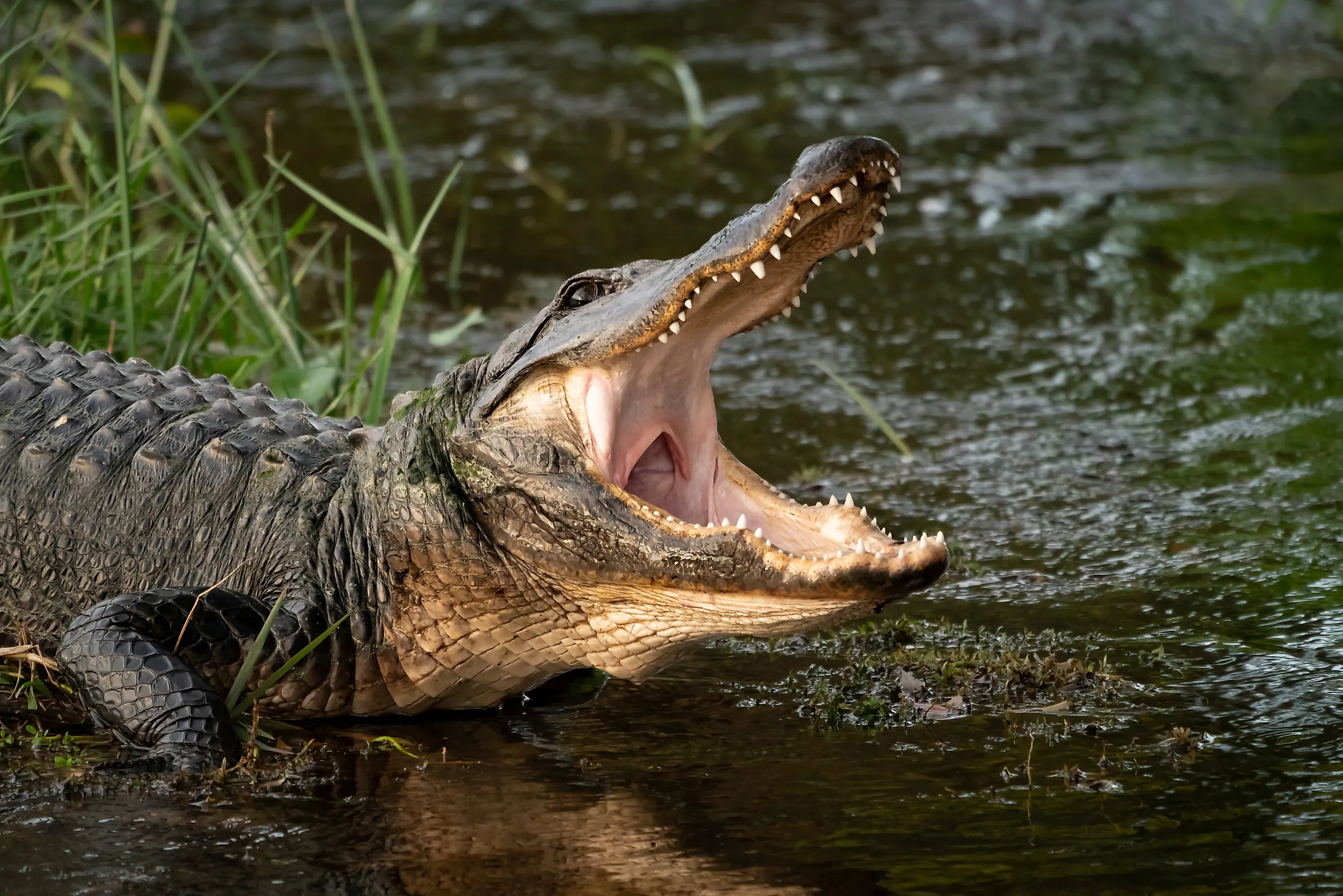
Alligator
"Alligator" likely comes from an anglicized form of the Spanish el lagarto, meaning "the lizard." The name suits these animals, as they are the largest reptiles in their environments, with the biggest weighing more than half a ton.
Alligators are members of the Crocodilia order and are only found in the United States and China. These creatures are unchallenged in their habitats other than by humans, who have hunted them for food, leather, or simply out of fear. Conservation efforts have revitalized the American alligator significantly, but much work remains on the Chinese alligator.
Alligators serve an important ecological role, both by keeping prey populations in check and by shaping their environments through the large burrows they dig.
Species and Size

Two alligator species live on opposite sides of the world: the American alligator (Alligator mississippiensis) and the Chinese alligator (Alligator sinensis). The Chinese alligator is listed as Critically Endangered, with fewer than 150 believed to remain in the wild.
The Chinese alligator typically grows to around 5 feet, with large individuals reaching close to 7 feet. They usually weigh between 50 and 90 pounds. Today they are restricted to the lower Yangtze River basin and a small number of protected marshes in Anhui and Zhejiang provinces.
American alligators are larger than their Chinese counterparts and far more widespread. Adult females average about 8.2 feet in length, while males average around 11.2 feet. The longest American alligator on official record was a male taken in Alabama in 2014, measuring 15 feet 9 inches and weighing just over 1,011 pounds. Adults typically weigh between 500 and 1,000 pounds, with the largest individuals exceeding that.
They are found across the southern United States, with a range stretching from the Gulf of Mexico in Texas up to North Carolina, covering 10 states. An estimated 5 million American alligators live in the wild, with the largest populations in Louisiana (about 2 million) and Florida (about 1.3 million).
Physical Traits

American alligators are imposing creatures with a body covered in what appears to be armor. These are actually bony plates known as scutes, or osteoderms, embedded in the skin. Alligators have flat, muscular tails and a long, rounded snout with nostrils set on top. They can lift the tip of their snout just above the water surface to breathe while the rest of their body remains submerged.
American alligators have short legs for movement on land. They can still move quickly in short bursts, reaching speeds of roughly 9 to 11 miles per hour, though they tire quickly and do not sustain those speeds over distance.
American alligators have 74 to 80 sharp teeth, which are continuously replaced as they wear down from biting prey or natural decay. A single alligator can go through thousands of teeth over its lifetime.
Chinese alligators are similar in body plan to American alligators, with a few notable distinctions. Chinese alligators have bony plates embedded in their belly skin and eyelids, features that American alligators lack. They also tend to have a proportionally larger head relative to body size and a more upturned snout.
Ecosystems

Both species prefer freshwater environments. American alligators are found throughout freshwater lakes, rivers, streams, and marshes across their range. Chinese alligators historically occupied floodplain marshes, lakes, and wetlands along the Yangtze River and today survive in a handful of protected marshes.
Alligators favor slower-moving water, which is part of why the St. Johns River in Florida supports one of the densest alligator populations in the country. The water there moves at an average of about 0.3 miles per hour, giving it a reputation as one of the laziest rivers in North America.
Alligators can also enter brackish and saltwater for short periods, though they cannot live in salt environments long-term. Unlike crocodiles, alligators lack salt glands that excrete excess salt. Coastal alligators in the Gulf of Mexico region and along the Atlantic seaboard do venture into tidal waters to forage, but they return to fresh water before salt stress becomes a problem.
Alligators play an important role in their environment through the burrows they dig. They build large tunnels for protection and use them to ride out winter in a dormant state known as brumation, the reptile equivalent of hibernation. When not in use by alligators, these tunnels become critical shelter for many other species, particularly during droughts when the water at the bottom of a "gator hole" may be the only water left in a marsh.
Hunting

American alligators are the largest and strongest predators in their ecosystems, in large part because of their bite. Research has measured the American alligator's bite force at around 2,125 pounds, making it one of the strongest bites of any living animal (saltwater crocodiles measure higher, at roughly 3,700 pounds). For comparison, a lion's bite is estimated at about 650 pounds. An alligator's bite is powerful enough to pierce a turtle's shell.
Alligators primarily hunt at night, typically in the shallower parts of a waterbody and often right along the shoreline. They wait for prey to come close, then lunge, bite, and drag the animal into the water to drown it using a behavior called the "death roll." American alligators are opportunistic and will eat fish, birds, mammals, reptiles, and carrion. Unfortunately, this includes domestic animals like dogs that wander too close to the water. Alligators do not generally target humans unless a person triggers their ambush response by swimming or splashing close to them.
Although Chinese alligators are smaller than their American cousins, they are the apex predators in their own habitat. They have blunter teeth well-suited for crushing the shells of snails, freshwater mussels, and crustaceans. They also take fish and small mammals, and in some rural areas have been known to prey on domestic ducks.
Social Behavior

American alligators are more social than their reputation suggests, though their behavior depends on the situation. Hatchlings stay close together for protection, as they are vulnerable to predators such as raccoons, wading birds, large fish, and even larger alligators. Adults also congregate in loose groups in areas with abundant prey, although they do not hunt cooperatively or share nests. They communicate through a range of vocalizations and body language, including high-pitched calls from hatchlings, head slaps on the water surface, and low, rumbling bellows used to attract mates.
Alligators can become aggressive with one another during mating and egg-laying season. In mating season, males fight other males for territory in violent contests that can leave the loser with parts of its tail bitten off. Once a male has secured territory, he calls out to females with a deep bellow or by slapping the water. If a female approves, the pair rub each other's snouts and backs before mating. The female then lays up to 50 eggs in a mound of vegetation.
Females guard their nests from predators and manage incubation by keeping eggs close to a warm water source. The sex of the hatchlings is determined by nest temperature: warmer nests in the 90 to 93 degree Fahrenheit range produce mostly males, while cooler nests in the 82 to 86 degree range produce mostly females.
Chinese alligators display similar social and mating behavior, though they tend to be less territorial than American alligators. Both sexes of Chinese alligators produce loud mating calls, and when many animals call at once the effect can sound like a chorus. Both species are polygynous, meaning a male will mate with multiple females during the breeding season.
Both American and Chinese alligators are protective of their young, caring for them for up to two years until the juveniles are large enough to fend for themselves.
Conservation

The American alligator was heavily hunted in the 1800s and 1900s, for several reasons. Some people hunted them out of fear, while others killed them for meat or for leather used in belts, shoes, and bags. On top of hunting, marshes and wetlands across their range were drained or filled for commercial and agricultural development. By the 1960s the American alligator was listed as endangered, which triggered a significant recovery effort at both federal and state levels.
That effort has largely worked. The American alligator was removed from the endangered species list in 1987 and now numbers in the millions. Because alligators are apex predators whose populations can unbalance an ecosystem if left unchecked, several states, including Louisiana, Florida, Texas, and Arkansas, now run regulated alligator hunting seasons to keep numbers in balance.
The Chinese alligator, by contrast, remains in serious danger of extinction due to conflict with farmers, past hunting, and widespread habitat destruction along the Yangtze. Conservation efforts include captive breeding programs in Chinese and American zoos, along with reintroductions into protected environments in China. The Wildlife Conservation Society has worked with Chinese authorities, including what is now the National Forestry and Grassland Administration, to reintroduce Chinese alligators into suitable habitat. These efforts are especially important because remaining wild populations are very small and fragmented.
The Chinese government has classified the Chinese alligator as a First-Class Nationally Protected Animal, which affords it the country's highest level of wildlife protection. Public education remains a key part of the work, particularly for farming communities that live alongside the few remaining wild populations.
Peaceful Cohabitation
One reasonable way to describe alligator social behavior is peaceful cohabitation. Alligators don't cooperate much, but they tolerate each other and their mothers clearly protect their young.
Humans can take a similar approach with alligators. In some cases, American alligators that wander into residential areas and lose their natural wariness of people become what wildlife managers call "nuisance alligators" and must be removed. Chinese alligators are smaller and far less territorial than American alligators, and attacks on humans are rare even where reintroduced populations exist.
For the average person, avoiding alligator conflict is a matter of awareness: know which waters hold large alligator populations, avoid swimming or letting pets near the shoreline in those waters, and never feed an alligator, which quickly erases its fear of humans. With continued conservation work and common sense on the human side, the two species can share the same landscape.