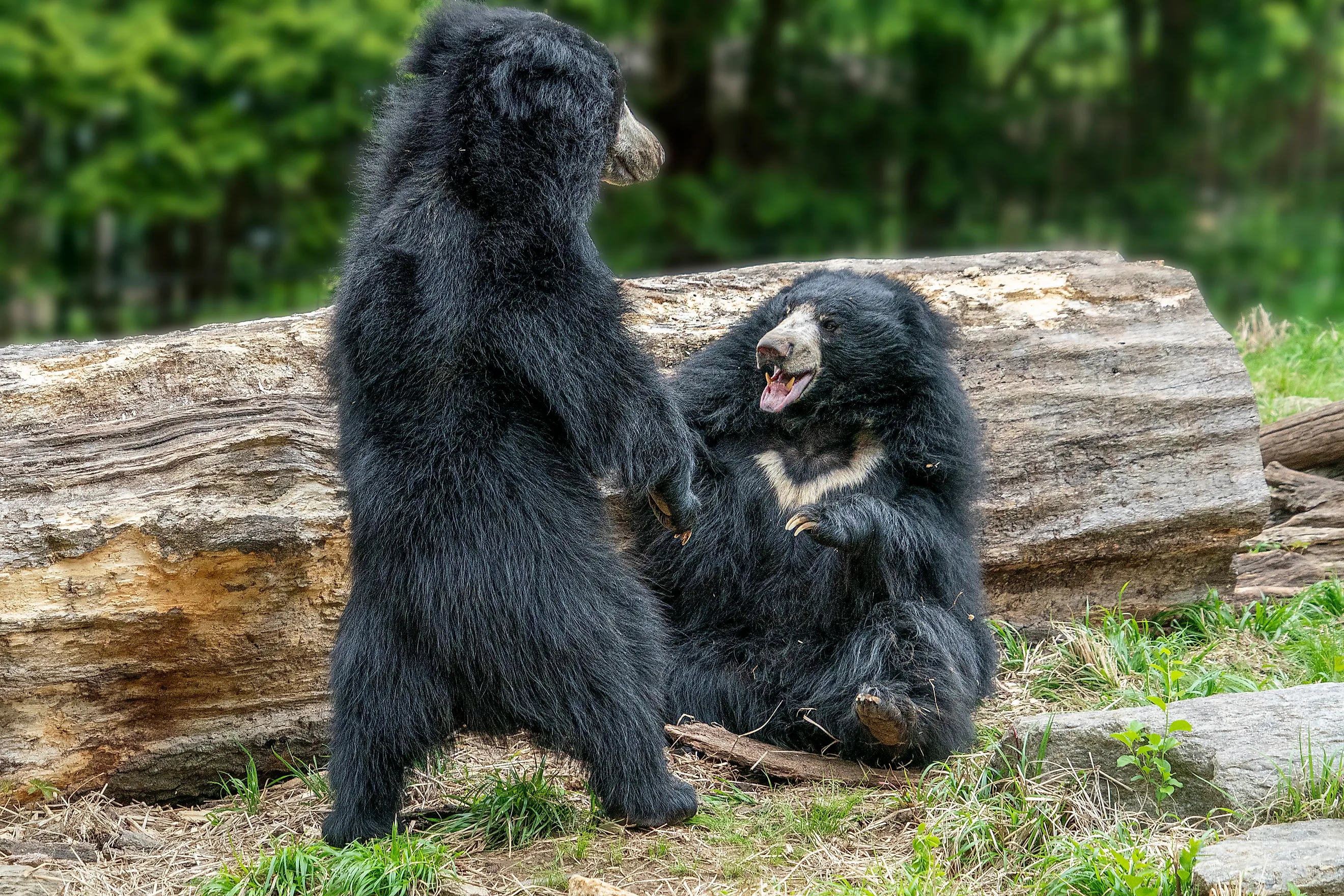
Sloth Bear
One of the four bear species found on the Indian subcontinent, and the only one endemic to it, the sloth bear (Melursus ursinus) has long captured the attention of wildlife lovers and researchers alike. Unlike its better-known relatives, such as the sun bear and Asiatic black bear, this silky-haired black ursine has evolved into a specialized ant, termite, and bee eater, thanks to the sickle-shaped claws, long lower lips, and absence of the upper middle incisors that help it devour a large number of insects in a single feed. From making loud snorting sounds while feeding to carrying cubs on their backs, sloth bears are also known to charge aggressively at anyone (including humans) they consider a threat.
As human populations in India continue to swell and intact forest habitats come under increasing pressure, negative interactions between people and wild species like the sloth bear are becoming more common. Understanding the habitat needs of these insect-loving forest dwellers, putting urgent conservation measures in place, and finding workable ways for people and wildlife to coexist are all critical today.
Taxonomic Classification

Bears are large terrestrial mammals placed in the order Carnivora and the family Ursidae. The first description of the sloth bear was given by the English zoologist George Shaw in 1791, who named it Bradypus ursinus for the animal's shared characteristics with tree sloths, chiefly the long claws and the absence of the upper middle incisors. In 1793, the German naturalist Bernhard Meyer first recognized the animal as a bear and classified it under a separate genus, Melursus. Following further work by other scientists at the subgenus level, the bear was eventually named Melursus ursinus.
Subspecies of Sloth Bear

In 1933, researchers distinguished two subspecies of sloth bears: Melursus ursinus ursinus, the Indian sloth bear, and Melursus ursinus inornatus, the Sri Lankan sloth bear. The Indian sloth bear, identified by a relatively large skull, is the most widespread, occupying forested areas and low hills bordering the outer margins of the Himalayas. In Nepal, the Indian sloth bear is restricted to the lowland Terai region.
The Sri Lankan sloth bear is recognized by a smaller skull and shorter body hair, which makes it appear less shaggy than its Indian counterpart. This subspecies was once common throughout the island nation. In recent decades, however, the conversion of forestlands to agricultural plantations has reduced bear populations significantly, and the subspecies is today found mostly in the country's northern and eastern lowland regions.
Physical Description

The sloth bear is a medium-sized bear with a short-haired long muzzle and a black, shaggy coat. The coat is especially long behind the neck and between the shoulders and most sparse on the undersides and legs, giving the bear a maned appearance. The all-black look is broken by a distinctive whitish Y- or V-shaped patch on the chest. The long coat helps protect the bear from insect bites and exaggerates its size to other bears and predators such as tigers.
The bear's dirty-white to yellow-colored long snout ends in extendable lips flexible enough to stretch and close over the nostrils, which come in handy when feeding on ants or sucking termites out of their mounds. A broad palate and the missing pair of upper middle incisors create an effective mouth-vacuum that pulls insects in with ease.
The large floppy ears often stick out through the shaggy fur alongside small eyes and bowed forelegs. The highly developed paws end in sickle-shaped, ivory-colored claws that are well-suited for digging and breaking open hard termite mounds. Compared to the other members of the bear family, the sloth bear also has a slightly longer tail.
Range and Habitat

Sloth bears have an entirely tropical distribution, found throughout peninsular India, the Terai region of southern Nepal, and the moderate climatic zones of Sri Lanka and Bhutan. They have been declared regionally extinct from the moist deciduous forests of central Bangladesh. In India, sloth bears live in wooded areas extending from the Himalayan foothills to the southern extremity of the Western Ghats, with the Western Ghats and forests of the Central Indian Highlands being their current strongholds.
The sloth bear naturally inhabits a diverse range of habitats, including dry and moist deciduous forests, tropical evergreen forests, tall grass areas, savannahs, rocky hills, and scrublands. In most of the Indian subcontinent, they are common at altitudes below 4,900 feet, whereas in the dry forests of Sri Lanka, they are typically found below 980 feet.
Behavior

Sloth bears are primarily solitary, apart from mothers carrying cubs and courting pairs. To mark territories and communicate with other bears, they scrape with their forepaws and routinely rub their flanks against trees. There is considerable overlap in individual home ranges, and noisy, aggressive encounters between male sloth bears (or between a bear and a tiger) happen year-round.
Sloth bears are primarily nocturnal, with bursts of high activity at dawn and dusk. Females are more active during the daytime, carrying their cubs on their backs as a defensive measure against predators such as leopards, tigers, and other bears.
Reproduction

The Indian sloth bear's mating season runs from April to June, and the cubs are born in December or early January. Females usually give birth to one or two cubs per litter in natural caves or in shelters under boulders, though litters of three have been documented. During this time, mothers survive on fat reserves and metabolic water and do not leave the shelter until the cubs are 6 to 10 weeks old. Once the cubs reach this age, they come out of the den, often riding on the mother's back, and stay with her until they are 1.5 to 2.5 years old. The cubs reach sexual maturity at around 2.5 to 3 years of age, at which point they separate from their mother and begin searching for mates.
Food

Sloth bears are well-known myrmecophages, meaning ant and termite specialists, and are omnivores that also feed on bees, sugar-rich fruits, flowers, plant matter, honey, and carrion. During the non-fruiting season, the bear uses its strong sense of smell to locate ant colonies and termite mounds. Once located, the bear tears up the mounds or digs into the ground to reach the colonies with its sharp, curved claws. It then sucks up the insects through its muzzle, producing a loud vacuum-like noise as it feeds.
A variety of forest fruits, along with pods of Indian laburnum and fallen flowers of Madhuca longifolia trees, supplement the sloth bear's diet seasonally. Sloth bears are in turn important seed dispersers for many tropical plant species whose fruits they eat. Good climbers, sloth bears also regularly climb trees to raid honeycombs for honey.
Threats
Despite a relatively small home range, an adaptable diet, and an ability to survive in varied tropical conditions, the sloth bear population (estimated at fewer than 20,000 across the Indian subcontinent) is believed to be declining due to the degradation and fragmentation of forest habitats. More than half of the population lives outside protected areas, where monitoring and conservation management are limited, and those bears are severely threatened by rapid changes in land use driven by deforestation, mining, illegal cultivation, and forest-land diversion for infrastructure development. These pressures also drive more sloth bears into human-dominated areas next to forest reserves in search of food, leading to dangerous encounters on both sides.
Poaching is a serious concern as well. Sloth bears are hunted and exported to Southeast Asian countries for their claws, bile, baculum, and gall bladder, which are used in traditional Chinese medicines. For centuries, sloth bears were also captured by Kalandars for "dancing performances" in royal courts and on the streets. That practice was outlawed under the Wildlife (Protection) Act of 1972, and after decades of campaigning by Indian and global animal welfare groups, the last Kalandar dancing bear was freed in 2009. Today the sloth bear is listed in Schedule I of the Indian Wildlife (Protection) Act, in Appendix I of CITES, and as Vulnerable on the IUCN's Red List of Threatened Species.
Importance of Sloth Bears
The sloth bear plays a crucial role in maintaining the ecosystems it inhabits. As a strong indicator species for habitat quality, its presence is closely tied to a healthy forest, and protecting it means protecting many other species that share the same habitat. Identifying and maintaining the habitats and corridors used by bears (most of which lie outside protected areas), reducing human-bear conflict, encouraging alternate cropping practices, and supporting on-the-ground conservation programs are all key steps in securing the sloth bear's long-term survival in the wild.