Owl
Owls are some of the most recognizable birds on the planet, and also some of the strangest. Their eyes are so large that they cannot move in their sockets, so the birds have to turn their entire heads to look around. They can rotate those heads up to about 270 degrees, a range far beyond most animals. Their wings produce very little sound in flight. They swallow mice whole and later regurgitate the indigestible material as pellets. With more than 200 species spread across six continents, owls have evolved into one of the most fascinating branches of the bird family tree. Here is a closer look at what makes them tick.
Where Owls Live

Owls live on every continent except Antarctica, from the snowy tundra of the Arctic to the rainforests of the tropics. That global range means different species have adapted to wildly different landscapes. Snowy owls hunt over open Arctic ice. Burrowing owls dig into prairie soil on the plains of North and South America. Great gray owls patrol the boreal forests of Canada, Alaska, and Siberia, while little owls perch on olive trees in the Mediterranean.
One key factor in where owls settle down is nesting space. The more good nesting sites there are, the more owls you are likely to find in an area. Most nest in trees or in the crevices of cliffs, but some species get creative. Barn owls take over old buildings, silos, and church steeples. Burrowing owls move into empty prairie dog tunnels and ground squirrel holes, sometimes expanding them with their own digging. Understanding an owl's habitat helps explain where each species chooses to raise its chicks.
What Owls Eat

An owl's diet varies by species but generally includes insects, small mammals, birds, and occasionally fish or reptiles. Smaller species stick to insects, frogs, and small rodents. Medium-sized owls take on rats, rabbits, and songbirds. The biggest owls, like the Eurasian eagle-owl, have been known to take young deer, foxes, and even other birds of prey. Most owls hunt at night, though some are active at dawn, dusk, or in full daylight.
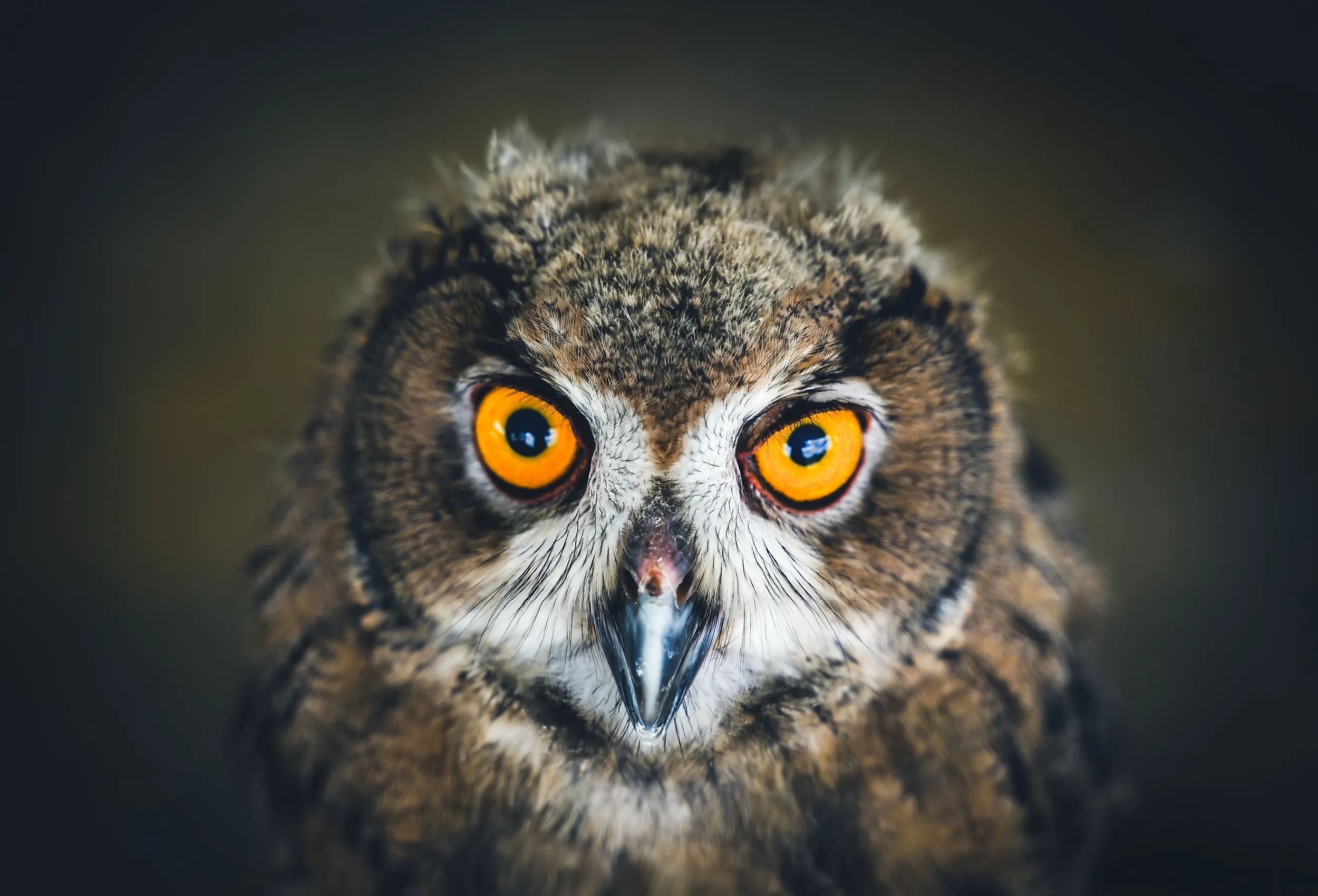
What makes owls such effective night hunters is a combination of adaptations the rest of the animal kingdom would envy. Their large eyes and high density of rod cells, the light-sensitive receptors behind the retina, allow them to see in very low light. Owls do not have a reflective tissue layer like many nocturnal mammals, but their eyes are so large relative to their skulls that they gather enormous amounts of ambient light, enough to spot a moving mouse under starlight alone.
Their hearing is just as impressive. Barn owls have asymmetrical ear openings, with one positioned slightly higher than the other, which lets them pinpoint the exact location of a rustling mouse by the tiny time difference between when the sound reaches each ear. They can catch prey in complete darkness using sound alone.
Then there is the silent flight. Owl feathers have serrated leading edges and soft, fringed trailing edges that muffle the turbulence most birds create when they fly. The result is a predator that arrives without warning. Prey animals often do not hear the owl until the talons close.
Owls swallow small prey whole. Whatever cannot be digested, like bones, fur, teeth, and claws, gets compacted in the gizzard and regurgitated hours later as a tightly packed pellet. Biologists dissect these pellets to figure out what local owls have been eating, which is how we know so much about their diets in the first place.
Physical Description

The size range across owl species is remarkable. The elf owl of the American Southwest measures about 5 inches from head to tail and weighs less than a golf ball. Blakiston's fish owl, the heaviest owl in the world, can reach 28 inches with a wingspan approaching 7 feet and weighs up to 10 pounds. Between those extremes sits everything from the spotted owlet of South Asia to the great gray owl of the northern forests.
What owls share is a set of features built for hunting: flat, disc-shaped faces that funnel sound toward their ears; large, forward-facing eyes that provide the depth perception needed to judge distance to prey; short tails for quick maneuvering; rounded, muffled wings for silent flight; and powerful feet tipped with curved, needle-sharp talons. The tufts on species like the great horned owl and the long-eared owl are not actually ears. They are just feathers that help with camouflage and communication.
Reproduction

Since owls are mostly nocturnal, camouflaged, and quiet in flight, they cannot rely on spotting each other to find mates. Instead, they communicate through sound. Bill-snaps, wing claps, and vocalizations with specific pitches and rhythms all tell other owls who is nearby, what species they are, and whether they are male or female. In some species, males have deeper calls than females.
Mating rituals vary by species. Screech owls sing duets that strengthen the pair bond: the male starts, the female answers, and over about 15 minutes, they move closer together until they meet. Great horned owls put on a more visual display, with males bowing deeply and fanning their tails. Wood owls add dance-like movements and head bobs. Once paired, most owl species stay together for the breeding season, and some mate for life.
Other Behavior

Owls use their voices for much more than mating. Young owls call out for help when they sense danger, and burrowing owl chicks have one of the most impressive defenses in the bird world: when threatened in their underground nests, they produce a hissing, rattling sound that closely mimics a rattlesnake. Predators that reach into a burrow expecting a helpless chick often back out in a hurry when they hear what sounds like a venomous snake coiled up inside.
Adult owls also use physical displays to ward off threats. When confronting an intruder, a large owl will spread its wings wide, fluff its feathers, rock from side to side, and snap its bill to appear bigger and more dangerous. If avoiding detection is the better strategy, owls do the opposite: they compress their feathers tight against their bodies, close their eyes to slits, raise their ear tufts, and hold completely still, turning themselves into what looks like a broken branch. Against the bark of a tree, the illusion is nearly perfect.
Threats

Despite their superpowers, owls face serious trouble. Habitat destruction is the biggest threat: as forests, grasslands, and wetlands disappear, the nesting sites and hunting grounds owls depend on disappear with them. Owls also fall victim to a more subtle problem called secondary poisoning. When farmers and cities use rodenticides to kill rats and mice, the poison stays in the rodent's body. Owls that hunt those poisoned rodents take the chemical into their own systems, often with fatal results.
Several owl species are now listed as endangered or critically endangered on the IUCN Red List. Blakiston's fish owl, the heaviest species, has seen significant population declines as the old-growth forests and salmon-bearing rivers it depends on have been logged and dammed. Island-dwelling owls are especially vulnerable because their small populations cannot absorb many losses. Conservation efforts, including reforestation, the installation of nest boxes, and public education about biodiversity, have helped some species recover, but much depends on what happens to the habitats that still remain.
Give A Hoot
Owls are one of nature's best showcases of evolutionary engineering: eyes that see in the dark, ears that hear in stereo, wings that make no sound, and necks that turn three-quarters of the way around. They live almost everywhere, from Arctic tundra to Mediterranean olive groves to desert cactus country, and each species has its own set of tricks. Their survival depends on the survival of the forests, grasslands, and wetlands they hunt from, so protecting those habitats is the best thing anyone can do to keep these incredible birds around. If you want to learn more, groups like the Audubon Society and local raptor rescues are great places to start.