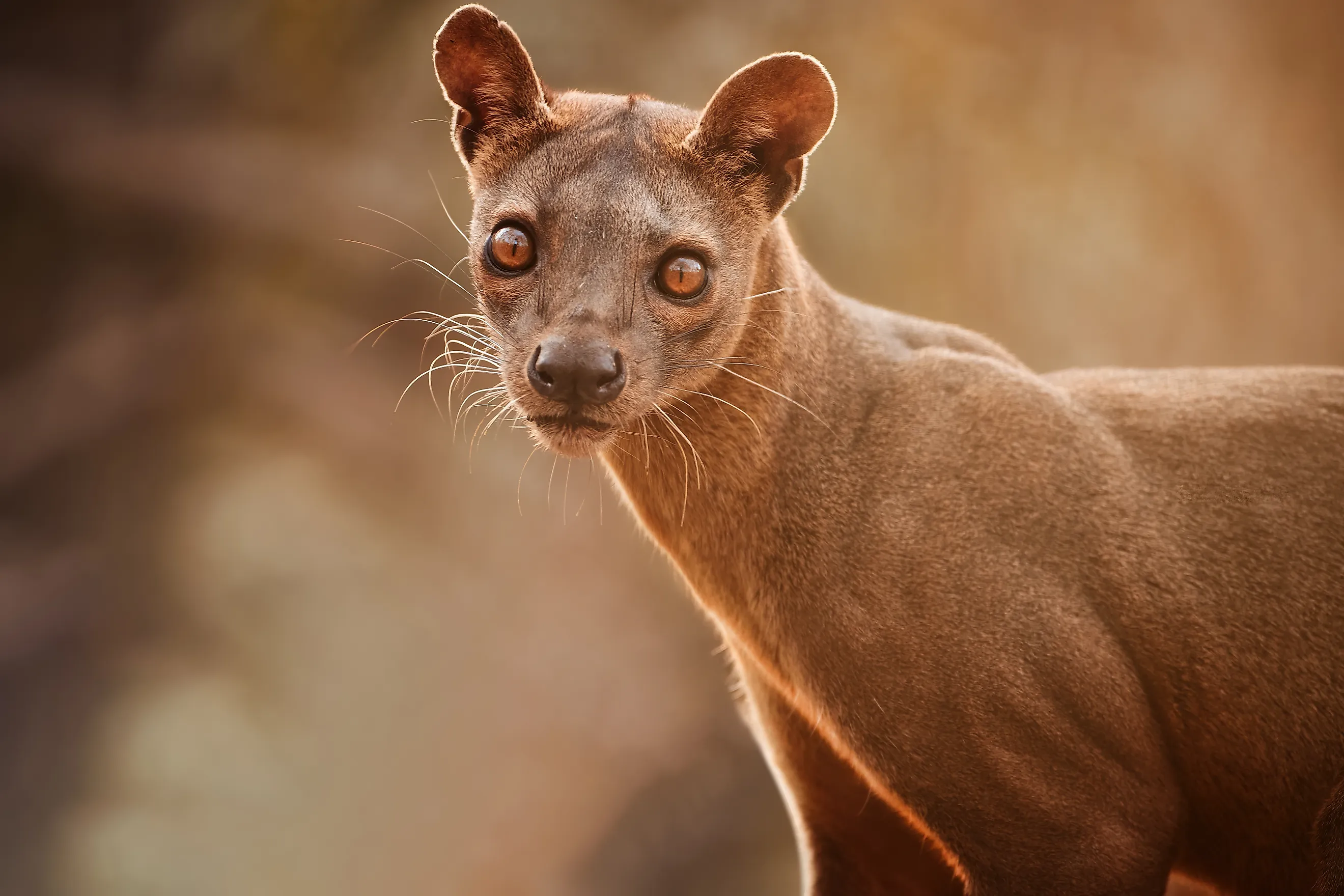
Fossa
In the isolated forests of Madagascar prowls a creature that looks a lot like a large cat. The creature is the furthest thing from a cat, however, since it moves like a monkey and is a distant relative of the mongoose. The fossa is the apex mammalian predator of its island home and is rarely observed in the wild. This fascinating animal is also something of an anomaly, having evolved in relative isolation. Madagascar separated from Africa roughly 160 to 170 million years ago, which means the island's wildlife has developed traits unlike those of any other place on Earth. The fossa is a prime example, evolved to hunt in one of the most vertical environments on the planet.
Taxonomy Of The Fossa

Fossa is pronounced in several ways, including 'fah-sah,' 'foosa,' and 'foosh.' Fossas belong to the Phylum Chordata and the Class Mammalia. They are carnivorous members of the Eupleridae family and the Cryptoprocta genus. Fossas are scientifically known as Cryptoprocta ferox. Scientists argued for many decades about where the fossa actually belongs. When they looked at the animal's retractable claws and body shape, they were inclined to place it in the feline category. However, some believed that the fossa's skull and teeth were shaped more like those of civets. Only after modern genetic testing was the fossa placed in the family Eupleridae, a group of carnivores endemic to Madagascar. The fossa is also the largest member of this family.
Physical Description

The fossa has a coat that ranges through brown and tan, with secondary shading in cream, gray, and white. These animals resemble cats, especially in silhouette, with a head-to-body length of around 70 to 80 centimeters. Their tails can reach up to 90 centimeters long and typically equal or exceed head-to-body length. Fossas use their muscular tails for balance while running and leaping. At the shoulder, they stand around 35 centimeters high. Adult fossas generally weigh between 12 and 26 pounds (5.5 to 12 kilograms), with males noticeably heavier than females. They also have powerful forelimbs and hindlimbs, an elongated muzzle, and flexible, reversible ankles that allow them to leap or descend headfirst.
The Range And Habitat Of The Fossa

Fossas are endemic to Madagascar. Historically, they were distributed across the island's forests, where they found both shelter and prey. Like many other animals worldwide, the fossa's range is now fragmented due to human activity.
Today, the fossa is largely restricted to the eastern tropical rainforests and the dry deciduous forests of the west. Key habitats include Ankarafantsika National Park and Kirindy Forest. Fossas are also found in the spiny thickets on the south side of the island. They prefer primary forests but have been seen in secondary forests and savanna cliffs where some forest patches remain. Where they are found depends heavily on the density of Madagascar's lemur populations, the fossa's main food source.
Hunting And Diet

As Madagascar's apex mammalian predator, the fossa will eat just about any animal it can catch. Fossas favor lemurs, which can make up more than 50% of a fossa's diet in certain regions. They also consume large insects and will even eat fruit if prey is scarce. This opportunistic hunting behavior matters on an island where resources fluctuate between seasons and storms.
Fossas are cathemeral hunters, meaning they are active both during the day and at night. They often hunt diurnal lemurs during the day and mouse lemurs at night. On the ground, they can outrun tenrecs, lizards, birds, and other animals. The fossa's hunting technique revolves around stealth and power: stalking prey in the tree canopy or through the undergrowth before launching an attack that lands a bite to the skull or neck. When a fossa walks, the soles of its feet meet the ground in plantigrade style, the same way humans and bears walk.
Social Behavior

Fossas are solitary animals that avoid one another outside of mating season. They are territorial and use scent marking to establish range boundaries. Fossas have large perineal scent glands that produce a strong, musky secretion. This scent communicates each fossa's identity, health, and reproductive status to those passing through.
Fossas may be solitary, but they are not silent. They communicate through vocalizations, including purring when content and yelping during play. They also produce cat-like screams during mating rituals. Fossas in captivity have been observed to be intelligent and curious, interacting with enrichment items and showing problem-solving skills. One of the fossa's notable traits is its boldness. Without large mammalian predators on Madagascar, the fossa does not exhibit the skittishness common in mainland carnivores, though it still coexists with crocodiles, large snakes, and raptors that can pose a threat to young fossas.
Reproduction

Male fossas display aggression during mating season. They adopt threatening postures and emit warning vocalizations, sometimes leading to fights where one male tries to bite the other. When a female is ready to mate, she signals to the male of her choice by lifting her hindquarters and turning her external genitalia inside out. Copulation can last nearly three hours, one of the longest mating acts among carnivores.
Mating typically occurs in September and October, with young born in a den in December and January. Cubs are blind and toothless at birth but already have fur. They are weaned at about four months, when they can leave the den for the first time. Mothers protect their cubs until they become independent, usually between 15 and 20 months of age.
Importance And Cultural Impact

As Madagascar's top mammalian predator, the fossa keeps lemur populations in check, which helps maintain the ecosystem balance. Without the fossa, prey species including lemurs would likely overpopulate, causing damage to the forests. If the island's vegetation collapses due to overgrazing, it can result in a loss of biodiversity across the entire ecosystem.
The fossa also has a complicated cultural standing in Madagascar. In some regions of the island, it is considered bad luck to kill a fossa. In other areas, the animal is feared because it is believed to steal chickens and other small livestock, which has led to conflict between local communities and fossas.
Threats And Conservation Efforts

Habitat loss and conflict with humans have led to the fossa being listed as Vulnerable on the IUCN Red List, with an estimated population of fewer than 2,500 mature individuals remaining in the wild. The biggest threat is habitat loss, as Madagascar has lost a substantial share of its original forest cover due to charcoal production, logging, and slash-and-burn agriculture. The forests continue to shrink, isolating fossa populations in small patches.
Invasive species have also been introduced, and feral dogs and cats now compete with the fossa for food. They also carry diseases, including rabies and canine distemper, which can be fatal to native carnivores. When prey is scarce, fossas may venture into villages to hunt, where they are often killed by farmers. Conservation efforts include reforestation projects, the creation of protected wildlife corridors, and public education programs that have shown some success in helping local communities understand why the fossa should not be killed.
The Fossa's Survival
The fossa is a reminder of how wildlife can evolve in isolation into something found nowhere else. Shrinking forests and retaliatory killings continue to reduce fossa numbers, and the animal's long-term survival now depends on how much of its habitat is protected and how effectively conflict with local communities can be reduced. The story of this elusive apex predator is tied directly to the future of Madagascar's forests.