The Rise of The Ottoman Navy in The Mediterranean
As a predominantly Mediterranean power, the Ottoman Empire relied heavily on its navy as a key contributor to its regional strength and longevity. It helped establish the empire as a major world power by supporting the conquest of Constantinople. The navy was instrumental in the intense competition that took place in some eras with other Mediterranean-based states. Finally, the Ottoman Navy was the main military might behind the expansion into North Africa and was thus a major reason the empire came to stretch into three continents.
Background

The Ottoman Empire emerged in the late 1200s and early 1300s in northwestern Anatolia. Under its first sultan, Osman I, it had little to no naval presence. However, this changed with subsequent leaders. The capture of the city of Ismit on the Sea of Marmara in 1337 marked the establishment of the empire's first major foothold on an important inland sea connected to the Mediterranean. The next hundred years saw the Ottomans make deep incursions into the Balkans and subsequently come to control many cities along the Aegean Sea. All this necessitated the establishment of a navy to protect key sea-based trade routes, compete with rival maritime powers, and defend Ottoman territory.
The Conquest of Constantinople

A major display of Ottoman naval strength occurred in 1453 when the Ottomans besieged Constantinople in an attempt to take it from the Byzantines. Between 80,000 and 100,000 troops surrounded the city on land, and large cannons were utilized to bombard the city walls. At the same time, an Ottoman fleet blockaded the city by sea. Initially, they faced difficulties. The Byzantines blocked the passage around the Golden Horn, preventing the navy from fully encircling the city. The Ottomans responded by creating a road of greased logs and dragging about 70 ships overland. Then they launched them back into the water behind the lines. With this coordinated land and sea pressure, the city was surrounded and fell in late May 1453.
The conquest of Constantinople had two major implications for the Ottoman Navy. First, it demonstrated the navy's strategic importance within a broader combined assault. Second, it reinforced the navy's value to the empire's continued expansion and dominance of the region, since the Ottomans now controlled the Bosphorus Strait. As the only maritime link between the Black and Mediterranean Seas, the Bosphorus was a key trade artery. To hold this vital economic and strategic location, the Ottomans invested further in naval development in the coming centuries.
Expansion into North Africa

The rest of the 1400s saw the Ottoman Navy expand and compete for influence in the Mediterranean. However, incursions by European powers such as Spain into North Africa threatened this influence. The Ottomans initially responded by supporting private naval commanders known as corsairs, who sought to expel European forces. Over time, these arrangements evolved into more formal Ottoman control. Naval bases were established in Algiers, Tunis, and Tripoli, and shipyards in Constantinople (renamed Istanbul) were expanded during the Ottoman period to supply them. While direct control over the interior of North Africa remained limited and often semi-autonomous, Ottoman hard power along the coastlines relied heavily on naval strength.
Peak and Decline

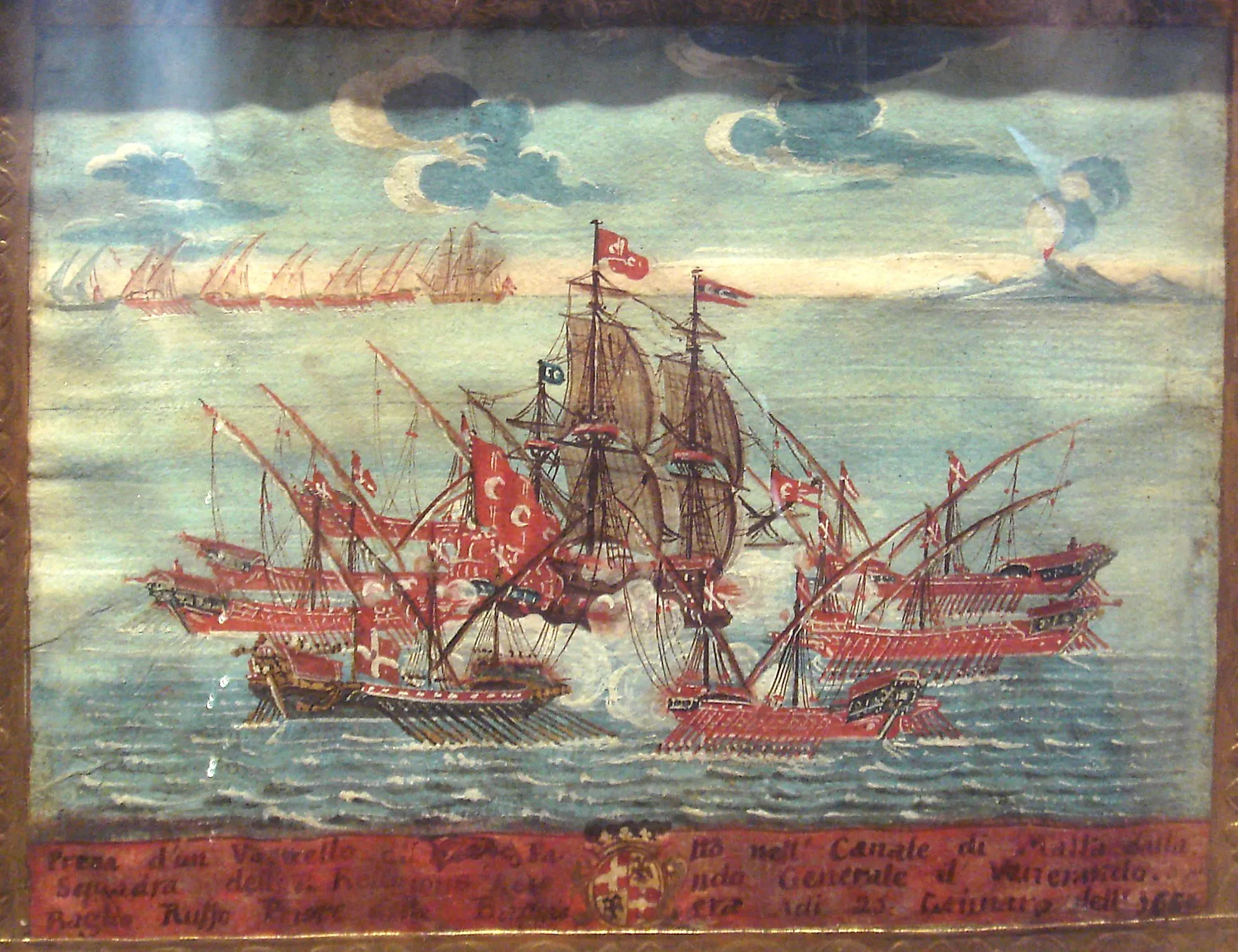
From about the 1520s to the 1570s, the Ottoman Navy reached its peak. In 1538, they defeated the Holy League, a coalition led by Venice and Spain, in the Battle of Preveza, becoming a dominant naval force in the Mediterranean. However, the tide began to turn in 1571. That year, the Ottomans invaded the Venetian-controlled island of Cyprus. The Holy League responded and defeated the Ottoman fleet at the Battle of Lepanto, resulting in the loss of nearly 200 ships and around 30,000 men. The Ottomans rebuilt their fleet quickly in terms of ship numbers and retained control of Cyprus, though replacing experienced crews and commanders was more difficult. The battle showed that the Ottomans could be challenged. Over the next century, the Ottoman Navy remained strong but faced mounting pressures, which increased in the 1700s and 1800s. Gradually, advances in European naval technology and shifting global trade routes reduced Ottoman dominance in the Mediterranean, marking the slow decline of its once commanding position at sea.
Importance and Legacy

The rise of the Ottoman Navy in the Mediterranean was a crucial component of the empire's power accumulation. Early expansion in the 1300s saw the Ottomans acquire key coastline territories, necessitating the development of a navy. That navy proved strategically important during the conquest of Constantinople in 1453. It also became central to Ottoman power projection along the North African coasts in the 1500s and to its victories against European coalitions during that period. The strength of the Ottoman fleet helped elevate the empire into the ranks of the great powers of its age, and as that naval dominance gradually eroded, it weakened the empire’s ability to defend its territories and compete with rising European rivals, contributing to its broader decline.