Ancient Buildings Still in Daily Use Today
Most buildings this old sit roped off as ruins for tourists to photograph. The seven here still fill with people every single day. Priests say Mass under the Pantheon's open dome in Rome. A Roman lighthouse in Spain throws its beam across the Atlantic each night. Families in New Mexico live inside adobe walls their ancestors packed by hand. Croatians run shops and cafes inside the stone rooms of a Roman emperor's palace.
Pantheon - Rome, Italy

The original Pantheon was built between 27 and 25 BC, while the structure that largely survives today was completed around AD 125 during the reign of Emperor Hadrian. It remains one of the best-preserved monuments of the Roman Empire. Initially constructed as a temple associated with various Roman deities, it was consecrated as the Basilica of Saint Mary and the Martyrs in AD 609 and has served as a Christian church ever since. Its religious use played a major role in preserving the building through nearly two millennia of political and social change.
The Pantheon is also celebrated for its immense unreinforced concrete dome, which spans about 142 ft (43.3 m). At its center, an oculus measuring approximately 29 ft (8.9 m) across provides the principal source of natural light for the rotunda while also reducing the dome's overall weight. Together, the dome and oculus remain extraordinary achievements of ancient Roman engineering.
Today, the Pantheon continues to host masses, weddings, religious celebrations, and major feast-day services while welcoming millions of visitors. It also serves as the burial place of several notable Italians, including Renaissance artist Raphael and the Italian kings Vittorio Emanuele II and Umberto I.
Tower of Hercules - A Coruña, Spain

Rising above the Atlantic coast of northwestern Spain, the Tower of Hercules is the world's oldest surviving Roman lighthouse that remains operational. It was constructed in the late 1st or early 2nd century AD to guide ships navigating the rugged coast of Galicia, where rocky shores and unpredictable weather have challenged mariners for centuries.
The lighthouse underwent major reconstruction during the late 18th century, when its Roman core was encased within a new neoclassical exterior and its upper section was expanded. Even so, a substantial portion of the ancient structure survives within the present tower, making it a remarkable example of Roman maritime engineering still being used for navigation.
Standing approximately 180 ft (55 m) tall on a peninsula overlooking the entrance to A Coruña's harbor, the tower continues to operate as a lighthouse. Its beacon helps guide commercial, fishing, and recreational vessels approaching the coast and harbor.
More than 1,900 years after its construction, the Tower of Hercules remains both a practical navigational aid and a popular tourist destination. Visitors can climb its interior staircase for sweeping views of the Atlantic Ocean, while a nearby sculpture park and coastal walking trails provide additional opportunities for exploration.
Jetavanaramaya - Anuradhapura, Sri Lanka

Jetavanaramaya was begun under King Mahasena in the late 3rd century and completed under his son and successor in the early 4th century. The immense Buddhist stupa formed the centerpiece of Jetavana Monastery, which became an important center of scholarship and monastic life in ancient Sri Lanka.
Its original height is debated, although historical reconstructions commonly place it between approximately 330 and 400 ft (100 and 122 m). At its greatest extent, it ranked among the tallest structures of the ancient world. The monument is also estimated to contain more than 90 million fired bricks, demonstrating the extraordinary engineering and organizational capabilities of the ancient Sinhalese civilization.
Centuries of decline and neglect damaged parts of the complex, but extensive conservation work has stabilized the stupa and preserved much of its historic character. Today, Jetavanaramaya remains a place of Buddhist devotion and pilgrimage within the sacred city of Anuradhapura. Visitors come to pray, meditate, present offerings, and take part in religious observances, particularly during important Buddhist festivals.
The site is open to respectful visitors, who are expected to follow local customs, dress modestly, and remove their footwear before approaching sacred areas.
Diocletian's Palace - Split, Croatia

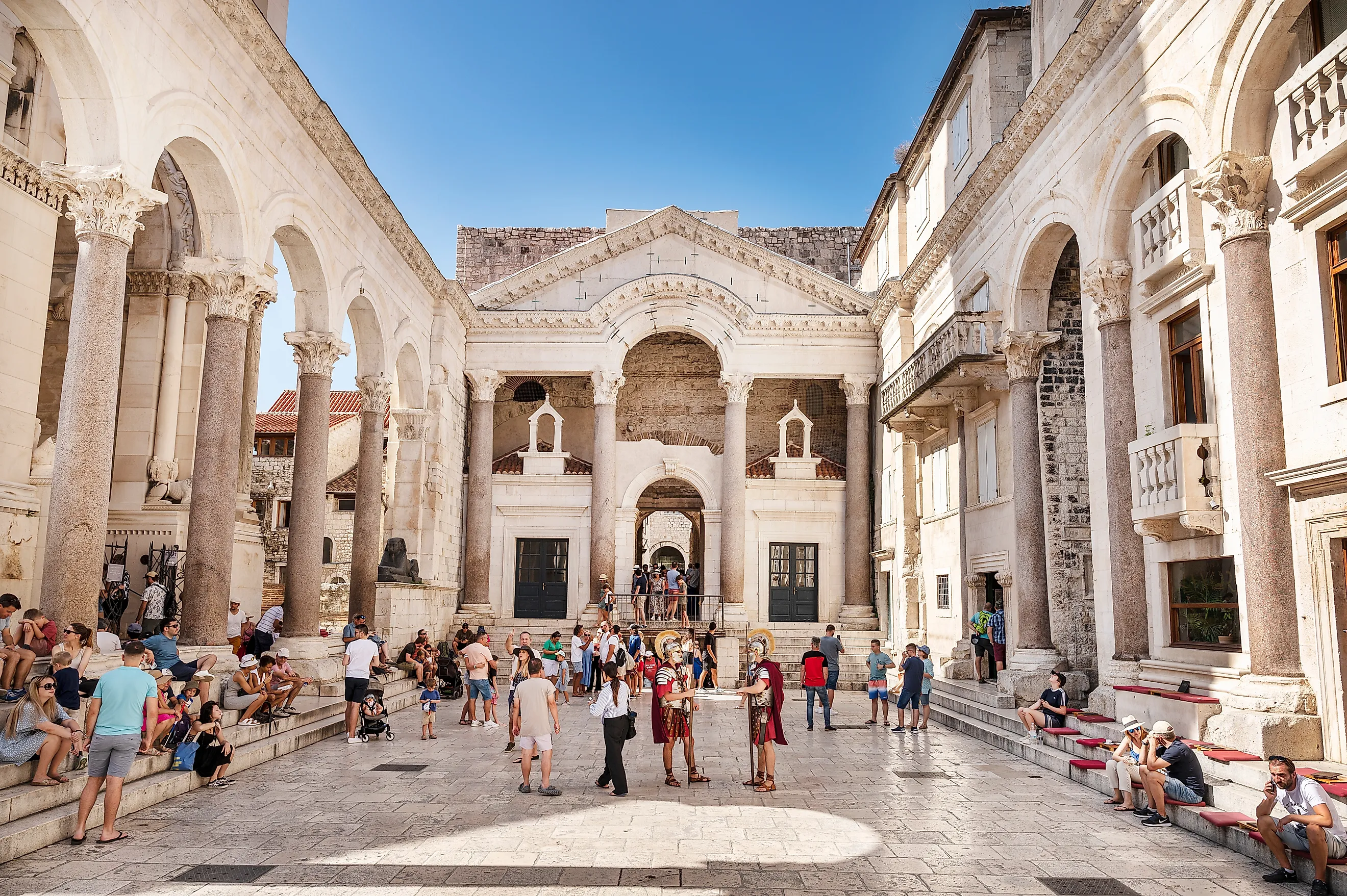
Completed around AD 305 as the retirement residence of the Roman emperor Diocletian, Diocletian's Palace has evolved into one of the world's most unusual living historic sites. Rather than surviving solely as a preserved ruin, the enormous complex gradually became the foundation of the medieval city of Split.
During the 7th century, refugees settled within its fortified walls following invasions of the surrounding region. Over time, homes, churches, workshops, shops, restaurants, public squares, and other urban spaces were incorporated into and around the Roman structures. The result is a densely inhabited district in which ancient architecture remains woven into everyday city life.
The palace originally covered approximately 7 or 8 acres, or more than 30,000 square meters. It combined the grandeur of an imperial residence with the walls, gates, and organized layout of a Roman military complex. Much of that layout remains visible today, including the Peristyle courtyard, monumental gates, underground cellars, walls, and surviving sections of Diocletian's private apartments.
Today, residents, workers, worshippers, and visitors move through the palace district every day. Modern businesses operate inside buildings that incorporate ancient Roman walls, while concerts, public gatherings, dining, and commerce take place throughout the complex. Christian services are also held in the Cathedral of Saint Domnius, which occupies Diocletian's former mausoleum.
Few ancient monuments demonstrate modern everyday use as vividly as Diocletian's Palace, where contemporary urban life unfolds within an imperial complex built more than 1,700 years ago.
Great Stupa at Sanchi - Madhya Pradesh, India

Commissioned during the reign of Emperor Ashoka in the 3rd century BC, the Great Stupa at Sanchi is one of India's oldest surviving Buddhist monuments. Although the wider monastic complex is no longer an active residential monastery, the site remains a destination for Buddhist pilgrimage, prayer, commemoration, and reflection.
Ashoka commissioned the original brick stupa to enshrine sacred relics associated with the Buddha. Later rulers enlarged the structure and added a stone casing, railings, stairways, and four elaborately carved gateways known as toranas. These additions created the monument's present appearance and made it one of the most important surviving examples of early Buddhist architecture.
The stupa's hemispherical dome rises approximately 54 ft (16.5 m). Its gateways are covered with carvings depicting Jataka tales, scenes connected with the Buddha's life, processions, sacred symbols, animals, and episodes from early Buddhist tradition.
Sanchi ceased to function as a major monastic center for several centuries, but its religious significance has since been revived. Today, Buddhist pilgrims from India and other countries visit the Great Stupa for ceremonies and devotional activities, allowing the ancient monument to serve once again as a place of living religious practice.
Mor Gabriel Monastery - Mardin Province, Turkey

Traditionally founded in AD 397, Mor Gabriel Monastery is one of the world's oldest active Christian monasteries. Located on the Tur Abdin plateau in southeastern Turkey, near the historical crossroads of Europe and the Middle East, it developed into an important center of Christian worship, learning, and monastic life.
The monastery was originally established as an early Christian community and later became one of the most important centers of Syriac Orthodox Christianity. Its surviving complex includes stone churches, chapels, courtyards, living quarters, tombs, and other monastic buildings that were constructed, restored, and expanded across many centuries.
Although the traditional foundation dates to the late 4th century, much of the surviving architecture dates from later periods, particularly the 5th and 6th centuries. The monastery also preserves important examples of early Christian architecture, liturgical traditions, inscriptions, and Syriac cultural heritage.
Despite periods of conflict, political upheaval, decline, and restoration, Mor Gabriel remains a functioning religious community. Monks and clergy continue to live, worship, and conduct services there, while Syriac Orthodox Christians and other visitors travel to the monastery for liturgies, pilgrimages, festivals, and cultural exploration.
Taos Pueblo - New Mexico, United States

Many ancient North American settlements survive only as archaeological remains, but Taos Pueblo remains a living Indigenous community. Its multistory adobe buildings are sometimes compared to an ancient apartment complex, although their importance extends far beyond their residential function. They remain central to the cultural, religious, and communal life of the Taos Pueblo people.
The community's traditions in the Taos Valley extend back more than 1,000 years, while the surviving settlement is generally associated with construction and occupation beginning in the late 13th or early 14th century. Taos Pueblo is located at the base of the Sangre de Cristo Mountains near modern-day Taos, New Mexico.
The pueblo's most recognizable structures, known as the North House and South House, were built using earth, water, straw, and timber. Generations of residents have repaired and replastered the buildings using traditional adobe methods, allowing the structures to remain both functional and culturally authentic.
Some community members continue to live within the historic village, while others maintain rooms there for residential, ceremonial, religious, or family use. Traditional events, dances, feast days, and community gatherings continue to take place within the settlement.
The present San Geronimo Church, located within the pueblo, was completed in the 19th century after earlier churches were damaged or destroyed. It remains an important religious site and reflects the community's distinctive combination of Indigenous beliefs and Roman Catholic traditions.
The pueblo's thick adobe walls help regulate indoor temperatures by absorbing heat during the day and releasing it slowly after sunset. This natural insulation keeps interiors cooler during hot summer days and warmer during cold desert nights.
Recognized as a UNESCO World Heritage Site in 1992, Taos Pueblo is a rare example of ancient American architecture that remains embedded in the daily and ceremonial life of the community that created it.
Discover These Reminders of Human Ingenuity for Yourself
These ancient structures are more than surviving monuments. They are functioning links to the civilizations and communities that shaped them. Some remain dedicated to their original purposes, while others have been adapted, restored, or brought back into active use after periods of decline.
Together, they demonstrate that architecture can remain relevant long after the societies that first constructed it have changed. Whether serving as a church, lighthouse, pilgrimage site, monastery, urban neighborhood, or family home, each continues to connect the distant past with the living present.
Their survival is a testament not only to remarkable design and engineering, but also to the generations of people who have maintained, repaired, respected, and reused them. Perhaps they can inspire today's architects and communities to create places that future generations will continue to value centuries from now.