The Deadliest Water In America's State Parks
Water kills people in state parks in surprisingly different ways. One park is known for deadly rip currents. Another lies above an underwater cave system. Elsewhere, a 3-foot dam can trap swimmers in a powerful recirculating current. In every case, the danger is far less obvious than most people expect.
California State Parks identifies drowning as the leading cause of accidental death in its parks, and its lifeguards alone perform about 10,000 water rescues each year. Other states don't publish comparable statewide data, so it's impossible to know whether the same holds true nationwide.
Even so, these parks show that water hazards come in many forms, including rip currents, flash floods, underwater caves, and low-head dams.
Hazard Overview
| Park | State | Water type | Primary mechanism |
|---|---|---|---|
|
Grand Haven & Holland State Parks |
Michigan |
Great Lakes shoreline |
Pier-driven structural rip currents |
|
Tyler State Park |
Pennsylvania |
River / low-head dam |
Recirculating hydraulic |
|
Wes Skiles Peacock Springs State Park |
Florida |
Artesian spring / cave system |
Silt-out disorientation |
|
Ohiopyle State Park |
Pennsylvania |
Whitewater river |
Rapids, undercuts, cold-water immersion |
|
Hot Springs State Park |
Wyoming |
Thermal mineral spring |
Scalding temperature |
|
Chatfield, Cherry Creek & Lake Pueblo State Parks |
Colorado |
Reservoir |
Sudden storm-driven chop |
|
Guadalupe River & Pedernales Falls State Parks |
Texas |
River |
Flash flood surge |
*** Conditions change quickly, so always check the latest advisories from the park before entering the water.
Grand Haven & Holland State Parks, Michigan

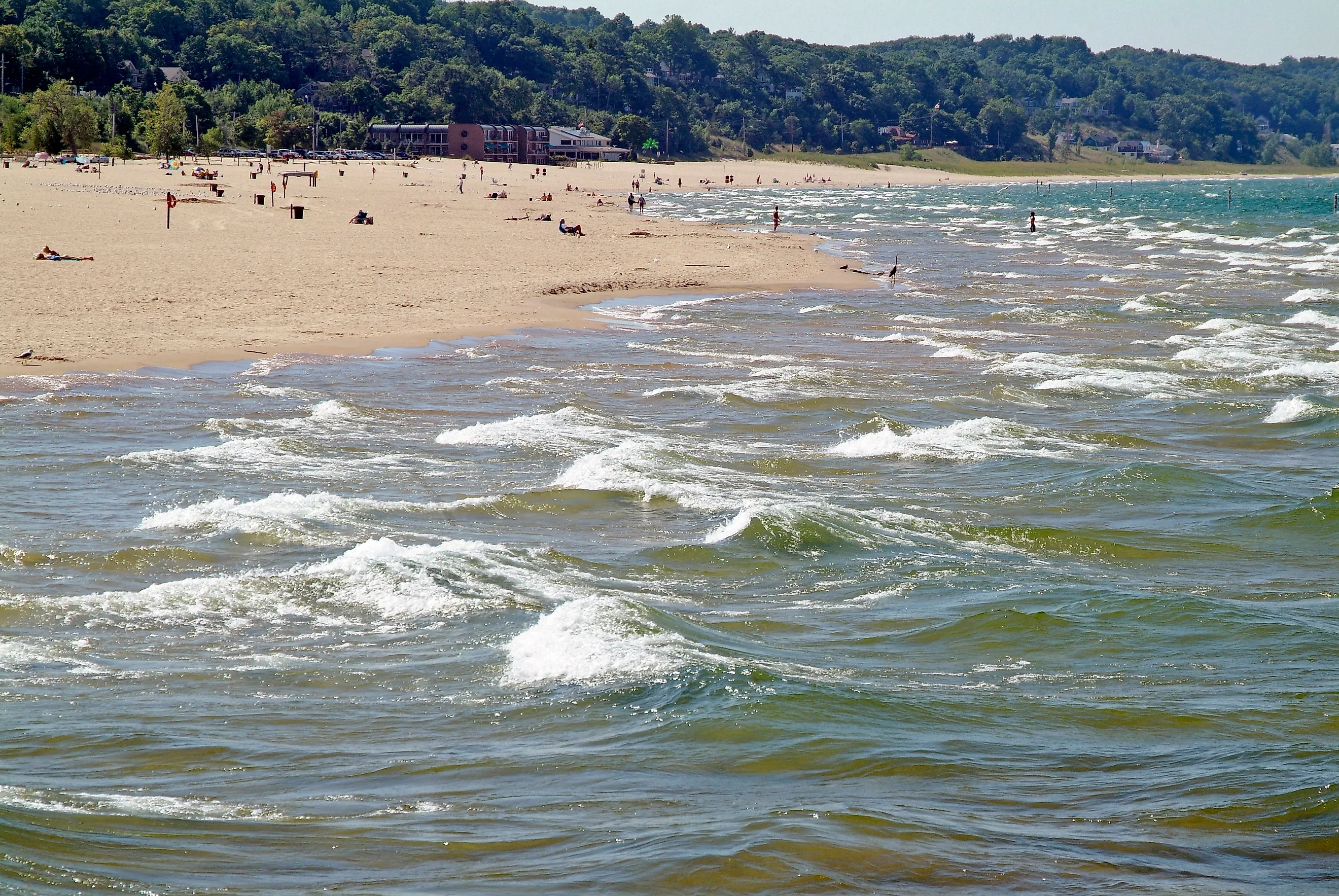
Pier-driven rip currents are the primary hazard at Grand Haven and Holland State Parks. Tracking by the Great Lakes Surf Rescue Project puts Lake Michigan among the deadliest of the lakes, with hundreds of drownings logged there since 2010. In 2022 alone, the lake accounted for roughly 45 percent of all Great Lakes drownings.
Concrete piers and breakwaters are built to protect harbor channels. They also interrupt the natural flow of breaking waves, creating a narrow, fast-moving current that carries water away from the shore alongside the pier. Michigan's Department of Natural Resources removed lifeguards from its state park beaches in the 1990s because of cost and liability concerns. Instead, swimmers at Grand Haven and Holland rely on warning flags and public advisories.
Rescuers pulled 28 people from rip currents at Holland State Park in a single day in August 2011, and the pier at Grand Haven has been tied to several deaths and many more rescues over the years. The counterintuitive survival advice from Michigan DNR staff: swim parallel to shore to escape the current, not straight back against it.
Tyler State Park, Pennsylvania

The main danger at Tyler State Park in Pennsylvania is the recirculating hydraulic created by its low-head dam, often called a "drowning machine." At least five deaths have been linked to this specific dam. A Brigham Young University database has documented more than 1,000 deaths at low-head dams nationwide over the past 50 years.
Low-head dams are the small, deceptively low concrete ledges that cross rivers and creeks in dozens of state parks around the country. Water spills evenly over the dam and circles back on itself at the bottom. The result is a powerful current that can trap swimmers, boaters, and rescuers in a continuous loop.
One of the park's own staff drowned at the Neshaminy Creek dam in May 2025. Alec Campbell, a 38-year-old resource ranger, died when his kayak capsized in fast, high water while he was placing a warning buoy near the ledge. Most low-head dams are not covered by state dam-safety programs. Those programs are designed to prevent dams from failing, not to address the dangerous currents created when water flows over them.
Wes Skiles Peacock Springs State Park, Florida

For cave divers, the greatest risk at Wes Skiles Peacock Springs State Park in Florida is becoming disoriented inside its underwater cave network, especially during a silt-out. Multiple diver fatalities have been documented since the 1980s, including a certified diver lost in the Peacock III passage in 1990 and another diver who ran low on air after becoming separated from a group in 2005.
Peacock's surface springs are turquoise, spring-fed, and shallow enough for a small child to wade in. Beneath them lies nearly 33,000 feet of mapped limestone cave passage connecting six named springs and sinkholes. A single fin kick can stir up the fine silt covering the cave floor. The water can turn completely cloudy within seconds, leaving divers with little or no visibility.
If they lose sight of the exit guideline, they can run out of air before finding their way back. The park requires proof of certification before any cave or cavern dive and bans solo diving, a rule adopted directly after the 1990 fatality. Open-water swimming in Orange Grove Sink and Peacock Spring itself carries none of this risk; the danger is specific to the cave system underneath, not the surface water people see.
Ohiopyle State Park, Pennsylvania

Powerful rapids, undercut rocks, and cold water make Ohiopyle State Park a challenging destination for whitewater rafting. The park has recorded multiple fatalities, including deaths in 1996 and 2022. The Lower Yough's Class III and IV rapids draw rafters through the warm months. Several fatal accidents have happened after rafters were thrown from their boats and became trapped beneath rocks or caught in powerful currents.
Kathy Lewis, 17, died at Dimple Rock in 1996 after her raft flipped and her life vest came free. In 2022, Julie Ann Moore, 50, died after her raft struck Dimple Rock and overturned, trapping her underwater farther down the rapids. After three deaths at Dimple Rock in 2000, a coroner's inquest and safety review led to a portage trail that lets boaters carry their craft around the worst of the rapids, and commercial outfitters expanded their pre-trip safety briefings.
Hot Springs State Park, Wyoming

People visiting Hot Springs State Park in Wyoming face a very different risk: scalding water from Big Spring. According to America's State Parks, the spring discharges more than 3.6 million gallons of mineral water each day at about 127 degrees Fahrenheit. Water that hot can cause severe burns quickly, which is why the spring itself is closed to bathers.
Established in 1897, Hot Springs State Park is Wyoming's oldest state park. It was created after a treaty required that part of the spring's water remain free for public use. Park staff honor that agreement by cooling a portion of the spring water to about 104 degrees Fahrenheit before it reaches the public bathhouse. Most of the remaining water flows across the park's Rainbow Terraces before emptying into the Bighorn River.
Colorado State Parks

Sudden afternoon thunderstorms are a major hazard at Chatfield, Cherry Creek, and Lake Pueblo State Parks, three of Colorado's busiest reservoir parks. These reservoirs can look calm for most of the day, then become dangerous within minutes as afternoon thunderstorms develop. Strong winds often arrive before the rain, quickly turning calm water rough and pushing swimmers and paddleboarders farther from shore. Officials say these storms frequently catch people by surprise.
By early July 2024, Colorado Parks and Wildlife had already recorded 14 drownings in the state parks and recreation areas it manages, tying the state's known annual record before summer was even half over. South Metro Fire Rescue, which responds to emergencies at Chatfield State Park, has also identified a common pattern in many fatal drownings. Rescuers often find a life jacket on the beach or in a boat instead of on the person who drowned.
Guadalupe River & Pedernales Falls State Parks, Texas

Flash flooding is the main water hazard at Guadalupe River and Pedernales Falls State Parks. A University of Texas at San Antonio analysis found that Texas recorded 1,069 flood deaths between 1959 and 2019, the highest total of any state. Louisiana was second with 693. Central Texas's Hill Country is part of what's widely known as Flash Flood Alley. The steep terrain, thin soils, and the Balcones Escarpment all push rivers to rise with remarkable speed after heavy rain.
The danger became tragically clear during a devastating overnight flood in July 2025, when the Guadalupe River rose more than 20 feet in a matter of hours and killed at least 135 people across the Hill Country. Both parks warn that rivers can rise rapidly after heavy rain falls upstream, even if it's dry where visitors are standing. Water that looks calm can turn fast, deep, and murky as a surge arrives from storms miles away.
When Calm Water Turns Deadly

These parks may look very different, but they all share one thing: water that can become deadly under the wrong conditions. Rip currents, low-head dams, underwater caves, whitewater rapids, thermal springs, reservoir storms, and flash floods each present a different kind of danger. Before getting in the water, check the latest conditions and warnings from the park. That simple step could make the difference between a safe day outdoors and a life-threatening emergency.