The Oldest Roller Coasters Still Running In America
Through careful preservation and dedicated fanfare, a handful of America's oldest roller coasters can still act as more than historic landmarks. Many date to the 1920s, when wooden coasters were being designed in a revolutionary way, with new safety features, sharper drops, and more aggressive layouts. Several have remained in operation for well over a century despite fires, major renovations, changing amusement trends, and threats of demolition. From Coney Island's famed Cyclone to San Diego's Giant Dipper, the rides we will be highlighting here preserve a direct link to the early decades of amusement parks as well as good old American engineering.
Jack Rabbit - Seabreeze Park, Rochester, New York

Jack Rabbit has been thrilling riders at Seabreeze Park in Rochester, New York, since May 31, 1920, officially making it the oldest operating roller coaster in the United States. Designed by John A. Miller and built by Harry C. Baker, the wooden coaster was constructed in just eight weeks as part of a major expansion at Seabreeze.
Its 2,130 feet of track use the park's natural terrain, including a 75-foot first drop, several airtime-producing hills, hairpin turns, and a final plunge through a dark tunnel. The tunnel part was added in 1928, while the coaster's original under-friction wheel system was a major advance in roller coaster engineering. To add to its already impressive story, Jack Rabbit survived a 1923 fire that badly damaged parts of Seabreeze, too.
Jack Rabbit - Kennywood, West Mifflin, Pennsylvania

Kennywood's own version of Jack Rabbit opened later in 1920 and is the second oldest operating roller coaster in America. Another design by John A. Miller, the wooden coaster was built into a natural ravine, using the terrain to create a distinctive ride profile. Its defining feature is a 70-foot double-dip drop, which sends the train through two closely spaced drops before the track climbs again. The coaster also incorporated under-friction, or upstop, wheels, an important development that helped keep coaster trains securely on their tracks during moments of negative force.
With plenty of maintenance over the years, Jack Rabbit has remained in continuous operation at Kennywood for more than a century. Its survival is especially notable because the park has repeatedly modernized around it while still retaining this classic 1920 design.
Roller Coaster - Lagoon Amusement Park, Farmington, Utah

Lagoon's simply named "Roller Coaster" has been operating since 1921, when it debuted as the "Lagoon Dipper." Yet another brainchild of John A. Miller, he created this one during his partnership with engineer Harry C. Baker to build a replacement for Lagoon's earlier "Scenic Railway."
Its 2,500 feet of track reach a height of about 60 feet and a top speed of 45 miles per hour. Miller incorporated several important safety innovations, too, including the usual upstop wheels beneath the rails, as well as a ratchet system that prevents trains from rolling backward on the lift hill.
It survived a major 1953 fire that destroyed its station and part of the lift hill, requiring reconstruction before reopening in 1954. Today, the Roller Coaster remains a National Register-listed historic structure and continues to operate with its original basic design.
Thunderhawk - Dorney Park, Allentown, Pennsylvania

Thunderhawk began running on March 30, 1924, as "The Coaster," making it one more century-old survivor of America's wooden coaster era. Built by the Philadelphia Toboggan Company and designed by Herbert Paul Schmeck, the ride originally used an out-and-back layout, but in 1930, they redesigned the track into the figure-eight configuration seen today. It retained its original name until 1989, when Dorney Park renamed it the admittedly much cooler "Thunderhawk".
Thunderhawk climbs 80 feet before dropping 65 feet, and reaches a max of 45 miles per hour across 2,767 feet of wooden track. The ride is also the oldest operating Philadelphia Toboggan Company coaster in general, its historic significance having earned recognition from the official American Coaster Enthusiasts organization.
Thunderbolt - Kennywood, West Mifflin, Pennsylvania

Originally built as the "Pippin" on May 4, 1924, Thunderbolt was slightly redesigned in 1968 and continues to use the same layout to this day. Andy Vettel reworked the wooden structure around the existing ravine and retained the Century Flyer trains introduced in 1958, while adding a series of tighter turns and helixes. The result was a notably different coaster from the original Pippin, with the terrain becoming more of an integral part of the experience.
Thunderbolt now reaches a maximum height of 70 feet, drops 90 feet into the ravine, hitting a max speed of 55 miles per hour. Its first drop comes almost immediately after leaving the station, while the largest plunge arrives near the end of the ride.
If you still consider it the same ride after the redesign, however, this is easily one of the oldest of its kind in the country. Kennywood continues to maintain the over 100-year-old main structure, replacing sections of wooden track each year to keep it going, hopefully, for many more years to come.
Giant Dipper - Santa Cruz Beach Boardwalk, Santa Cruz, California

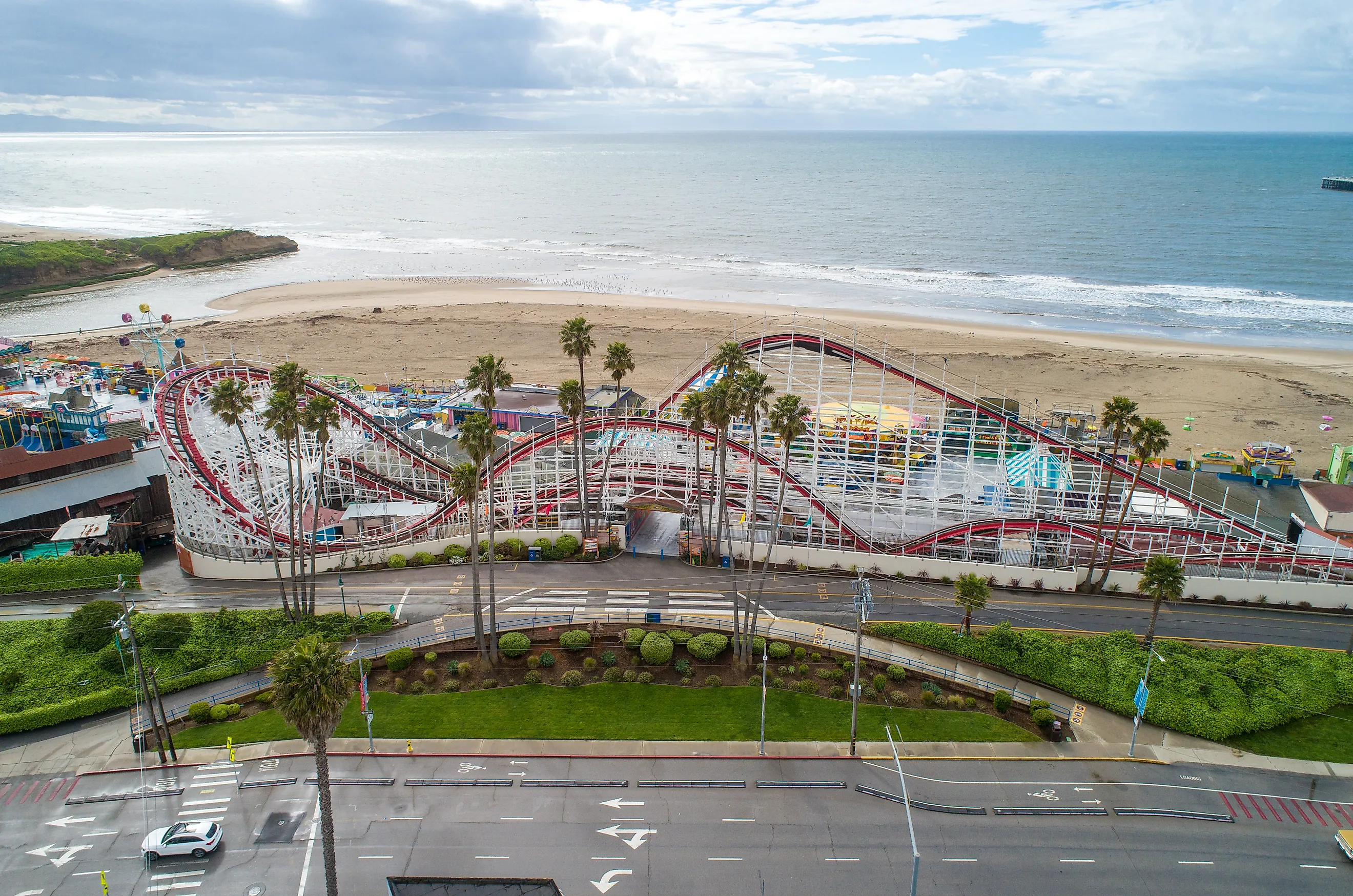
More than 68 million riders have experienced the Giant Dipper since it opened on May 17, 1924. Its construction is very well documented, as Arthur Looff built the wooden coaster in only around 47 days, using 327,000 board feet of lumber, 743,000 nails, and 63,000 pounds of steel track. With that, this half-mile ride reaches 55 miles per hour after climbing its 70-foot main hill, with successive dips and turns running alongside the scenic Santa Cruz Beach Boardwalk.
Its long operating history includes a National Historic Landmark designation in 1987, recognizing its importance to American amusement and engineering history. It has stayed in its original location and will likely continue to do so for a long time to come, with dedicated mechanics inspecting the track repeatedly during operating days and replacing sections of the wooden structure as needed.
Giant Dipper - Belmont Park, San Diego, California

Built in 1925 for the opening of Belmont Park, this version of the Giant Dipper has spent just over a hundred years running along Mission Beach. Designed by Prior & Church and built by the Ryan Brothers, this wooden coaster was constructed alongside "The Plunge" as part of John D. Spreckels' Mission Beach development. Its 2,600 feet of track reach 73 feet at the lift hill, with trains reaching speeds of about 48 miles per hour.
Like many of the rides on this list, this one found a way to survive decades of changing fortunes at its respective park, including Belmont Park's closure in 1976. In this instance, a local preservation effort helped save it from demolition.
The Giant Dipper was later designated a National Historic Landmark in 1987, and after an extensive restoration costing more than $2 million, it reopened in 1990, not having closed for any significant period of time since.
Cyclone - Luna Park, Coney Island, New York
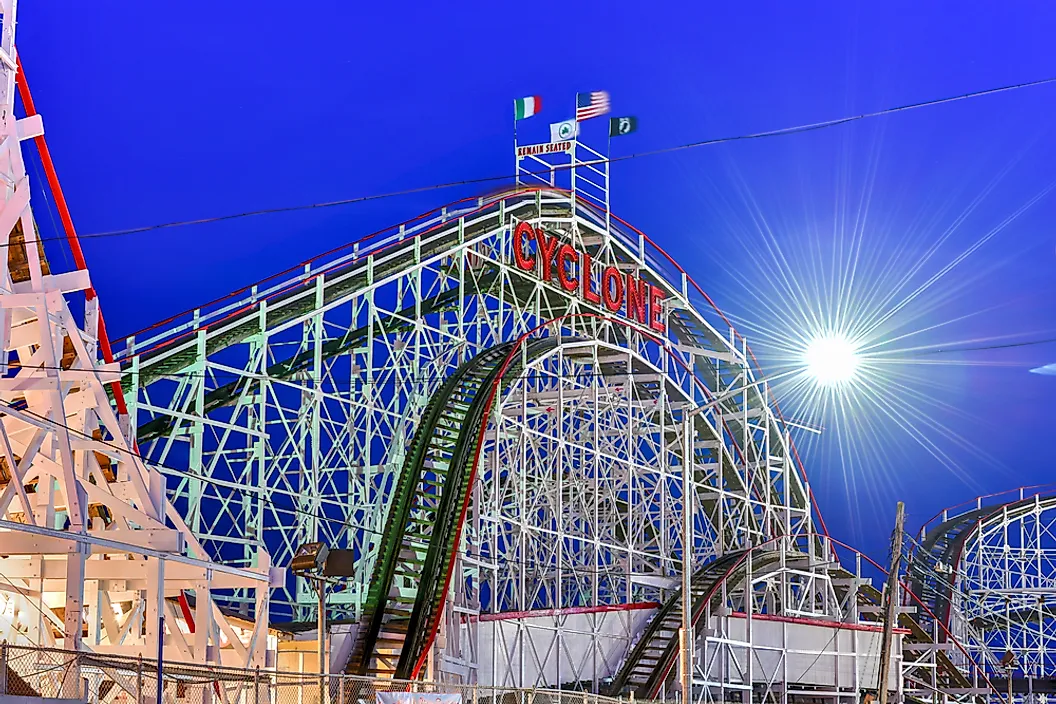
Opened on June 26, 1927, the Cyclone quickly became a mainstay of Coney Island's amusement district. Designed by Vernon Keenan, the wooden coaster was built for an at-the-time huge cost of $175,000, replacing the "Giant Racer" on its Surf Avenue site. Its 2,640 feet of track include a 75-foot lift hill, an 85-foot first drop, and speeds reaching 60 miles per hour. The track's tight turns, multiple drops, and steep 58-degree descent is yet another perfect example of the then relatively aggressive designs of 1920s-era wooden coasters.
The Cyclone faced demolition in the 1970s before a preservation campaign helped secure its future. It was then designated a New York City Landmark in 1988 and added to the National Register of Historic Places in 1991. Luna Park has operated the ride since 2011.
Ride Through History on these Legendary Coasters
These old-timey roller coasters have survived far beyond the era that produced them, yet their basic purpose remains unchanged: Fun. Shaky wooden structures, historic layouts, and century-old engineering still carry riders through surprisingly exciting drops, turns, and hills. However, their continued operation depends on constant maintenance and careful restoration by those who cherish them enough to keep them working pieces of American amusement park history.