9 Best Natural Wonders To Visit In Spain This Year
Spain's cities, cathedrals, and coastal resorts need no introduction, but there are natural wonders across the country that deserve just as much attention. Mulhacén is the highest peak on the Iberian Peninsula at 3,479 meters (11,414 feet), and on a clear day, hikers can see across to northern Africa. Salto del Nervión pours more than 220 meters (721 feet) out of the Delika Canyon, which makes it the tallest waterfall in Spain. The Nerja Caves have sheltered people since at least 25,000 BCE and still host a music festival every summer. The Tabernas Desert is the only true desert in Europe. These 9 sites are Spain's best natural wonders, and each one is worth building a trip around this year.
Mulhacén, Sierra Nevada Range

Mulhacén is the highest mountain peak on Spain's Iberian Peninsula, at 3,479 meters (11,414 feet), and belongs to the Sierra Nevada Range. If the weather is clear, hikers can see across into the landscape of northern Africa. To successfully climb Mulhacén, you have to be in excellent physical condition and fully prepared for a 23.5-kilometer (14.6-mile) journey with an elevation gain of about 1,340 meters (4,400 feet) that takes all day or even an extra day or two; some pursuing this peak opt for wild camping along the trail or at Refugio de Poqueira on the southwestern side of the mountain, but note that some official form of reservation is required to show to the Sierra Nevada National Park rangers.
Naranjo de Bulnes, Picos de Europa National Park

The flat-topped columnar limestone structure of Naranjo de Bulnes, part of Spain's Picos de Europa National Park and the Cantabrian Mountains in Asturias, was carved during the prehistoric Ice Age. This peak towers dramatically over the Vega de Urriellu Refuge, offering 4 routes up its 4 faces to the south, north, west, and east. The most direct and least challenging way up the mountain is the southern route, with a guided climb, while the most strenuous is the northern route, named after the climbers who first opened it, Alberto Rabadá and Ernesto Navarro. Stay a while longer here at the popular Camping Naranjo de Bulnes, which offers campsite plots, intimate bungalows, and wooded cabins, while conquering your next physical mission. Book for spring or summer for the best conditions and views.
Puig Major, Serra de Tramuntana

On the western side of the Balearic Islands' very own Mallorca, the Serra de Tramuntana is not only a UNESCO World Heritage site, but also an outdoor playground for hikers, backpackers, and cyclists. The tallest peak in the Serra de Tramuntana is Puig Major, rising to 1,445 meters (4,741 feet), with an almost 15-kilometer (9-mile) ascent. The very top is closed off by the military and adorned with a white, ball-shaped radar that the US Air Force installed in the 1950s and the Spanish Air Force operates today. The limestone mass of Puig Major is composed of Lower Jurassic and Upper Triassic rock, later stacked by thrust faulting that raised the Serra de Tramuntana. Try the 8-kilometer (5-mile) circular route that goes from Puig Pedrós to Puig Major for taking in some pretty views of the blue waters of the Balearic Sea, especially in spring or summer.
Salto del Nervión, Álava

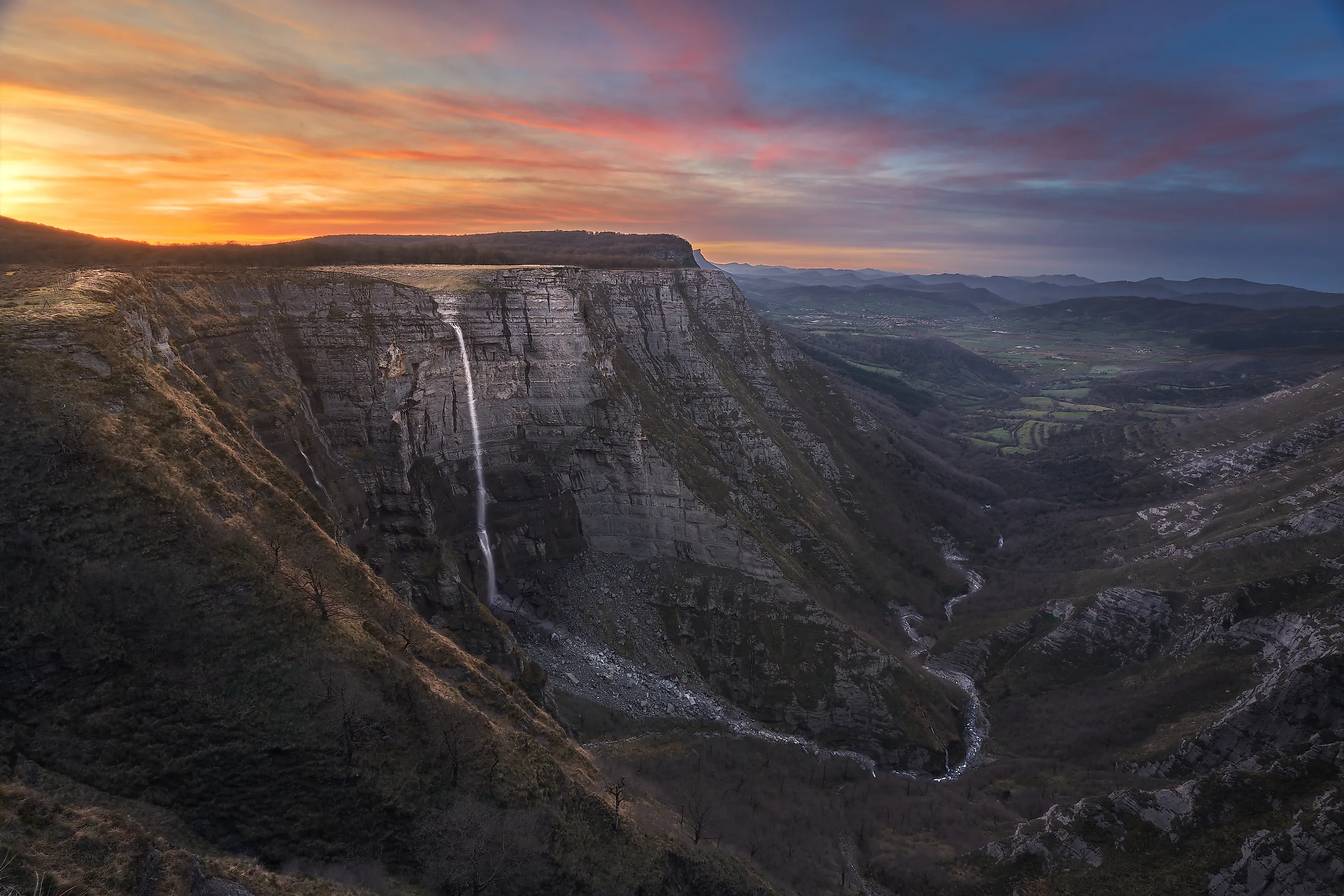
Pouring out of the dark green walls of the Delika Canyon in Álava, Salto del Nervión is the tallest waterfall in Spain at over 220 meters (721 feet), where the Nervión River is born at the base of the karstic falls. Go when the water is flowing at its fullest, when the rain has fallen, such as in late winter or spring. It is also a good spot for birdwatching, where you can catch a glimpse of the griffon vulture. Take the Salto del Nervión loop trail from the parking lot and pass an old church and Berberana's cave system, the Cueva de los Paules, and finally reach the impressive walls of the Salto del Nervión, which typically takes about 2.5 to 3 hours.
Les Fonts de l'Algar, Alicante

Alicante's Les Fonts de l'Algar nature preserve offers a swimming-hole experience on the Algar River, with open views of the crystal-clear turquoise water, limestone rocks, and surrounding vegetation, though it is not free due to the location's popularity. Avoid going in winter, when the already icy water will be even colder, and the paths may be slick. In summer and around Easter, a lifeguard watches the swimmers for extra safety. Also, Les Fonts de l'Algar is only about 18 kilometers (11 miles) from Benidorm, so the two can be paired on a single trip.
Tagus River

Flowing from the comarca of Sierra de Albarracín, the Tagus River drains into the Atlantic Ocean near Lisbon, Portugal, spanning 1,007 kilometers (626 miles) in total, 716 kilometers (445 miles) of which are in Spain, the longest river in the Iberian Peninsula. This European river serves as a major source of agricultural irrigation and hydroelectric power in Spain and Portugal, and is home to a Portuguese harbor and a friend of the walled Spanish city of Toledo. Black bass and other freshwater fish live in the Tagus River, while dolphins frequent its estuary near Lisbon. Many tourists opt for cruises along the Tagus River to enjoy time out on the water and take in the local area from a different perspective, particularly in spring, fall, or summer, rather than the cooler chill of winter.
Ebro River

The longest river in Spain and the second-longest river in the Mediterranean, the Ebro River originates in the village of Fontibre in the foothills of the Cantabrian Mountains, then flows 910 kilometers (565 miles) to the Ebro River Delta in Tarragona, where it empties into the Mediterranean Sea. The river basin is quite dry and has been affected by drought for several years, but it has boosted Spanish hydroelectric power and irrigation, and is connected to over 200 tributaries. The upper part of the basin, the Rioja Alta, even provided the name for Spain's Rioja wine. The Ebro River passes through Zaragoza, Logroño, and many other Spanish cities.
Nerja Caves, Andalusia

Andalusia's Nerja Caves have sheltered people since at least 25,000 BCE, spanning an incredibly wide range of human history. Originally discovered in 1959, these caves were later excavated and studied, revealing they were a major site of early human habitation, yielding bone and stone tools, evidence of early food-processing methods, paintings on the cave walls, and, of course, human skeletons. The Nerja Caves host a music festival every summer, traditionally from mid-June to mid-August, while the museum here is open year-round, with displays showcasing the region's fascinating history.
Tabernas Desert

The only desert in Spain and in Europe, the Tabernas Desert in Almería, has an environment comprising grassy steppes set among eroded badlands and a relatively temperate climate with under 250 millimeters (10 inches) of rainfall per year. Many birds reside here, including the jackdaw and the trumpeter finch, making it a fine location for birdwatching. Some Western movies have even been filmed here, such as the 1966 film The Good, the Bad and the Ugly, which used rugged terrain for cowboy chases on horseback. There is even an Old West town named Fort Bravo, often used as a film set. Spring is the best time to visit the Tabernas Desert, before it gets too hot in the summer.
The Wilder Side of Spain
If you want a side of Spain that has nothing to do with beach resorts or cathedral queues, point your trip at the country's landscapes instead. These 9 natural wonders stretch across the map, taking in the only true desert in Europe, the tallest waterfall in Spain, a UNESCO-listed mountain range on Mallorca, and the longest river on the Iberian Peninsula. Whether you are drawn to summits, canyons, caves, or open water, Spain's natural wonders are the best way to see how varied the country really is.