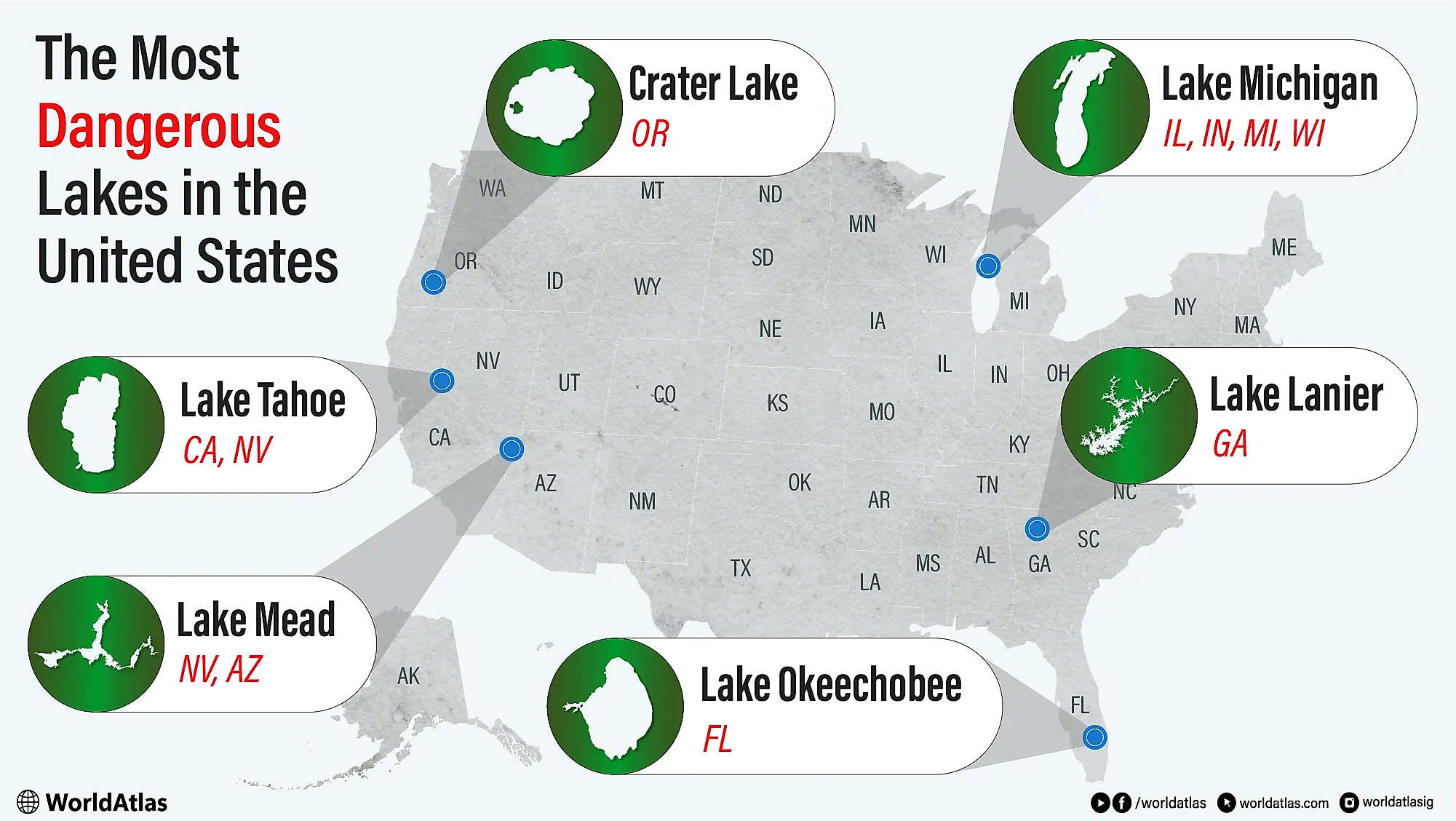
The Most Dangerous Lakes in the United States
The following are six of the most dangerous lakes in the United States: Lake Michigan, Lake Mead, Crater Lake, Lake Okeechobee, Lake Lanier, and Lake Tahoe. They consistently rise to the top of danger lists because they combine powerful currents, cold shock, sudden weather, submerged hazards, and, in some cases, a grim history of mass-casualty floods and shipwrecks.
Lake Michigan alone has recorded hundreds of drownings since 2010, driven by rip currents and steep drop-offs along heavily used beaches. Lake Mead has logged more deaths than any other U.S. national park site in recent decades, with extreme heat and deep, cold water turning routine outings into emergencies. Crater Lake, Lake Tahoe, and Lake Lanier add lethal depth, frigid water, and hidden obstacles beneath recreational hotspots, while Lake Okeechobee's legacy includes one of the deadliest hurricanes in American history.
For this article, we highlight lakes that stand out for at least one of three reasons: unusually high numbers of reported deaths, very severe worst-case events (such as catastrophic floods), or unique physical hazards that make rescues especially difficult.
The Most Dangerous Lakes in the United States
| Lake | States |
|---|---|
| Lake Michigan | IL, IN, WI, MI |
| Lake Mead | NV, AZ |
| Crater Lake | OR |
| Lake Okeechobee | FL |
| Lake Lanier | GA |
| Lake Tahoe | CA, NV |
Lake Michigan

Lake Michigan is one of the deadliest lakes in the U.S. in absolute numbers. Great Lakes Surf Rescue Project data show more than 600 drownings on Lake Michigan alone since 2010, far more than on any other Great Lake. Many of these incidents are linked to strong currents and steep drop-offs along popular beaches in Illinois, Indiana, Wisconsin, and Michigan. In 2025, for example, 19 of the first 42 Great Lakes drownings occurred in Lake Michigan. The lake's size, over 22,000 square miles, and depth of about 923 feet let it behave more like an inland sea, with storms capable of producing waves over 20 feet high, as documented during events such as Superstorm Sandy's passage over the region. Add in hundreds of historic shipwrecks, heavy commercial shipping, dense beach crowds, and water cold enough to shock swimmers even in summer, and Lake Michigan reliably produces a very high number of fatalities.
Lake Mead

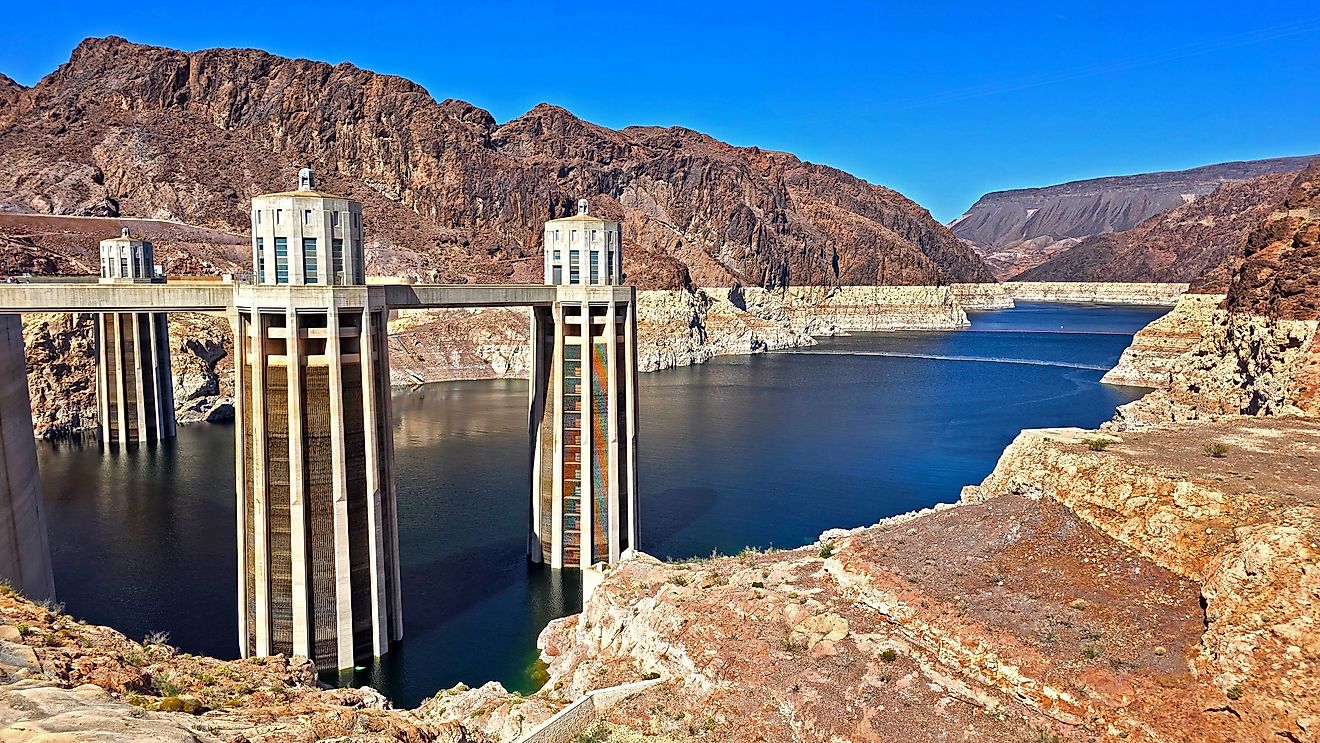
Lake Mead's ranking reflects both its harsh desert setting and the sheer number of people who get into trouble there. Between 2014 and 2021, 145 people died at Lake Mead National Recreation Area, an average of roughly 18 deaths a year, with drownings the single biggest cause. Looking at a longer window, an Outside magazine-based analysis cited by park historians has repeatedly identified Lake Mead as the U.S. national park site with the most deaths overall, with more than 1,000 fatalities between 2006 and 2016 (excluding suicides). Those deaths are spread over millions of annual visits, 5.58 million in 2022 alone, so even conservative back-of-the-envelope comparisons of typical drowning counts to visitor numbers suggest a drowning risk on the order of about one death per million recreation visits, before you even factor in other causes. Intense summer heat, cold water at depth, sudden winds, and steep rocky shorelines make rescue difficult. Prolonged drought has dropped water levels, exposing old structures and hazards, while a long history of submerged wrecks, including a B-29 bomber, underscores how unforgiving this reservoir can be.
Crater Lake

Crater Lake ranks high for severity of consequences, even if its visitor-normalized risk is hard to quantify. The National Park Service notes that Crater Lake is the deepest lake in the U.S. at about 1,943 feet, with extremely cold water year-round. There is only one legal place to swim, at the bottom of the steep Cleetwood Cove Trail, and rangers explicitly warn that sudden immersion in the frigid water can rapidly lead to cold shock and loss of muscle control. Park records and local news reports periodically document drownings and serious incidents: in 2019, for instance, a man disappeared while swimming off Cleetwood Cove and was presumed drowned after an extensive but unsuccessful search. The caldera walls rise sharply from the lake, making rescue operations logistically difficult. Add in sudden mountain storms, icy rim trails, and sheer drop-offs, and Crater Lake becomes a place where a single misstep or impulsive swim can have very little margin for error. The Park Service doesn't publish data detailed enough to support a defensible deaths-per-million-visits estimate, but the severity of consequences is clear.
Lake Okeechobee

Lake Okeechobee's danger is rooted as much in history and infrastructure as in day-to-day boating risk. The shallow, 730-square-mile lake has produced catastrophic flooding when hurricanes drive water over or through surrounding levees. The 1928 Okeechobee Hurricane remains one of the deadliest natural disasters in U.S. history, killing more than 2,500 people, many of them around the lake when storm surge overtopped inadequate dikes. That disaster led to the construction of the Herbert Hoover Dike, but decades later, the U.S. Army Corps of Engineers has warned about its aging condition and has spent years on major rehabilitation to reduce the risk of another failure. Day to day, the lake's broad, shallow waters can turn into steep, confused waves under strong winds, catching small boats off guard. Toxic blue-green algal blooms, which the state has repeatedly documented in and downstream of Okeechobee, add health risks for anglers and nearby communities. Because recreational visitation isn't tracked consistently and historic disaster deaths dwarf normal-year boating fatalities, there's no realistic way to compute a credible death rate. Even so, the combination of shallow storm-tossed water and levee-breach history keeps Okeechobee on any serious danger list.
Lake Lanier

Lake Lanier's ranking reflects a high accident count at a single, extremely busy inland lake. News outlets drawing on Georgia Department of Natural Resources figures report more than 200 deaths on Lanier since 1994, largely from drownings and boating accidents. The U.S. Army Corps of Engineers estimates roughly 11-12 million visits a year, which means even a conservative tally works out to at least about 0.6 deaths per million visits over the long term, unusually high for one recreation reservoir. Much of that risk comes from what lies under the water: when the lake was created in the 1950s, former towns, roads, forests and cemeteries were flooded, leaving behind tree stumps, foundations, and debris just below the surface. A diver interviewed by Atlanta's WXIA described "diving in Lake Lanier" as probably one of the most dangerous things he'd done, because of entanglement hazards and poor visibility. Combine that with millions of visitors, heavy holiday boat traffic, fluctuating water levels, and alcohol use, and Lanier becomes a lake where crowded conditions and hidden obstacles translate into a higher-than-average fatality rate.
Lake Tahoe

Lake Tahoe earns its place on the list less for raw body count than for how unforgiving it is when something goes wrong, even amid huge visitation. Tourism and transportation sources estimate that the Tahoe basin sees on the order of 15 million visits a year, between skiers, hikers, boaters, and casino guests. The lake itself is 1,645 feet deep, making it the second-deepest in the U.S., with very cold water even in summer. Those conditions help explain why the body of a diver lost in the lake was found in near-perfect condition 17 years later at a depth of about 300 feet. Decomposition is slowed dramatically at those temperatures and depths. Geologically, Tahoe sits atop active faults; modeling studies suggest that earthquakes on these faults could trigger underwater landslides and tsunami-like waves 10-33 feet high, capable of crossing the lake in minutes. High-altitude scuba diving here carries elevated decompression-sickness risk, and sudden mountain storms can whip up big waves over long fetches. The lake's mix of depth, cold, seismic setting, and intense recreation means that when accidents do occur, they are unusually difficult to survive or to respond to.
Other Dangerous U.S. Lakes

Several other lakes could appear on a longer list of America’s most dangerous waters. Lake of the Ozarks in Missouri is frequently cited by boating safety officials for its high number of crashes and alcohol-related incidents on a crowded “party lake.” Lake Erie, the shallowest Great Lake, is notorious for fast-building storms, strong currents, and recurring toxic algal blooms. Lake Powell on the Arizona-Utah border combines fluctuating water levels, submerged canyon walls, and heavy houseboat traffic, leading to regular accidents. Utah Lake in central Utah is better known for repeated lake-wide harmful algal blooms that can make large areas unsafe for people and pets. These and other lakes underscore that many U.S. waterways can be hazardous under the wrong conditions, even if they are not covered in depth here.