9 Most Breathtaking Towns In Alabama
Mentone shows off its beauty upfront, with DeSoto Falls pouring 104 feet off Lookout Mountain into a rock bowl just north of the village. Eufaula makes its case in stone, seventeen Corinthian columns wide across the front of the Shorter Mansion. Wetumpka is stranger still. The downtown sits inside a crater five miles across, punched out by an asteroid 85 million years ago; a truly spectacular sight. These nine Alabama towns below offer breathtaking scenery to get lost in.
Fairhope

The Fairhope Municipal Pier runs about a quarter mile into Mobile Bay, and on a clear evening, most of the town seems to be walking it. Anglers work the rail out at the end. The park at the shore end holds a duck pond, a rose garden and a walking trail under the oaks. It is one of the few places on the eastern shore where the bay light gets an unobstructed run at you.
A short drive south, the Weeks Bay National Estuarine Research Reserve keeps a self-guided trail of less than a mile. Markers along it name what is growing underfoot. The Arthur C. "Skipper" Tonsmeire Weeks Bay Resource Center sits at the end of it, with the Fish River sliding past the windows.
Fairhope began in 1894, when twenty-eight followers of the economist Henry George came down from Iowa and bought bluff land as a single tax colony. They wanted land value returned to the community rather than to speculators. The city itself was not incorporated until 1908. What the colonists left behind now fills the Fairhope Museum of History, housed in the Spanish Mission building that served as city hall starting in 1928.
Mentone

Brow Park earns its name honestly. It sits where Mentone runs out of mountain, and the ground simply stops and hands the whole Tennessee Valley over. Picnic tables, a walking path and a pavilion are the entire inventory. Mentone is the highest incorporated town in the state, and the park is where that fact becomes something you can see.
DeSoto Falls drops 104 feet into a rock bowl just north of town. An overlook puts the full height in front of you without demanding a hard walk, which is why it is one of the most photographed spots in north Alabama. Only Grace's High Falls over in Little River Canyon runs taller. The falls sit inside DeSoto State Park, roughly 3,500 acres of Lookout Mountain woods that go loud with wildflowers in April.
Down in the village, the Log Cabin Village has turned a cluster of old buildings into shops. The Groovy Goat stocks work by area makers alongside Alabama wine, in a storefront that has not shed a single degree of its 1970s enthusiasm.
Fort Payne

The Little River is a strange piece of water. It runs most of its length on top of Lookout Mountain before cutting down into one of the deepest canyon systems east of the Mississippi. Little River Canyon National Preserve protects about 15,000 acres of that, and an eleven-mile rim drive strings the overlooks together for anyone short on hiking time. Little River Falls drops 45 feet at the canyon head. Grace's High Falls, seasonal and 133 feet, is the tallest in Alabama when the water is running.
Downtown, the Fort Payne Depot Museum occupies a Richardsonian Romanesque station built in 1891 out of locally quarried pink sandstone. Investors from the north put it up during a coal and iron boom that never fully arrived. Trains stopped carrying passengers here in 1970 and freight in 1983. Since 1986, the building has held railroad memorabilia, Cherokee artifacts and a collection of hand-built dioramas.
The Alabama Fan Club and Museum sits over on Glenn Boulevard, and it is exactly what the sign says. The country band Alabama came out of Fort Payne, and the museum keeps the awards, the stage clothes and the accumulated evidence of a fifty-year career in one low building on the edge of their hometown.
Guntersville

Lake Guntersville stretches 75 miles along the Tennessee River and covers about 69,000 acres, which makes it Alabama's largest lake. Bass anglers treat it as a pilgrimage. Guntersville City Harbor puts the restaurants and the boat slips in the same place, so the view comes with dinner.
Lake Guntersville State Park covers roughly 6,000 acres of woods on the northeastern shore, with 36 miles of trail and an eighteen-hole course above the water. Its Eagle Awareness program runs through the winter weekends and has been going for decades, back to when Alabama's bald eagles were nearly gone. January mornings on the lake belong to the birds and to the people who get up early to find them.
The Guntersville Museum works in a smaller frame. It occupies the old armory, a stone building put up in 1936 under the Works Progress Administration, and its collections run through the Cherokee removal and up to 1939. That was the year the dam closed and the rising lake drowned the original townsite. Everybody moved uphill. The town you drive through today is the second one.
Eufaula

Seventeen Corinthian columns hold up the front of the Shorter Mansion, and they are the reason most cameras come out on North Eufaula Avenue. Eli Sims Shorter II built the house in 1884. It burned in 1895, went back up, and then got the 1906 renovation that produced the Neoclassical Revival pile standing there now. It anchors the Seth Lore and Irwinton Historic District, which holds more than 700 significant structures and ranks as the second-largest historic district in the state.
Fendall Hall is the quieter one. Edward and Ann Young built the Italianate villa between 1856 and 1860, and five generations of the family lived in it. The Alabama Historical Commission now runs it, restored to its appearance between 1880 and 1916. Three rooms carry Victorian murals painted in 1884 that have no real equal in an American house.
The Eufaula National Wildlife Refuge was established in 1964 on both banks of the Chattahoochee River, where the water widens into the Walter F. George Reservoir. It's 11,184 acres of wetland, cropland and grassland that pull in wintering waterfowl by the thousand. Herons work the shallows year-round. Bald eagles and white-tailed deer show up often enough that the refuge road is worth driving slowly.
Florence

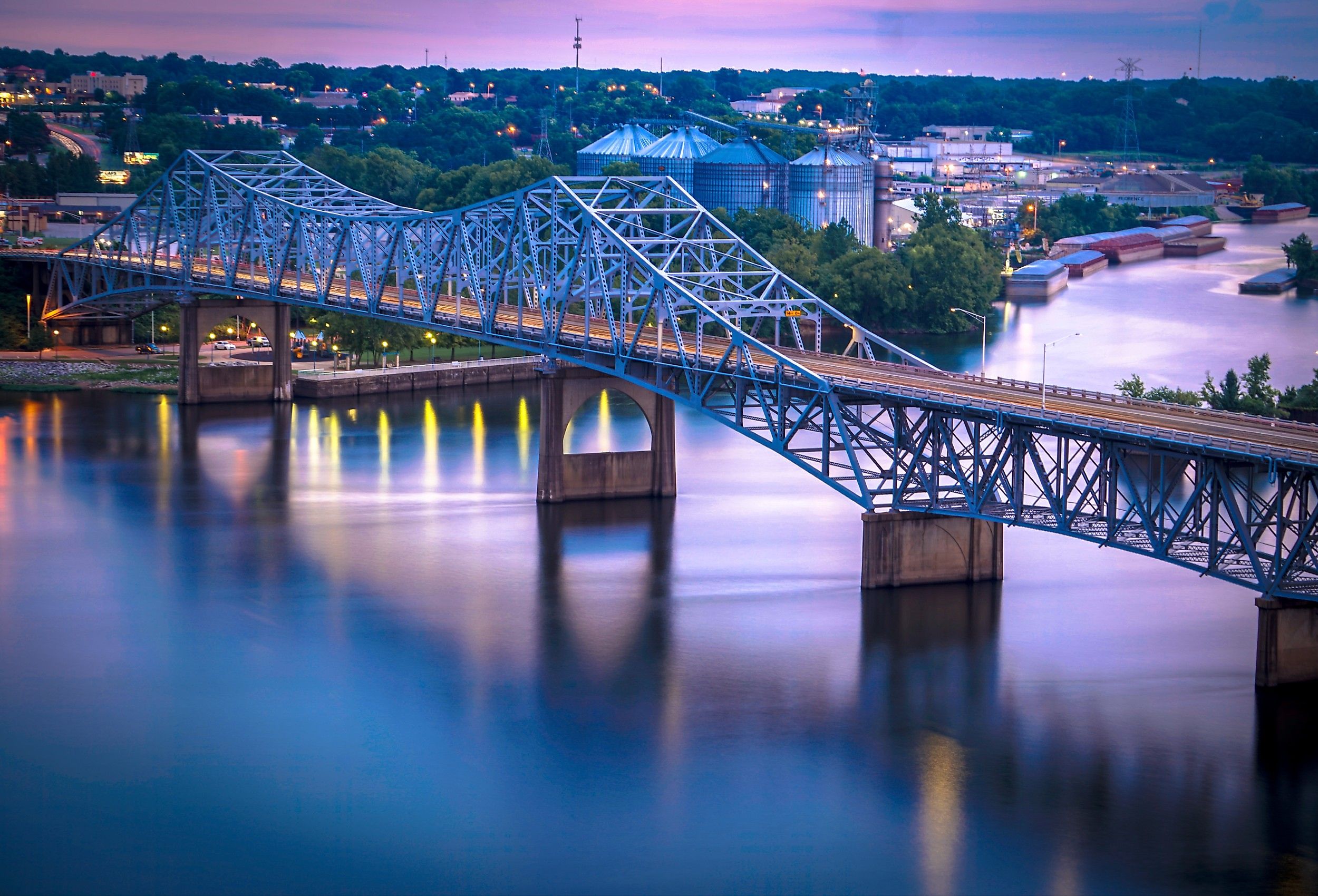
The Rosenbaum House went up in 1939 out of cypress, brick and glass. It was built for a young couple who had $12,000 and a copy of the architect's autobiography. It is the only building Frank Lloyd Wright ever designed in Alabama. Scholars call it the purest surviving example of his Usonian plan, flat-roofed and low-slung on a two-acre lot facing the Tennessee River. The Rosenbaums lived in it until 1999, when they handed it to the city. Wright's original furniture is still inside.
W. C. Handy was born in Florence in 1873, in a log cabin his grandfather built. The W. C. Handy Birthplace, Museum and Library keeps the cabin. It also keeps his handwritten sheet music. Seeing the corrections in his own hand does something that a recording cannot. Every summer, the town gives him a week-long festival with a couple of hundred separate events on the schedule.
For the river itself, the River Heritage Trail runs more than a mile along the bank on the Florence side. It is flat, shaded and close enough to the water that the barge traffic feels like part of the walk.
Tuscumbia

The water pump in the yard at Ivy Green is the reason people come. Helen Keller was born in the clapboard house in 1880, and it was at that pump that Anne Sullivan spelled w-a-t-e-r into her hand. The house dates to 1820 and still stands on its original grounds, a few blocks off the main road through town.
Belle Mont sits south of Tuscumbia on a hilltop in Colbert County, raised around 1828 for a Virginia-born planter named Alexander Mitchell. The design is Jeffersonian Palladian, a raised central block with low wings, and it is one of the very few of its kind left in the Deep South. The Alabama Historical Commission owns it. Every October, the house fills up with the annual quilt exhibit, a hundred-odd years of pattern and stitching hung through the rooms.
Coldwater Falls looks entirely natural until somebody tells you otherwise. The 42-foot cascade in Spring Park was built out of more than 2,000 tons of Colbert County sandstone, and roughly 4.3 million gallons run over its 80-foot width every day. The rest of the park leans old-fashioned, with a carousel, a small train and an evening water show set to music.
Monroeville

Harper Lee grew up on the square here, and Truman Capote spent his childhood summers next door. The old Monroe County Courthouse became the model for the courtroom in Lee's 1960 novel and again in the 1962 film, and the balcony is the detail everybody recognizes on sight. It runs as a museum now, and the state has since named Monroeville the Literary Capital of Alabama.
The Literary Capital Sculpture Trail spreads out from the courthouse in every direction. Students from the University of Alabama cast fourteen bronzes for it, unveiled in 2019, honoring the ten writers who earned the county its title. Some perch on benches. One is a typewriter. Lee, Capote and the Pulitzer-winning columnist Cynthia Tucker each got two.
Late every February, the Monroeville Literary Festival takes over that same courtroom for a long weekend of readings and arguments about Southern books. It has been running for close to three decades. The Harper Lee Award gets handed out there, which means the writers who win it accept the thing standing in the room that started all of this.
Wetumpka

Roughly 85 million years ago, an asteroid hit what is now the east side of Wetumpka and left a crater close to five miles across. Erosion has softened the rim into a ring of low hills that most drivers pass without noticing. It is one of the best-preserved marine impact craters anywhere. The Wetumpka Impact Crater Discovery and Visitors Center on Company Street lays out the science and hands over a map for the self-guided driving route. Once a year, geologists lead a tour of the rim in person.
Seven murals make up the downtown art trail. The Coosa Belle honors a tugboat that worked this stretch of river, and Blooming on the Coosa went up during the 2021 filming of a national home renovation series that adopted the town for a season. Others run through local history or the crater itself.
Art Town Gallery on East Bridge Street operates as a cooperative, which means the person ringing up your pottery may well have thrown it. The work is regional, and the prices are not gallery prices.
The Coosa River drops off the fall line right at the edge of downtown. That drop is why a town grew here in the first place, since falling water ran mills and blocked boats and forced everything to stop and unload. The Fall Line Overlook puts the rapids and the arched Bibb Graves Bridge in the same frame.
Made views and found ones
Most of what gets photographed in these towns was arranged by somebody. Lake Guntersville is a reservoir that swallowed a town in 1939. Coldwater Falls is 2,000 tons of quarried sandstone stacked by a work crew. The Rosenbaum House is one architect's drawing, the Shorter Mansion is cotton money twice rebuilt, and the sculpture trail in Monroeville came out of a university studio. Only the Wetumpka crater arrived on its own, and even that needed an asteroid plus 85 million years of erosion before it turned into something a person could stand and look at.