Legal Voting Age by Country
The voting age is the minimum age at which a citizen can legally cast a ballot in a public election. Most countries set it at 18, a remarkable global consensus that did not exist before the 1970s. A handful set it lower, at 16 or 17, often only for certain types of elections. A small group still sets it higher, at 20, 21, or in one unusual case 25. The full picture, including all 230-plus countries and territories, is in the table below; the prose sections walk through how this consensus formed and where the outliers sit today.
How 18 Became the Global Standard

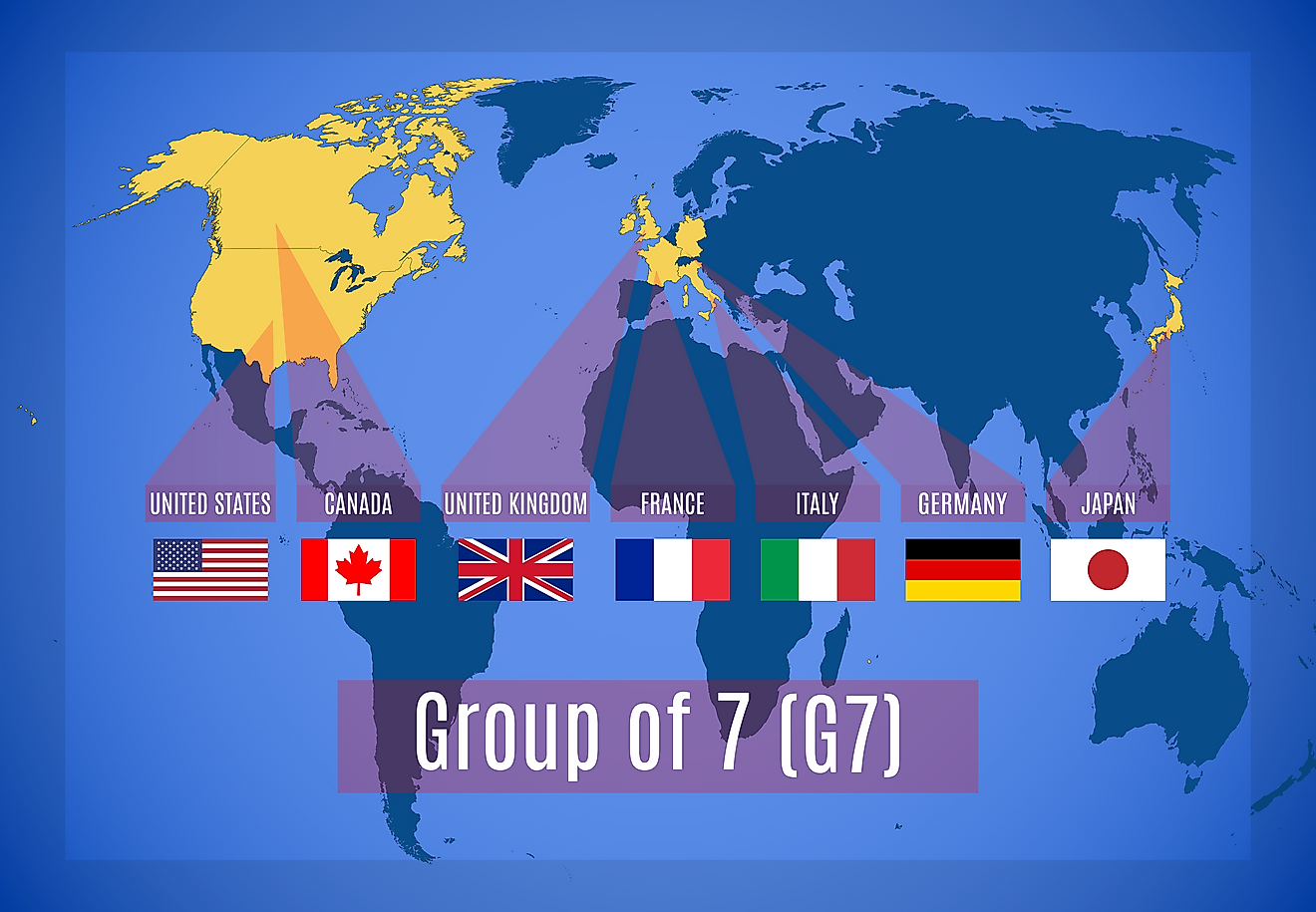
For most of the 20th century, the voting age in democratic countries was 21, an inheritance from the old common-law age of majority. That changed quickly between roughly 1965 and 1975. The United Kingdom lowered it from 21 to 18 in 1969. Canada followed in 1970. The United States ratified the 26th Amendment in 1971, locking in 18 nationwide largely in response to the argument that 18-year-olds being drafted to fight in Vietnam should be allowed to vote on the politicians sending them. Japan was a much later holdout and only lowered its national voting age from 20 to 18 in 2016. South Korea did the same in 2020, dropping from 19 to 18. Malaysia moved from 21 to 18 in 2019, with the change taking effect in 2021.
The result is that, today, around 85% of the world's countries set the voting age at 18. The clusters of countries above and below that line are small enough to list by name.
Countries With a Voting Age of 16
The countries where 16-year-olds can vote in at least some national-level elections are Austria, Brazil, Cuba, Ecuador, Nicaragua, Malta, and Wales (for Welsh elections). Ethiopia's constitution sets the voting age at 18, but it is sometimes listed at 16 because of inconsistencies between the constitutional text and earlier electoral law; the 18 figure is the one currently applied. The British Crown Dependencies of the Isle of Man, Guernsey, and Jersey allow voting at 16 in their own local elections.
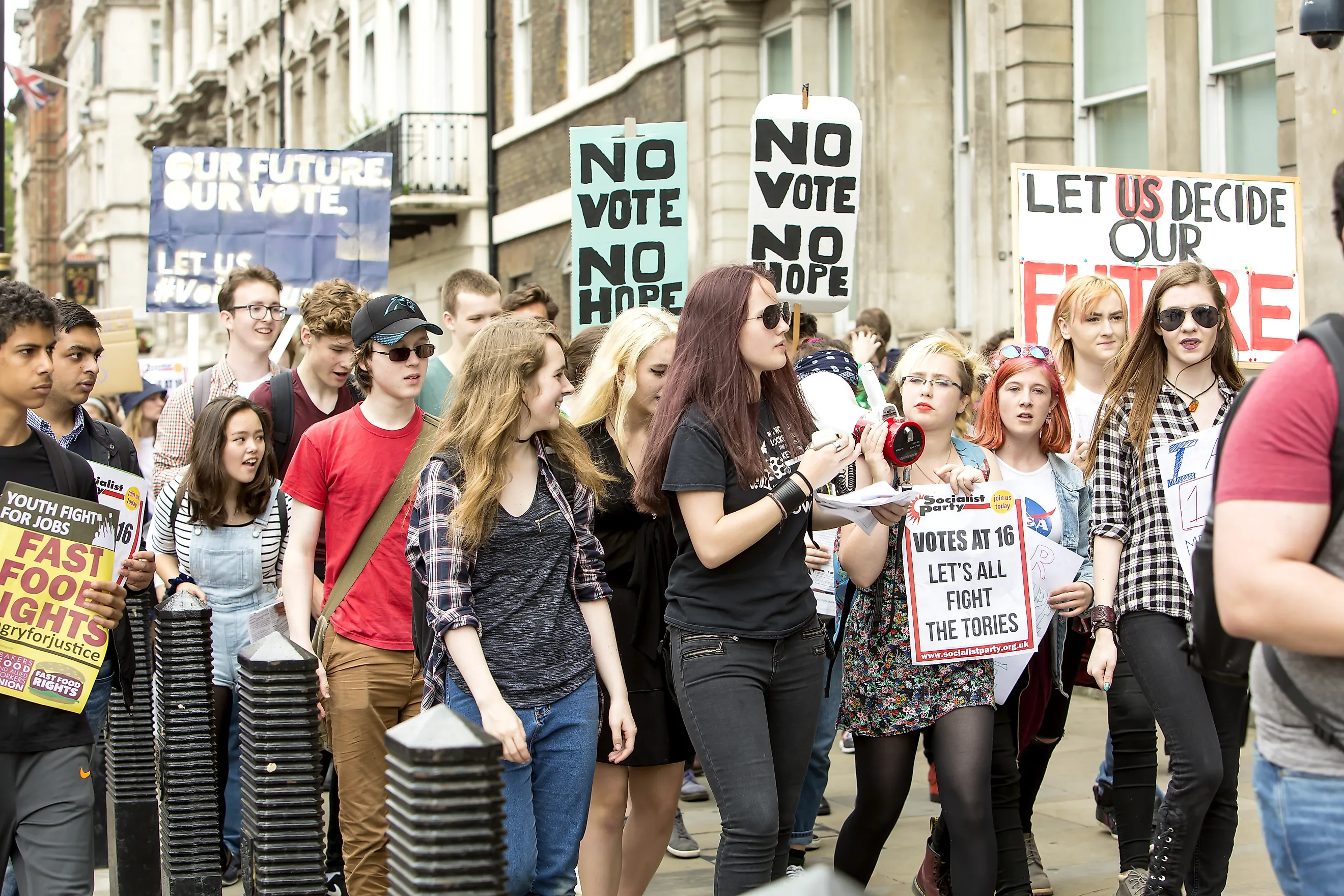
Scotland is the most famous case study. Sixteen- and 17-year-olds were allowed to vote in the 2014 Scottish independence referendum, and the experiment was widely judged a success: turnout among that age group was high and follow-up surveys showed strong engagement with the campaign. Scotland followed up by lowering the voting age to 16 for Scottish Parliament and local elections in 2015. Wales did the same for its Senedd elections in 2021. Westminster general elections in England, Wales, and Northern Ireland, however, still use 18.
Austria was the first European Union country to lower its national voting age to 16, in 2007. Brazil and Nicaragua have allowed 16-year-olds to vote since the 1980s. In Argentina, the legal voting age is 18, but voting is optional from 16 to 18 and again at 70 and above.
Countries With a Voting Age of 17
The voting age is 17 in Timor-Leste, Greece, Indonesia, North Korea, Sudan, and South Sudan. Indonesia is a special case: the formal age is 17, but married citizens may vote regardless of age, a rule that effectively allows some 16-year-olds to cast ballots.
Countries With a Voting Age of 18
This is where the overwhelming majority of countries sit. More than 180 nations use 18, including the United States, the United Kingdom, Canada, Argentina (with the optional 16-to-18 window noted above), Mexico, India, China, Japan, Germany, France, Italy, Spain, Russia, South Africa, and Australia. Bosnia and Herzegovina sets the age at 18 generally but allows employed citizens to vote at 16, similar to a few other European countries that tie an earlier age to economic participation.
Countries With a Voting Age of 19, 20, or 21
South Korea was the longtime sole holder of a voting age of 19, but it lowered to 18 in 2020, leaving no country at 19 today.
The voting age is 20 in Nauru, Bahrain, and Taiwan, although Taiwan held a constitutional referendum in 2022 to lower its voting age to 18; the proposal failed to clear the high turnout threshold required for ratification, leaving the age at 20.
The voting age is 21 in Cameroon, Kuwait, Oman, Samoa, Singapore, Tokelau, and Tonga. Malaysia was on this list until 2021, when its lowered voting age took effect. Kuwait notably did not extend the franchise to women until 2005.
The United Arab Emirates: A Special Case
The United Arab Emirates is often cited as having the highest voting age in the world at 25, but the figure deserves context. The UAE does not hold direct elections for its national leadership. The only ballots citizens can cast are for the partially elected Federal National Council, an advisory body, and only a fraction of UAE citizens are even eligible to participate as electors in those votes. The "voting age of 25" applies to that limited electorate; the country does not have universal suffrage in the sense that the rest of this article describes. Saudi Arabia, similarly, holds only municipal elections, with the voting age set at 18.
Compulsory Versus Optional Voting
Voting age determines who can vote; compulsory voting laws determine who must. Around two dozen countries have compulsory voting on the books, although enforcement varies widely. Countries with strict enforcement, including fines for non-voters, include Australia, Belgium, Brazil, Argentina, Singapore, Uruguay, and Luxembourg. Several others, including Bolivia, Costa Rica, Egypt, Greece, and Mexico, have compulsory voting laws that are weakly or not at all enforced. Most of the rest of the world's democracies treat voting as a right rather than a duty.
The Debate Over Lowering the Age to 16
Arguments for 16 usually rest on a few specific points. Sixteen-year-olds in many countries can already work, drive, marry with parental consent, and pay income tax, all of which are commonly cited as the kinds of "adult" responsibilities that justify a vote. Proponents also point to the Scottish referendum data, which suggested 16- and 17-year-old turnout exceeded that of 18- to 24-year-olds and that voting at 16 may build a habit of civic participation that lasts.
Arguments against tend to focus on cognitive and life-experience differences. Critics point out that 16-year-olds typically still live with their parents, have not entered the workforce in any meaningful way, and have had limited exposure to the kinds of civic, financial, and policy questions that elections turn on. The brain-development science that sometimes gets cited on either side of this debate is genuinely mixed and does not cleanly support either position.
The political reality is that where the age has been lowered, it has tended to stick. No country that has dropped to 16 has subsequently raised it back to 18.
Voting Age by Country
| Rank | Country | Legal Voting Age |
|---|---|---|
| 1 | Afghanistan | 18 |
| 2 | Albania | 18 |
| 3 | Algeria | 18 |
| 4 | American Samoa | 18 |
| 5 | Andorra | 18 |
| 6 | Angola | 18 |
| 7 | Anguilla | 18 |
| 8 | Antigua and Barbuda | 18 |
| 9 | Argentina | 18 (16 to 18 and 70+ optional) |
| 10 | Armenia | 18 |
| 11 | Aruba | 18 |
| 12 | Australia | 18 |
| 13 | Austria | 16 |
| 14 | Azerbaijan | 18 |
| 15 | Bahamas | 18 |
| 16 | Bahrain | 20 |
| 17 | Bangladesh | 18 |
| 18 | Barbados | 18 |
| 19 | Belarus | 18 |
| 20 | Belgium | 18 |
| 21 | Belize | 18 |
| 22 | Benin | 18 |
| 23 | Bermuda | 18 |
| 24 | Bhutan | 18 |
| 25 | Bolivia | 18 |
| 26 | Bosnia and Herzegovina | 18 (16 if employed) |
| 27 | Botswana | 18 |
| 28 | Brazil | 16 |
| 29 | British Virgin Islands | 18 |
| 30 | Brunei | 18 |
| 31 | Bulgaria | 18 |
| 32 | Burkina Faso | 18 |
| 33 | Burundi | 18 |
| 34 | Cabo Verde | 18 |
| 35 | Cambodia | 18 |
| 36 | Cameroon | 21 |
| 37 | Canada | 18 |
| 38 | Cayman Islands | 18 |
| 39 | Central African Republic | 18 |
| 40 | Chad | 18 |
| 41 | Chile | 18 |
| 42 | China | 18 |
| 43 | Cocos Islands | 18 |
| 44 | Colombia | 18 |
| 45 | Comoros | 18 |
| 46 | Democratic Republic of the Congo | 18 |
| 47 | Republic of the Congo | 18 |
| 48 | Cook Islands | 18 |
| 49 | Costa Rica | 18 |
| 50 | Cote d'Ivoire | 18 |
| 51 | Croatia | 18 |
| 52 | Cuba | 16 |
| 53 | Curacao | 18 |
| 54 | Cyprus | 18 |
| 55 | Czech Republic | 18 |
| 56 | Denmark | 18 |
| 57 | Djibouti | 18 |
| 58 | Dominica | 18 |
| 59 | Dominican Republic | 18 |
| 60 | Ecuador | 16 |
| 61 | Egypt | 18 |
| 62 | El Salvador | 18 |
| 63 | Equatorial Guinea | 18 |
| 64 | Eritrea | 18 |
| 65 | Estonia | 18 |
| 66 | Eswatini | 18 |
| 67 | Ethiopia | 18 |
| 68 | Falkland Islands | 18 |
| 69 | Faroe Islands | 18 |
| 70 | Fiji | 18 |
| 71 | Finland | 18 |
| 72 | France | 18 |
| 73 | French Polynesia | 18 |
| 74 | Gabon | 18 |
| 75 | Gambia | 18 |
| 76 | Georgia | 18 |
| 77 | Germany | 18 |
| 78 | Ghana | 18 |
| 79 | Gibraltar | 18 |
| 80 | Greece | 17 |
| 81 | Greenland | 18 |
| 82 | Grenada | 18 |
| 83 | Guadeloupe | 18 |
| 84 | Guam | 18 |
| 85 | Guatemala | 18 |
| 86 | Guernsey | 16 |
| 87 | Guinea | 18 |
| 88 | Guinea-Bissau | 18 |
| 89 | Guyana | 18 |
| 90 | Haiti | 18 |
| 91 | Honduras | 18 |
| 92 | Hong Kong | 18 |
| 93 | Hungary | 18 |
| 94 | Iceland | 18 |
| 95 | India | 18 |
| 96 | Indonesia | 17 (any age if married) |
| 97 | Iran | 18 |
| 98 | Iraq | 18 |
| 99 | Ireland | 18 |
| 100 | Isle of Man | 16 |
| 101 | Israel | 18 |
| 102 | Italy | 18 |
| 103 | Jamaica | 18 |
| 104 | Japan | 18 |
| 105 | Jersey | 16 |
| 106 | Jordan | 18 |
| 107 | Kazakhstan | 18 |
| 108 | Kenya | 18 |
| 109 | Kiribati | 18 |
| 110 | North Korea | 17 |
| 111 | South Korea | 18 |
| 112 | Kosovo | 18 |
| 113 | Kuwait | 21 |
| 114 | Kyrgyzstan | 18 |
| 115 | Laos | 18 |
| 116 | Latvia | 18 |
| 117 | Lebanon | 18 |
| 118 | Lesotho | 18 |
| 119 | Liberia | 18 |
| 120 | Libya | 18 |
| 121 | Liechtenstein | 18 |
| 122 | Lithuania | 18 |
| 123 | Luxembourg | 18 |
| 124 | Macau | 18 |
| 125 | Madagascar | 18 |
| 126 | Malawi | 18 |
| 127 | Malaysia | 18 |
| 128 | Maldives | 18 |
| 129 | Mali | 18 |
| 130 | Malta | 16 |
| 131 | Marshall Islands | 18 |
| 132 | Martinique | 18 |
| 133 | Mauritania | 18 |
| 134 | Mauritius | 18 |
| 135 | Mayotte | 18 |
| 136 | Mexico | 18 |
| 137 | Federated States of Micronesia | 18 |
| 138 | Moldova | 18 |
| 139 | Monaco | 18 |
| 140 | Mongolia | 18 |
| 141 | Montenegro | 18 |
| 142 | Montserrat | 18 |
| 143 | Morocco | 18 |
| 144 | Mozambique | 18 |
| 145 | Myanmar | 18 |
| 146 | Namibia | 18 |
| 147 | Nauru | 20 |
| 148 | Nepal | 18 |
| 149 | Netherlands | 18 |
| 150 | New Caledonia | 18 |
| 151 | New Zealand | 18 |
| 152 | Nicaragua | 16 |
| 153 | Niger | 18 |
| 154 | Nigeria | 18 |
| 155 | Niue | 18 |
| 156 | Norfolk Island | 18 |
| 157 | North Macedonia | 18 |
| 158 | Northern Mariana Islands | 18 |
| 159 | Norway | 18 |
| 160 | Oman | 21 |
| 161 | Pakistan | 18 |
| 162 | Palau | 18 |
| 163 | Panama | 18 |
| 164 | Papua New Guinea | 18 |
| 165 | Paraguay | 18 |
| 166 | Peru | 18 |
| 167 | Philippines | 18 |
| 168 | Pitcairn Islands | 18 |
| 169 | Poland | 18 |
| 170 | Portugal | 18 |
| 171 | Puerto Rico | 18 |
| 172 | Qatar | 18 |
| 173 | Reunion | 18 |
| 174 | Romania | 18 |
| 175 | Russia | 18 |
| 176 | Rwanda | 18 |
| 177 | Saint Helena | 18 |
| 178 | Saint Kitts and Nevis | 18 |
| 179 | Saint Lucia | 18 |
| 180 | Saint Pierre and Miquelon | 18 |
| 181 | Saint Vincent and the Grenadines | 18 |
| 182 | Samoa | 21 |
| 183 | San Marino | 18 |
| 184 | Sao Tome and Principe | 18 |
| 185 | Saudi Arabia | 18 |
| 186 | Scotland (Scottish elections) | 16 |
| 187 | Senegal | 18 |
| 188 | Serbia | 18 |
| 189 | Seychelles | 18 |
| 190 | Sierra Leone | 18 |
| 191 | Singapore | 21 |
| 192 | Sint Maarten | 18 |
| 193 | Slovakia | 18 |
| 194 | Slovenia | 18 |
| 195 | Solomon Islands | 18 |
| 196 | Somalia | 18 |
| 197 | South Africa | 18 |
| 198 | South Sudan | 17 |
| 199 | Spain | 18 |
| 200 | Sri Lanka | 18 |
| 201 | Sudan | 17 |
| 202 | Suriname | 18 |
| 203 | Sweden | 18 |
| 204 | Switzerland | 18 |
| 205 | Syria | 18 |
| 206 | Taiwan | 20 |
| 207 | Tajikistan | 18 |
| 208 | Tanzania | 18 |
| 209 | Thailand | 18 |
| 210 | Timor-Leste | 17 |