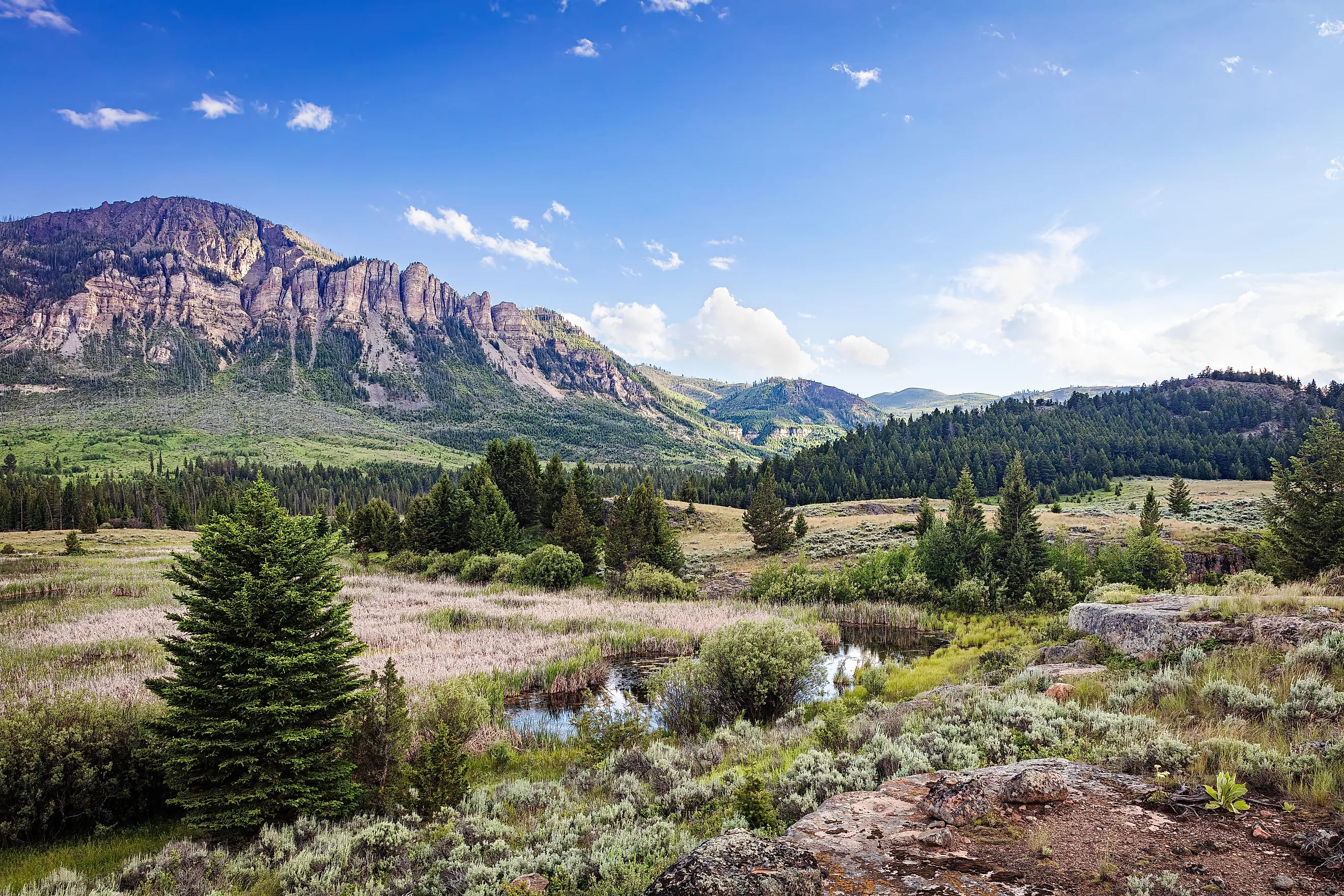
The First National Forest In America
The forest that gave birth to the mountain man folklore is also the place where nearly every animal species found in North America can be found.
Shoshone National Forest in Wyoming is one of the reasons people travel from all over the world to experience the Greater Yellowstone System. The trees border Yellowstone National Park to the west, and the park is also home to a section of the Continental Divide.
It is in the region where the North Fork Easter daisy grows, and it protects four different wilderness areas.
The Oldest And One Of The Greatest National Forests

Shoshone National Forest, which started as the Yellowstone Park Timberland Reserve, is older than all the other federally protected forest reserves in America.
It was established on March 30, 1891, after President Benjamin Harrison signed the relevant proclamation. The forest sits in the Absaroka Mountains of northwestern Wyoming and is also the largest of 21 forests in the Central Rocky Mountain Region.
It was eventually named Shoshone National Forest in honor of the Eastern Shoshone people and is considered one of the country's greatest national forests today.
Other national forests also deserve some of the shine, however, including Colorado's White River National Forest. This forest was established as the White River Plateau Timber Land Reserve on October 16, 1891, making it just a few months younger than Shoshone.
As such, it is the second-oldest federally designated forest reserve, created under the Land Revision Act of 1891.
Saving The Trees To Protect Lives

The 'sheepeaters' were most likely the first inhabitants of the area where the Shoshone forest now stands. They lived in tepees and preyed on mountain sheep.
Just more than 30 years before the American Revolution, the first settlers arrived in Wyoming. French-Canadian brothers, Francois and Louis De La Verendrye, traveled through the Rocky Mountains, setting up branch trading posts as they went. They eventually settled in the Great Lakes Region.
In 1806, John Colter left the Lewis and Clark Expedition and traveled up the Clark's Fork River. It is believed that he was the first white man to see the so-called Stinking Water River, now called the Shoshone River.

Other mountain men followed, and they started exploiting the natural landscape. Then came prospectors and miners. The first real residents in the area were the cattlemen, which gave rise to cattle-raising. The more homesteaders and settlers arrived, the more acreage was taken up. It was not long before the range became too small for the number of livestock in the area.
The region became even more populated, and livestock started grazing in the mountains. It was only in 1891, with the establishment of the Shoshone Forest, that the Federal Government started controlling the use of natural resources.
The trees high up in the mountains were stripped away at this point. This created a massive problem, because there was no shade to keep the mountain snow from melting too fast.
Without the trees, the spring thaws caused devastating flooding. After the flooding came scorched crops due to the dry summer months, which also left livestock without water.

The situation became a crisis that eventually reached lawmakers in Washington, D.C. Those who supported public land protection worked to get Section 24 added to the Land Revision Act of 1891.
This gave President Benjamin Harrison the power to sign a proclamation creating the Yellowstone Park Timberland Reserve. The 1.2 million acres next to Yellowstone National Park were then made off-limits for logging and homesteading.
It was the first time the federal government made an effort to protect public timberlands and, as such, lives.
The land was initially managed by the General Land Office under the Department of the Interior. President Theodore Roosevelt gave over control of the forest reserves to the United States Forest Service in 1905. The reserve was then mapped out and properly patrolled. It was officially renamed Shoshone National Forest in 1945.
Seeing Glaciers Meet The Sky

Amazingly, Shoshone National Forest is still considered a hidden natural wonder of Wyoming today, even though it stretches across 2.5 million acres of the Rocky Mountains. It is accessible from five counties, namely Park, Hot Springs, Big Horn, Fremont, and Teton.
Those coming from the south can access the forest through the town of Dubois. The forest is considered an alternative to Yellowstone National Park, especially by those who do not want to deal with crowds.
Near Dubois, Shoshone offers several campgrounds. Some are modern with picnic tables and fire rings, while others are basic and very remote. The remote campsites are close to rivers and mountain trails, making it easier to fish and watch wildlife.
Speaking of wildlife, the access trails from the Dubois side lead into the Fitzpatrick Wilderness. Here, there are mountain passes and alpine lakes to see, and the hiking trails lead into areas where elk and moose roam free. Visitors also often spot bighorn sheep and even bears in the area.

Shoshone National Forest boasts the largest number of glaciers of any national forest in the Rockies. There are around 140 unnamed glaciers and 16 named ones.
The most visited is the Gannett Glacier, which seems to meet the sky from the slopes of Gannett Peak, which is Wyoming's highest point at 13,804 feet. It is the largest glacier in the Rockies.
Around 1.4 million acres of the forest is vehicle-free, which helps protect the wildlife habitat. Those who want to see some of the views from their cars can take one of several scenic highways, including Buffalo Bill Scenic Byway, Chief Joseph Scenic Byway, the renowned Beartooth Highway, and the Wyoming Centennial Scenic Byway.
Beyond The Shoshone National Forest

No forest beats Shoshone National Forest when it comes to the title of 'first national forest.' But there are some distinctions to keep in mind. For one, Yellowstone National Park is often mixed up with the Shoshone Forest.
Yellowstone was America's first national park. Shoshone sits alongside the park as the country's oldest national forest. National forests are maintained by the U.S. Forest Service, while national parks are run by the National Park Service.
There are other forests that have some claims to fame. The Ouachita National Forest in Arkansas and Oklahoma dates back to the Hot Springs Reservation set up in 1832. But Hot Springs was established for the natural bathhouses, not the timber, and it was not added to the national forest system until much later.
New York's Adirondack Forest Preserve was created before Shoshone, in 1885, but it belongs to the state and is not a federal national forest.
From Timber Reserves To Modern Wilderness Regions

The value of America's first national forest is truly priceless. It is a wilderness landscape where people can enjoy the outdoors and see wildlife up close. Scientists use the forest to conduct their research, and timber use and grazing are controlled.
The Shoshone National Forest keeps this part of the country's wilderness areas both intact and healthy.