The Largest Wilderness Areas In The United States
A wilderness area is the strictest kind of protected land the United States has. Under the 1964 Wilderness Act, these are places set aside to stay wild: no roads, no buildings, no permanent human presence, with people allowed in only as visitors who leave no trace. The country now protects 806 such areas covering roughly 111 million acres, about 4.5% of all U.S. land, an expanse larger than the state of California. And here is the part that surprises people: the five largest are all in one state. Alaska holds more than half of America's wilderness, and its giants make the largest protected areas in the Lower 48 look like city parks. Here are the five biggest, ranked by size.
The Five Largest Wilderness Areas in the US
Wrangell-Saint Elias

The largest wilderness area in the country sits in south-central Alaska, along the Canadian border, and the scale is genuinely hard to picture. At 9,078,675 acres (about 14,185 square miles), the Wrangell-Saint Elias Wilderness makes up roughly two-thirds of Wrangell-St. Elias National Park and Preserve, itself the biggest national park in the United States. This is where four mountain ranges collide, producing nine of the sixteen highest peaks in the country, including 18,008-foot Mount Saint Elias. More than a quarter of the park is buried under ice, part of the largest glacial system in North America, and one glacier here, the Malaspina, is bigger than Rhode Island.
The wildlife matches the terrain: Dall sheep (whose populations here are considered among the world's finest), caribou, moose, grizzlies, and mountain goats. Only two rough dirt roads enter the whole expanse, both dead-ending at the wilderness boundary, and the rest is reached by bush plane or on foot. Inside the wilderness sits the ghost town of Kennecott, an abandoned copper-mining complex that ran from 1911 to the late 1930s and now stands preserved against the glaciers, a reminder that even this much wild once had a price tag.
Mollie Beattie

The second-largest wilderness, at roughly 8 million acres (about 12,500 square miles), sits inside the Arctic National Wildlife Refuge and takes up about 40% of it. Named for Mollie Beattie, the first woman to head the U.S. Fish and Wildlife Service, it protects one of the last great untouched Arctic ecosystems in North America, running from the peaks of the Brooks Range down across tundra to the coastal plain on the Beaufort Sea.
This is the heart of one of the planet's epic wildlife spectacles: the Porcupine caribou herd, hundreds of thousands strong, migrates across this land to calve each year. Polar bears den along the coast, while moose, muskoxen, wolves, and grizzlies range inland. It is also some of the most politically contested ground in the country, sitting atop potential oil reserves, which is exactly why its wilderness designation matters so much to the people fighting to keep it undeveloped.
Gates of the Arctic

At about 7,167,192 acres (roughly 11,198 square miles), the third-largest wilderness covers most of Gates of the Arctic National Park, the northernmost national park in the country and entirely above the Arctic Circle. The defining fact about this place is what it does not have: no roads, no trails, no campgrounds, no visitor facilities of any kind. You navigate the Brooks Range the way people have for thousands of years, by reading the land itself.
Rivers are the highways here, including the John and the Alatna, and floating them is one of the few practical ways to travel. More than half a million caribou move through the central Brooks Range twice a year on their migration. It is consistently among the least-visited national parks in America, not because it lacks wonder but because reaching it takes real commitment, usually a bush flight and a willingness to be genuinely on your own. Backpackers who come are warned, sensibly, to give the grizzlies a wide berth.
Noatak

The fourth-largest wilderness, around 5,765,427 acres (about 9,008 square miles), forms the core of Noatak National Preserve and shares a border with Gates of the Arctic to the east. Together, the two make up the largest stretch of unbroken wilderness in the country, a single expanse of around 13 million acres with no roads or development cutting through it.
Its centerpiece is the Noatak River, which drains the largest untouched river basin in the United States, an entire watershed that runs its full length without a dam, a bridge, or a town. That makes it a living laboratory for scientists studying how an Arctic river system behaves with no human hand on it, and a bucket-list float trip for paddlers willing to be flown in. The whole basin is a designated International Biosphere Reserve, which is the scientific world's way of saying this place is too important to lose.
Katmai

Rounding out the top five at roughly 3,384,358 acres (about 5,288 square miles), the Katmai Wilderness sits within Katmai National Park and Preserve in southwest Alaska, and it owes its existence to a catastrophe. In 1912, the eruption of Novarupta was the largest volcanic blast of the 20th century, burying a river valley in ash and creating the Valley of Ten Thousand Smokes, named for the countless steam vents that hissed from the smoldering ground for years afterward.
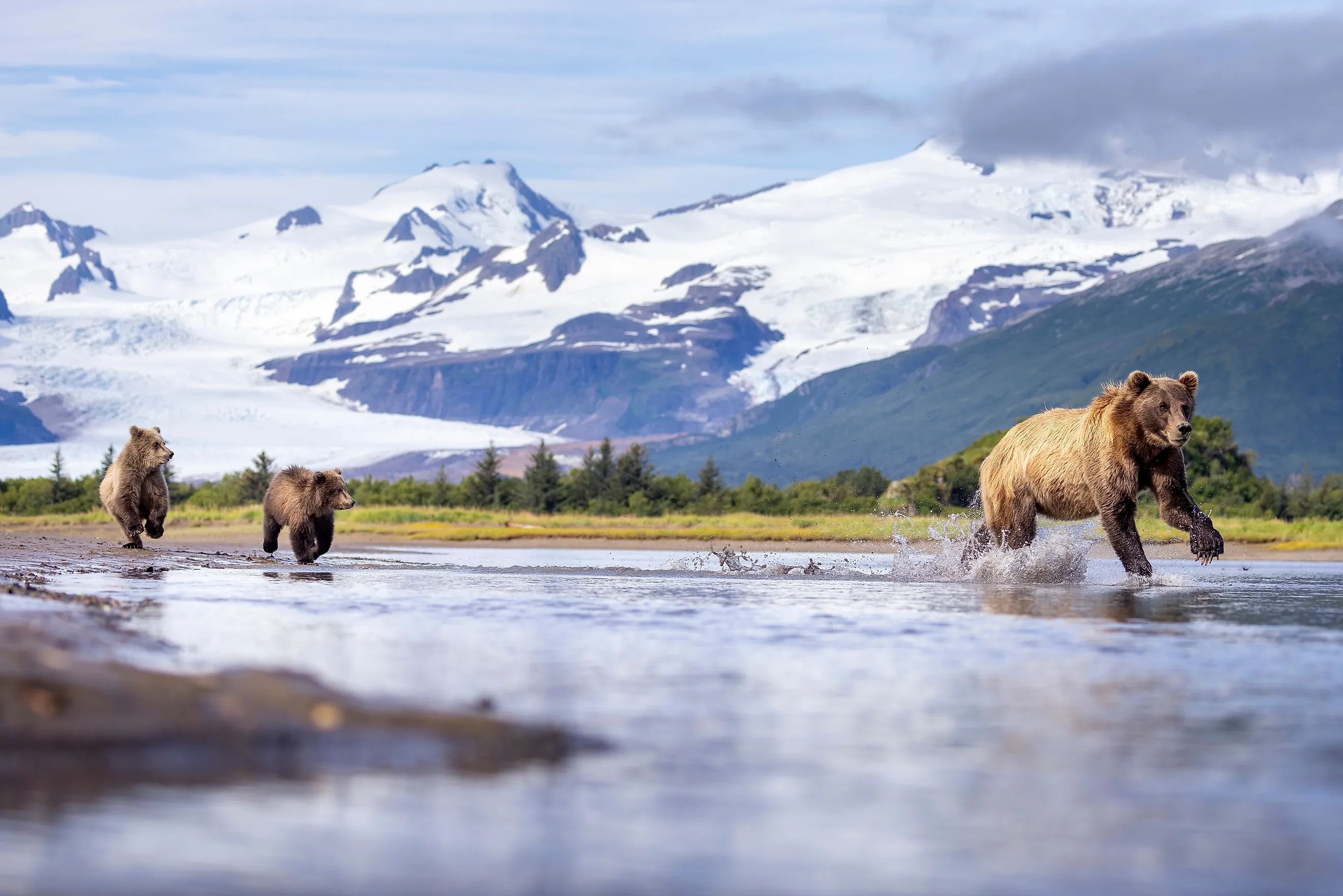
Today Katmai is best known for a gentler spectacle: its brown bears, one of the largest protected populations on Earth. Each summer they gather at Brooks Falls to snatch leaping salmon out of the air, a scene so famous it now has its own internet holiday, "Fat Bear Week," when fans vote on which bear has packed on the most weight for winter. Volcanoes, lakes, and salmon runs make this one of the most alive landscapes on the list, even if hardly anyone ever sees it in person.
The 20 Largest Wilderness Areas, Ranked
The five above are only the beginning. Widen the view to the top twenty and the pattern holds hard: Alaska takes most of the list, with a handful of giants in the Lower 48 (Death Valley, Frank Church-River of No Return, Bob Marshall) breaking through. All figures are total designated wilderness acreage, drawn from Wilderness.net.
| Rank | Wilderness Area | State | Acres |
|---|---|---|---|
| 1 | Wrangell-Saint Elias | AK | 9,078,675 |
| 2 | Mollie Beattie | AK | 8,000,000 |
| 3 | Gates of the Arctic | AK | 7,167,192 |
| 4 | Noatak | AK | 5,765,427 |
| 5 | Katmai | AK | 3,384,358 |
| 6 | Death Valley | CA | 3,190,455 |
| 7 | Glacier Bay | AK | 2,664,876 |
| 8 | Togiak | AK | 2,369,456 |
| 9 | Frank Church-River of No Return | ID | 2,366,907 |
| 10 | Misty Fjords National Monument | AK | 2,142,243 |
| 11 | Denali | AK | 2,124,783 |
| 12 | Kenai | AK | 1,354,247 |
| 13 | Aleutian Islands | AK | 1,300,000 |
| 14 | Andreafsky | AK | 1,300,000 |
| 15 | Innoko | AK | 1,240,000 |
| 16 | Boundary Waters Canoe Area | MN | 1,090,000 |
| 17 | Bob Marshall | MT | 1,009,356 |
| 18 | Daniel J. Evans (Olympic) | WA | 876,669 |
| 19 | Cabeza Prieta | AZ | 803,418 |
| 20 | Glacier Peak | WA | 566,057 |
Why It All Comes Down to Alaska
That the five largest wilderness areas are all Alaskan is not a coincidence. It comes down mostly to a single law: the Alaska National Interest Lands Conservation Act of 1980, which protected over 56 million acres of wilderness in one stroke, the largest such act in the nation's history. The timing mattered, because Alaska was still wild and roadless enough that drawing enormous boundaries was actually possible, in a way it never could be in the crowded Lower 48. The result is a handful of protected areas each larger than most U.S. states, where the rules are simple and absolute: leave it as you found it, because places this wild, once lost, do not come back.