The Most Visited National Forest In The United States
More people visit Colorado's White River National Forest than any other national forest in the United States. The USDA Forest Service estimated roughly 14.74 million recreational visits in 2022, along with about 18.44 million individual site visits. White River's unusually high numbers come from a combination of major ski resorts, repeat seasonal use, easy access from the Denver metropolitan area, and a dense concentration of mountain recreation destinations. Its position at the top of the national ranking is not based on tourism-board estimates. The Forest Service measures recreation across the National Forest System using a standardized monitoring program that allows White River to be compared directly with other federal forests.
The Most Visited National Forest In The Country

The Forest Service described White River as "by far the most visited" forest in the National Forest System in its 2022 monitoring report. That year, the agency estimated 14.74 million National Forest visits. The total places White River ahead of other national forests that receive heavy recreation traffic from major cities, ski destinations, lake districts, and mountain corridors.
The agency also recorded about 18.44 million site visits, but that figure does not mean 18.44 million different people entered the forest. A National Forest visit counts one person's recreational trip into the forest. A site visit counts entry to an individual recreation site or area. Someone who skis in the morning and visits a separate trailhead later that day can therefore generate one forest visit but multiple site visits.
How The Forest Service Counts Millions Of Visits

White River has no single entrance gate, so the Forest Service cannot count visitors the way some national parks count vehicles entering through controlled roads. People reach the forest by interstate, local road, trailhead, ski area, campground, and numerous other access points. The agency instead relies on its National Visitor Use Monitoring program.
The program combines observations at sampled recreation locations with surveys of people leaving those sites. Researchers collect information such as group size, activity, trip purpose, and length of stay, then use statistical methods to estimate overall recreation across the forest. Each national forest generally goes through the process about once every five years. White River's recent monitoring rounds occurred in 2007, 2012, 2017, and 2022.
The totals are therefore estimates rather than exact headcounts. Their main strength is consistency. Forests across the National Forest System are measured using the same basic protocol, allowing researchers to compare recreation levels without relying on unrelated ski-resort attendance figures, local tourism estimates, or traffic counts.
Visitation Jumped After 2017

White River had already been receiving more than 12 million recreational visits for years before its most recent increase. The Forest Service estimated about 12.29 million visits in 2012 and 12.27 million in 2017, leaving the total essentially unchanged over that five-year period. By 2022, however, visitation had risen to 14.74 million, an increase of roughly 20% from 2017.
Site visits increased even faster. They rose from approximately 13.77 million in 2017 to 18.44 million in 2022. A peer-reviewed study published in 2025 calculated the increase at about 34%. The sharp post-2017 rise stands out because it followed several years in which visitation had barely moved.
Skiing Generates More Than Half Of The Traffic

Downhill skiing is the biggest single contributor to White River's visitor numbers. Eleven major ski resorts operate on forest land, including destination areas around Aspen, Vail, Breckenridge, Copper Mountain, Keystone, Beaver Creek, and Snowmass. Forest Service surveys in 2022 found that 53.6% of visitors participated in downhill skiing and 52.5% said skiing was the main reason for their trip.
Skiing also creates unusually high levels of repeat visitation. A season-pass holder skiing twenty days can generate twenty separate forest visits during one winter. That pattern differs from many hiking or sightseeing destinations, where visitors may come once or twice a year. Local skiers combine with domestic and international tourists to keep White River's winter visitation exceptionally high.
A 2.3-Million-Acre Forest In The Colorado Rockies

White River covers about 2.3 million acres across the central Colorado Rockies. Ten summits within its boundaries rise above 14,000 feet, while eight congressionally designated wilderness areas account for more than one-third of the forest. Its terrain includes sections of the Elk Mountains, Gore Range, Tenmile Range, Flat Tops, river valleys, conifer forests, and alpine tundra.
Location is a major advantage. The forest's eastern side lies within roughly 60 miles of metropolitan Denver, and Interstate 70 runs through the central Colorado mountain corridor. That highway places large sections of the forest within relatively easy reach of the state's largest population center while also connecting visitors with major ski areas and mountain towns.
What Visitors Come To See And Do

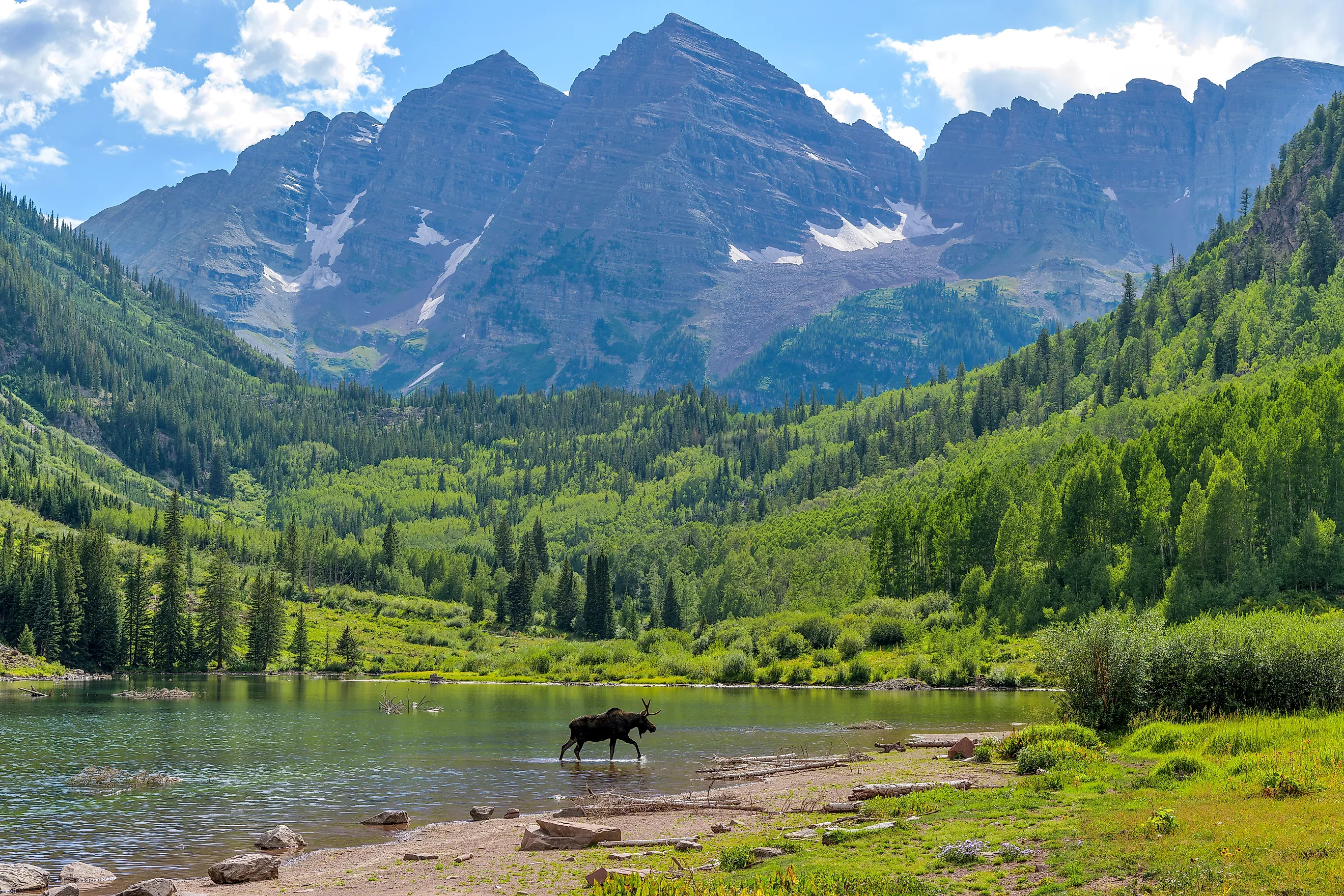
White River is busiest in winter, but its recreation season extends throughout the year. Maroon Bells near Aspen is one of its best-known landscapes. The two reddish peaks rise above Maroon Lake, where short trails and viewpoints give visitors easy access to the valley. Longer routes continue into the Maroon Bells-Snowmass Wilderness through alpine basins, high passes, and backcountry terrain.
Hanging Lake in Glenwood Canyon is another major destination. The turquoise lake sits beneath cliffs and waterfalls at the end of a steep trail east of Glenwood Springs. Access requires a timed-entry permit reserved in advance, and that requirement applies year-round. Elsewhere in White River, visitors hike, camp, mountain bike, fish, raft, hunt, climb, snowshoe, and explore extensive stretches of alpine and subalpine terrain. That diversity keeps recreation spread across several seasons rather than limiting the forest's popularity to skiing alone.
The Main Gateway Towns

White River does not have one obvious gateway because its enormous boundary surrounds several major Colorado mountain communities. Aspen provides access to Maroon Bells, the Maroon Bells-Snowmass Wilderness, and a major concentration of ski terrain. Glenwood Springs sits beside Interstate 70 and Glenwood Canyon, making it a useful base for Hanging Lake, the Roaring Fork Valley, and nearby sections of the Flat Tops.

Farther east, Vail and Avon sit at the center of the I-70 ski corridor. Breckenridge, Frisco, and Dillon provide access to the Tenmile Range, Blue River drainage, reservoirs, trails, and ski areas on the forest's eastern side. The concentration of lodging, restaurants, highways, and recreation services around these communities helps White River support visitor volumes that would be much harder to sustain in a remote forest with few nearby towns.
Heavy Recreation Also Reaches Wildlife Habitat
White River's extraordinary visitation creates environmental pressures as well as economic benefits. A 2025 study analyzed 233.6 million anonymous smartphone location records collected across the forest between 2019 and 2023 to map where recreation occurred. Researchers then compared those patterns with habitat used by Canada lynx, elk, and bighorn sheep.
Winter recreation overlapped about 9.8% of mapped Canada lynx habitat, 6.6% of elk winter range, and 4.5% of bighorn sheep winter range. The lynx figure was highest partly because suitable habitat lies near heavily used ski terrain. Mapping those overlaps allows managers to identify specific trails and recreation zones where seasonal restrictions or route changes may reduce wildlife disturbance.
America's Busiest National Forest
White River's 14.74 million estimated visits in 2022 reflect a combination few other national forests can match, combining intensive ski use, repeat local recreation, major tourism infrastructure, access from a large metropolitan area, and famous mountain destinations that remain popular outside winter. That popularity supports resorts, outfitters, restaurants, hotels, and Colorado mountain communities, but it also places heavy pressure on trails, alpine vegetation, parking areas, and wildlife habitat. White River's next monitoring cycle will show whether the rapid growth recorded after 2017 continued, but its current numbers already make it the clearest example of how large-scale recreation can shape a national forest.