How Many Shipwrecks Are On The Ocean Floor?
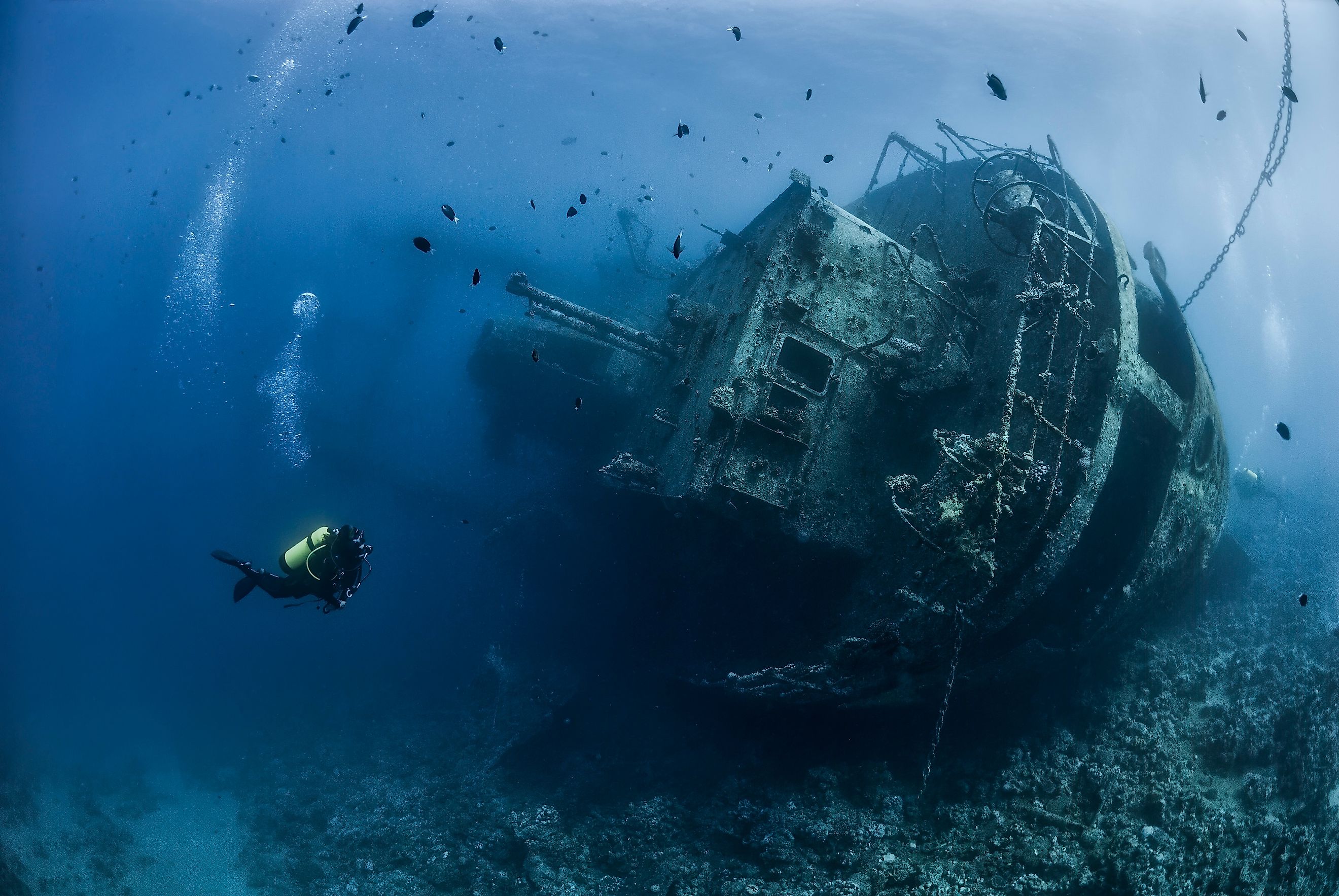
More than 3 million shipwrecks are lying on the floor of the ocean and other deep bodies of water. That's the estimate from scientists, archaeologists, and historians, and the number is based on available research and data, but the truth is, no one knows for certain. Less than 1% of known shipwrecks have been mapped, located, or explored by humans. For as long as humans have been venturing out onto deep water in boats, there have been wrecks. The earliest human travels into the open waters of the ocean are mostly lost to time because of the lack of written records, and any evidence of those early ships has long disappeared under the seas and oceans. With the beginnings of written history, over 5,000 years ago in Mesopotamia and Egypt, human activity can be tracked to some degree, and that would on occasion include the perils of sea travel. There have been some discoveries of ancient shipwrecks, most famously the 1900 discovery of an ancient Greek cargo ship dated from the first century BCE that carried the oldest analog computer, the Antikythera Mechanism. However, most of the shipwrecks that have been located and explored tend to be dated to the 19th century and after.
Historical Records and Databases

With the number of shipwrecks estimated into the millions, the reality is that exploration and modern tracking systems have found only a fraction of what is at the bottom of the ocean. The databases that keep track of these discoveries list only those ships that have definitively been located, and the databases are often in disagreement. The Global Maritime Wrecks Database has records for around 250,000 vessels. Wrecksite, an online database, has around 210,000 known shipwrecks listed, with specific locations of 179,000 of those wrecks. While the National Oceanic and Atmospheric Administration (NOAA) puts the estimate of total shipwrecks at closer to one million, there has been an ongoing collection of data at NOAA on known shipwrecks and their locations. This was done mainly through regional databases and nautical charts tracking data on wrecks. Rather than maintaining a database, nautical charts are available through a Geographic Information System (GIS), so the number of known shipwrecks is not updated by NOAA.
The exact numbers are difficult for any one agency to calculate. The vast ocean floor is mostly unmapped, and systematic searching for any one vessel is a challenge. Ancient ships were mostly wooden, while early ships made with iron have mostly broken down over the centuries. Standard diving is not possible in deep water, and exploration can only be done with specialized robotic equipment that is expensive. Historical records tend to be scarce, if they exist at all. What maritime records that do survive may only include information on the most notable boats, and what information that survives may be vague.
RMS Titanic
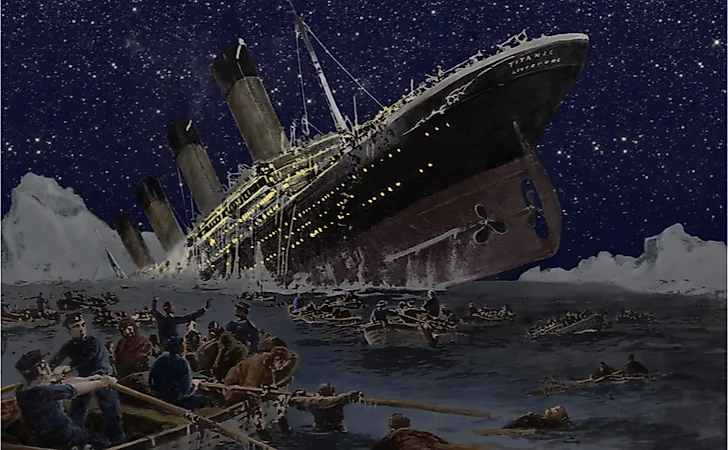
The most famous shipwreck in history is much a part of our collective lore. We know more about the sinking of the "unsinkable" Titanic than almost any other disaster. The Titanic struck an iceberg on April 15, 1912, and sank to the bottom 2.4 miles (3.8 km) below the surface. The ship broke apart during the hour-long descent, and the bow and stern fell apart, separated by roughly 1,900 feet (600 meters). There, the pieces of the ship lay for 73 years. It was generally known where the Titanic lay on the North Atlantic seabed, but the exact location had never been determined until 1985. In the immediate aftermath of its sinking, no serious effort to locate the ship was attempted due to the depth and the lack of technology necessary to investigate a wreck at such a depth.
From the 1930s through the 1960s, technology for tracking the location of the Titanic improved somewhat, particularly with the development of sonar, but little could be done. By the 1960s, deep-sea submersibles and remotely operated vehicles made deep-ocean exploration possible, and by the 1970s, deep-ocean research vessels and advanced submersibles made searching at that depth possible. Nevertheless, pinpointing a comparatively small ship in the vast ocean was still very difficult. In the 1980s, the American Robert Ballard and the French Jean-Louis Michel independently began to search for the exact location. By August through September 1985, a joint American-French expedition, using a remotely operated camera system, discovered debris scattered across the ocean floor. Following the trail, they finally spotted the Titanic. The extreme cold and darkness had helped preserve much of the wreck, and in 1986, the first crewed expedition to the wreck took place.
The Bismarck

The Bismarck was a massive German battleship that saw brief service during WWII. One of two of Nazi Germany's largest and most powerful battleships, the Bismarck was to become, soon after its launch, the site of one of the most famous naval battles of the war and one of the most famous shipwrecks. Commissioned in August 1940, the Bismarck's first and only major operation was in May 1941. The battleship was one of the most feared warships of its time, based solely on its appearance and specs. It was one of the most technologically advanced ships to see service in the war. Due to its massive size, heavy armor, and fast speed, it became legendary before it even saw action, seemingly invincible in the eyes of the British Royal Navy during a period of the war when Germany's effective use of U-boats made the North Atlantic extremely dangerous for Britain.
The Bismarck, on the run to German-occupied France, was hunted by the British. Within 24 hours of pursuit, the Bismarck was sunk on the morning of May 27, 1941. It had been hit by a British aerial torpedo strike and naval bombardment by British warships, crippling the Bismarck, and it sank to a depth of almost 3 miles of water. The wreck was discovered on June 8, 1989, by American oceanographer Robert Ballard, one of the team of American and French explorers who had discovered the Titanic four years before. Using the Argo camera sled, an ocean-crawling robot, the Argo streamed live video footage, and during the second attempt, the camera spotted the debris field and hull. The 50,000-ton ship was upright on the slope of an underwater mountain range. The well-preserved hull indicated evidence of intense British shelling, but there was little to show impact damage capable of sinking the ship. The evidence Ballard gathered showed that the German crew scuttled the ship to prevent its capture.
RMS Lusitania

On May 7, 1915, a German submarine torpedoed the British passenger liner RMS Lusitania. The 18-minute attack sank the ship, taking 1,195 lives. This altered the course of the war, turning global public opinion against Germany, especially in the United States, who were still not involved in the war. There were 128 American lives lost in the ship's sinking. Early echo-sounding technology was used to map the ocean floor and find the hull. A diver was lowered to the wreck in a 1,000-pound atmospheric diving suit and successfully walked on the ship's deck. In 1993, Robert Ballard, the co-discoverer of the Titanic and discoverer of the Bismarck, led a National Geographic expedition to visually map the area. The ship was found to be in an advanced state of deterioration, having been torn into two major pieces.
At the time of its sinking, a second explosion after the initial torpedo strike was claimed by eyewitnesses. There was no evidence of a second torpedo or boiler explosion, and Ballard hypothesized that the lone torpedo ignited volatile coal dust in the ship, causing it to sink so rapidly. There is still much debate about this. The level of damage to the wreck indicates that, beyond natural deterioration, it is believed that the Lusitania had been further damaged by depth charges deployed over the site to destroy German U-boats during WWII. It has also been speculated that the British deliberately collapsed the vessel to obscure confidential wartime cargo. With its shallow resting place, the ship is also vulnerable to salvagers, with many actively looting the wreckage from the 1960s through the 1980s. Salvagers hauled away three of the Lusitania's bronze propellers, along with its anchors, a foghorn, the ship's bell, and the bridge telegraphs. Smaller-scale souvenir hunters also cleared out cutlery, silverware, various brass and bronze fittings, portholes, and smaller removable fixtures. By the late 1980s, strict government protections began to be enforced.
Extreme Depth Discoveries
The USS Samuel B. Roberts took part in the Battle off Samar, off the Philippine coast. The 1,200-ton escort charged into a massive fleet of Japanese ships to protect American landing forces. It crippled a Japanese heavy cruiser before being sunk by a Japanese battleship. The ship's crew, 89 of whom died in the sinking, were hailed as heroes against insurmountable odds, and the ship was called "the destroyer escort that fought like a battleship". The Samuel B. Roberts was discovered on June 22, 2022, by American deep-sea explorer Victor Vescovo. The ship, nicknamed the Sammy B, rests at an extreme depth of 22,621 feet (6,895 meters), over 4 miles, beneath the Philippine Sea. It is the deepest shipwreck ever discovered and surveyed, surpassing the USS Johnston, sunk in the same battle and sitting roughly 1,400 feet shallower. The Johnston was located near the Philippine Trench, 21,180 feet (6,456 meters) at the bottom of the Philippine Sea. The ship was located and identified on March 31, 2021, by Victor Vescovo, a year before he discovered the Sammy B.
The Samuel B. Roberts was discovered with a piloted two-person submersible that was equipped with what was then the deepest-operating side-scan sonar system available. The expedition's original objective was to locate the aircraft carrier USS Gambier Bay, the only American aircraft carrier sunk by enemy surface gunfire during World War II, also lost during the Battle off Samar. After eight days of searching for the Gambier Bay, the team found the debris of the Sammy B. The ship apparently hit the ocean floor at a high speed, splitting it into two sections and scattering debris. The USS Gambier Bay, most likely resting at similar depths as the Samuel B. Roberts and the Johnston, has never been located.
There Is Still Much More to See
With only 1% of all shipwrecks mapped out on the ocean floor, marine archaeologists and scientists have only begun to find all the known shipwrecks in human history. The oceans are collectively too vast, and the deepest parts of the ocean are difficult to access, leaving shipwrecks, and in particular the earliest wooden ships, lost beneath the waves to languish on the harsh ocean floors. What has been found, nevertheless, tells an amazing story of human innovation and courage.